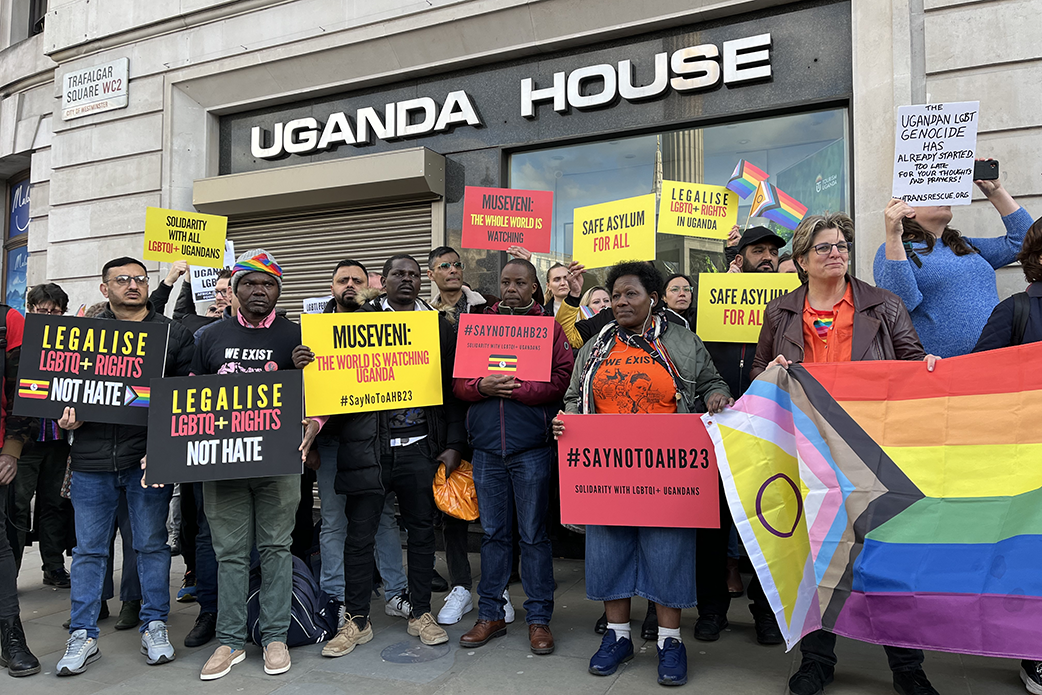
The infamous Anti-Homosexuality Act, 2023 (“Act”)’ came into force with President Yoweri Museveni giving assent to it on 26th May 2023. Uganda’s infamous legislation and severe actions targeting individuals within the LGBTQ+ community have been a point of concern for the world. For instance, President Biden issued a statement denouncing the approved legislation as “disgraceful”, jeopardizing U.S.-Uganda relations. Furthermore, the World Bank has put a halt on providing funds to Uganda. The inclusion of death penalties in specific cases contributes to the distress. The oppressive measures stated in the Act are camouflaged under the guise of protecting ‘traditional family values’ and ‘shielding young individuals’ from the perceived influence of homosexuality. Enacting the Anti-Homosexuality legislation transgresses Article 21 of the Ugandan Constitution, which upholds principles of equality and the prohibition of discrimination. This piece tries to understand what the Act provides and how it infringes upon freedoms of speech, association, and privacy, as well as principles of equality and non-discrimination (Article 29 of the Ugandan Constitution).
Section 145(a) of Uganda’s Penal Code Act already makes sexual intercourse between homosexuals criminal, phrasing it as ‘carnal intercourse against the law of nature’. The Ugandan Legislature propounds that the sole purpose of marriage is procreation and same-sex intercourse diverts from the very essence of it. Previously, the Anti-Homosexuality Bill 2014 proposed life imprisonment as punishment for homosexuality. However, it was subsequently annulled and declared void in the case of Oloka-Onyango and nine others v. Attorney General, 2014, (“Olaka v. AG”) due to a lack of an adequate quorum. Continuing along the same trajectory, the present Act magnifies this approach by introducing the death penalty as a punishment. Additionally, it penalizes minors with three years of imprisonment and keeps consensual and non-consensual sexual acts on the same level.
Anti-LGBTQ+ Sentiments and Anti-Colonial Rhetoric
It is of note that out of the 64 countries that criminalize homosexuality, nearly 50% of them are located in Africa. Uganda was not among the 66 countries that pledged to end discrimination because of sexual orientation in the UNGA Assembly 2008. Uganda perceives LGBTQ+ rights advocacy as a continuation of Western cultural imperialism, as they see it as an imposition of values and norms that contradict traditional African beliefs.
It is ironic that the Ugandan legislators overlooked the fact that the anti-sodomy laws were originally conceived and enforced by the very colonial powers now accused of spreading homosexuality. Homosexuality in Africa is a practice that has existed since time immemorial. Historical records document instances of same-sex interactions and relationships in various African countries, including Angola, Uganda, Cameroon, Nigeria, and Kenya.
The Information Minister of Uganda, Chris Baryomunsi affirmed that ‘We are a sovereign country and won’t rule according to the dictates of the West’. The use of this anti-colonial rhetoric is not limited to Uganda but is also employed by countries like Ghana and Kenya. In Ghana, a similar bill is accompanied by a preface warning against the influence of foreign cultures. Similarly, some politicians in Kenya, in their pursuit of enacting their legislation, have portrayed LGBT rights as a form of ‘second colonization,’ aiming to diminish Africa’s population. While a few African countries have made progress by decriminalizing homosexuality, Nigeria and Uganda, in recent times, have imposed stringent regulations, further exacerbating the challenges faced by the LGBTQ+ community.
The Anti-Homosexuality Act of 2023
The Anti-Homosexuality Act of 2023 has plunged the nation into a state of profound despair. Engaging in same-sex relations with minors, family members and disabled individuals falls under acts of aggravated homosexuality under Section 3 of the Act and is punishable with death. The said Section also penalizes “repeat offenders” with the death penalty. In a distressing echo of the past, this follows the notorious reintroduction of the “Kill the Gays” Bill in 2019, which also sought to impose the death penalty for similar offences. Also, by treating consensual and non-consensual homosexual activities equally (Section 6), the Act tramples upon individual autonomy and callously disregards the fundamental principles of human rights. Section 11 of the Act goes further by outlawing any form of promotion or support for homosexuality with a punishment of up to 20 years and hefty fines, effectively stifling an individual’s fundamental rights to freedom of speech and expression. The Act extends as far as restricting Ugandans from openly identifying as gay and speaking about LGBTQ topics striking at the very heart of justice and equality. This constitutes a violation of Article 9 of the African Charter, which expressly guarantees the right of every individual to express and share their opinions.
In 2014, while hearing the matter of Olaka v. AG, the Constitutional Court of Uganda failed to raise the substantial questions of law i.e. the discrimination against homosexuals and the fallacies in the then Anti-Homosexuality Bill. It only dealt with the procedural issue of quorum which is a question of fact. Eleven matters were identified for resolution by the Court but the court advised only to address the primary concern first of “whether the 2014 Anti-Homosexuality Act’s enactment lacked quorum in the House”. This was a missed opportunity with the court opting for a convenient route to avoid nullifying the law and the judiciary not being vocal about responding to the situations of grave violations and injustice to the LGBTQ+ community. A report from 4 March 2009 also highlights the violations of human rights against LGBT activists in Uganda including cases of arrests, detentions, and alleged torture of members of Sexual Minorities Uganda (SMUG) and Transgender, Intersex, and Transsexual (TIT). The government of Uganda was hesitant to provide any replies to the communications regarding these cases. The fundamental nature of International Humanitarian Law (IHL) lies in Article 41 (c) that once the domestic protocols are exhausted, then can IHL come into the picture. While there are sufficient provisions in the domestic laws of Uganda that are breached, there are innumerable international covenants that are also disregarded.
Violation of International Law
Uganda must honour its domestic and international obligations to safeguard individual rights, preventing discrimination and violence. The Act infringes upon numerous essential human rights, such as the right to freedom from discrimination, right to privacy, protection of human life and dignity, prevent exploitation, freedom of expression, and equality before the law. These rights are protected under Uganda’s Constitution (such as Article 2(1), 2(2), 21, 22, 23, 24, 29 and 44a). It also disregards international agreements (violates key articles of the African Charter on Human and Peoples’ Rights (Banjul Charter), including Articles 2, 3, 4, 5, and 9) that safeguard against discrimination, ensure equality before the law, protect human life and dignity, prevent exploitation, and uphold the rights to information and expression.
The irony is palpable as the world marks the 75th anniversary of the Universal Declaration of Human Rights in 2023, which proclaims the inherent freedom, equal dignity, and rights of every individual from birth. Yet, in this context, Uganda being a signatory, this egregious legislation emerges as a chilling contradiction, effectively undermining the principles of international humanitarian law. Amnesty International has consistently called for the elimination of this unjust legislation, recognizing its severe violation of human rights. Moreover, it runs contrary to Article 6, which prohibits arbitrary killing, Article 7, which prohibits torture, and Article 19, which guarantees freedom of speech and expression, enshrined in the International Covenant on Civil and Political Rights (ICCPR) to which Uganda is a state party.
The right to sexual freedom is intricately linked to the right to privacy, as demonstrated in the case of Toonen v. Australia before the United Nations Human Rights Council (UNHRC). In this case, which revolved around the prohibition of homosexual intercourse in Tasmania, the UNHRC concluded that such a ban constituted an unwarranted intrusion into Mr. Toonen’s right to privacy, as preserved under Article 17 of the ICCPR, thereby violating his rights. Similarly, Uganda’s Act parallels this violation by imposing strict and arbitrary restrictions on individuals’ rights to privacy and association, mirroring the ban on homosexual intercourse in Tasmania. Even though this case decided by UNHRC is only persuasive in nature, it acts as a tool to identify the inconsistencies that lie in the aforementioned Act and the need to rectify it.
Conclusion: Trading Justice for Intolerance and Oppression
Uganda’s pattern of abruptly introducing anti-homosexuality laws, including the notorious “Kill the Gays” Bill in 2019 and recent revival attempts reflects a deeply biased perspective towards homosexuals and non-binary individuals, fueling homophobic sentiments and hate crimes. The impact of such deplorable legislation cannot be overstated. Other regressive steps perpetuate discrimination, and fear, and strip individuals of their dignity, silencing their voices and stifling their hopes for a more inclusive and compassionate society. We are left to grapple with the devastating realization that the pursuit of justice and respect for human rights has been abandoned in favour of intolerance and oppression.
Snigdha Dash is a 3rd-year Law student at National Law University, Odisha
Shaswat Kashyap is a 3rd-year Law student at Gujarat National Law University
Image Credits: Hollie Wong
 Jindal Forum for International and Economic Laws