
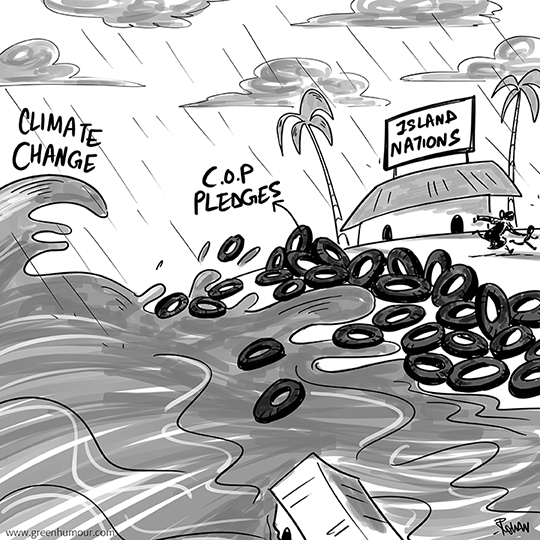
As much of legal normative theory posits, compliance with international norms has remained voluntary throughout history (see, Naiade el-Khoury on this). Unsurprisingly, States have consistently asserted that sovereignty and national interests can stand above international compliance and protection regimes. This is especially true in the case of international environmental law, where sustainability and development are, in practice, paradoxical goals. Even as recognition of climate change related risk and vulnerability has increased, States not in immediate danger of extensive harm have been reluctant when it comes to the creation of major environmental obligations and their internalization through domestic laws. The Bush administration’s decision to exit the Kyoto Protocol in 2001 because it was “not in the United States’ best interest,” is the perfect example of this rationalization. In this context, my primary aim through this contribution is to put Transnational Legal Process (TLP) to the test in one context: climate vulnerability; and I assess whether, as Koh argues, international law matters.
Island and coastal States that lie below sea level are disproportionately vulnerable to natural disasters. The long-term consequences of extreme weather events such as cyclones, hurricanes, and droughts are further exacerbated by climate change — the risks associated with inundation, salination of soil, loss of low-lying ecosystems such as mangroves, etc., are magnified by rising sea levels. Flooding will not only cause economic hardship and force migration, but it will also result in the loss of cultural resources and heritage tied to the land. Accordingly, restricting sea level rise by limiting global warming is paramount to minimizing risk and protecting cultural identities.
Koh states that TLP “helps to reconstruct the national interests of the participating nations” and results “in shared public norms that have a similar meaning in every national system around the world.” In environmental law, this should mean the creation of robust commitments and accountability mechanisms somewhat uniformly to maximize effectiveness. Take, for instance, commitments under the Paris Agreement. The Intergovernmental Panel on Climate Change’s (IPCC) 2021 report made clear that the world is locked into 30 years of climate impacts that would only worsen. However, it also argued that there was scope to restabilize climate systems thereafter if governments were to make drastic emissions cuts that would limit warming to 1.5° C compared to pre-industrial levels. To this end, the Paris Agreement enhanced global climate change governance, with parties finding consensus quickly and resolving to do the needful to limit the temperature increase.
Despite their negligible contributions to global emissions, small island nations have made ambitious emissions deduction commitments, submitting enhanced NDCs covering as many sectors as possible, and including enhanced mitigation and adaptation ambitions. Many developing countries too have submitted ambitious NDCs, albeit conditional, that can be implemented with the help of financial and other support. In theory, TLP has worked here — commitments have translated into actionable domestic policy to reduce emissions, control temperature rise, and thereby limit sea level rise. However, the success of the process is heavily reliant on holistic participation and leadership amongst developed countries. There has been some positive participation on this front. For instance, the UK, in 2019, amended its Climate Change Act, 2008, to require that the government achieve net zero by 2050. At COP26, the EU committed to reducing its emissions by at least 55 per cent from 1990 levels by 2030, and the US, the second greatest GHG emitter, rejoined the Paris Agreement (this was the result of a change in presidency, something that could potentially change again in the near future given the impending elections). At the same time, a decade after making a commitment at COP15, developed countries failed to mobilize USD 100 billion every year by 2020 for climate action in developing countries. It is of note that, contradictory to obligations in the Paris Agreement (see, Article 11.3) to cooperate to enhance the capacity of developing countries, Annex I countries do not describe their intentions to provide financial or capacity-building support in their NDCs (more here).
While net zero goals are being set for decades from now, extreme weather events have been wreaking havoc across the globe, from wildfires in North America and Australia and heatwaves in South Asia to typhoons in Asia and record-breaking rainfall in Europe; the frequency of such events is only set to rise. The countries most vulnerable to climate variability and sea level rise are those that are least developed, landlocked, or small islands. In the Global South, where resource distribution constraints and population concentration result in significant casualties and damage to property, the risk is disproportionate to historical emissions – at jeopardy is the very existence of atoll nations in the Pacific and low lying and island territories of countries in Asia and Africa.
To illustrate the disconnect between environmental frameworks and the needs of vulnerable regions, one need only look to the Pacific islands. While the existential threat to the Pacific Islands has been framed largely from a vulnerability perspective, with predictions of a future where the region will produce an unavoidable flow of climate refugees, little research has been done on adaptation. In fact, the strategy to relocate entire island populations was first suggested by an Australian government executive who spoke of the appeal of the economic benefits of such relocation as opposed to the costs of mitigation infrastructure (see here). Literature from the region suggests that this discourse obstructs the creation of space to study mitigation and adaptation alternatives based on the historic adaptability of these islands; much of the vulnerability narrative has also been linked to damage caused by over exploitation by colonial and military activities. Despite impassioned calls for funding and support towards capacity building by States in the Pacific for decades, previous efforts have often been marred by the geopolitical and other ambitions of funders. Traditional donor States like the US, Australia, France, and New Zealand now compete with China, a consistent presence and growing power in the Pacific, for geopolitical influence and regional strategic supremacy. Pacific leaders worry that such rivalries can create the risk of militarization and “strategic manipulation” (more here).
Koh argues that TLP helps to reconstruct the interests of participating States. The first step in the process through which international obligations become internally binding is interaction, i.e., States engaging with each other, followed by the creation of norms that define such interaction. In international environmental law, this must entail the integration of Global South perspectives and priorities regarding vulnerability, adaptation, and development. And while efforts have been made to bring the South within the international environmental law regime, little has been done to conceptualize mechanisms in a manner that represents the perspectives and concerns of the North and South equally (see, Karin Mickelson for more). Endeavours to incorporate these perspectives must also consider the effects of climate change and mitigation strategies on vulnerable groups such as women, children, minorities, refugees, and other marginalized communities. This would require placing environmental protection within larger narratives that go beyond merely emissions reduction, and redefining development so that its meaning isn’t restricted to economic growth — a notion that was recognized early on in environmental protection, but later reduced to mere concessions for the Global South.
In conclusion, while TLP has nudged some action in the form of environmental agreements that strive for cooperation and long-term emissions reductions, there is little consensus on how much is enough in the present to protect the interests of those most at risk. Perhaps more must be done to arrive at ambitious short-term thresholds across the board that minimize risk now before looking to the future. For instance, net-zero goals without coal phase-down plans indicate an immediate focus on coal-powered economic growth; to maximise the output from coal before its use must absolutely be stopped (see more on coal consumption trajectories here). This is a race to the bottom – emissions from coal will peak before they begin to fall, at which point, the damage will have been done. All things considered, weighed down by politics and national interests, international environmental law may not be having the impact it should when it comes to addressing immediate concerns of vulnerability to global warming. Some have more to lose than others, and the willingness of some States to defer action indicates a lack of reconstruction of national interests, a core tenet of the transnational legal process.
Gauri is a Lecturer at Jindal Global Law School. Her research interests lie at the intersection of climate change and migration. She has previously worked as a research consultant in a number of areas, including business and human rights, privacy, and regional energy policy. She holds an LL.M. in Natural Resources and International Environmental Law from the University of Iceland.
Image: Rohan Chakravarty for Green Humour.
 Jindal Forum for International and Economic Laws