
Introduction
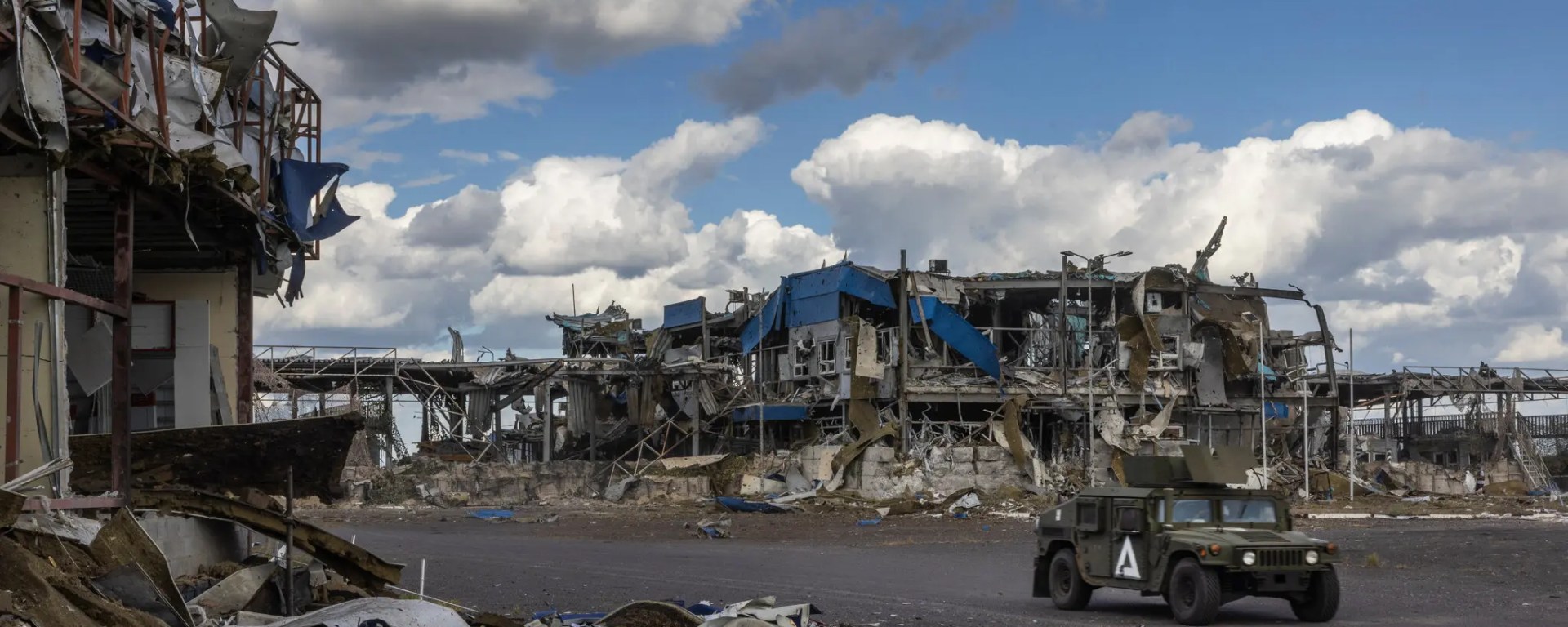
In August 2024, Ukraine launched an attack against Russia in their ongoing war when it invaded and partially occupied Russia’s Kursk Oblast. Ukraine argued that the operation’s aim was a buffer zone creation to avert further Russian attacks across the border and to strain Russia’s military potential, implying an act in self-defence. Naturally, this operation has taken a toll on Kursk civilians- resulting in casualties, displacements, and human rights violations.
Objectively, invasion and occupation of another State’s sovereign territory is a violation of international law. However, this blog argues that in this exceptionally specific Russia-Ukraine context, Ukraine’s Kursk operation is self-defence, which is justified from a legal-cum-military strategy perspective. Thereafter though, it probes into how the operation disregarded the self-determination rights of Kursk’s civilians from an individual rights perspective. The blog’s contentions navigate various caveats and are realistically international relations-oriented. Ultimately, this blog upholds universal principles of human rights without de-legitimising Ukraine’s self-defence rights.
Ukraine’s Kursk Incursion as Legitimate Self-Defence
Ukraine’s legal right to use force in self-defence stems from Article 2(4) and 51 of the UN Charter read together- wherein Article 51 maintains self-defence as an exception to Article 2(4)’s general prohibition on the use of force against a State’s sovereignty. A defending State may exercise the right when it is being subject to an armed attack from outside its territory as is the case when the Article 51 right accrues. As per the Nicaragua case, an armed attack’s severity/graveness threshold is clearly fulfilled in the Ukraine case as the country was invaded full-scale by official Russian State forces. But as per the ICJ and customary international law, this right is subject to three inter-connected limitations.
Firstly, the principle of necessity judges the means required to achieve an objective. It is opined that Ukraine’s Kursk occupation (as a buffer) was justified to deter further relentless Russian attacks and occupation throughout Ukraine- in light of Ukraine’s constant struggle to exist as a fully independent and sovereign State. More than two years of largely defending on home territory had not aided Ukraine much in stretching Russia’s military resources and thwarting Russian gains in Donbas so Ukraine’s Kursk move was a necessary gamble.
Secondly, the principle of imminence majorly judges the gravity, nature and timing of an attack, and the intention and capability of an attacker. It is very clear that Russia’s full-scale invasion of Ukraine, annexation of five Ukrainian regions, indiscriminate bombing and even nuclear sabre-rattling fall right within imminence. One could argue that Ukraine’s operation was unjustified, not universally accepted anticipatory self-defence but that is clearly not the case because Russia’s continuing armed attack does pose a substantial and continuing threat. Ukraine did not employ unjustified force to prevent a threat from emerging, in contrast to Russia’s invasion, which was launched on speculative threats. This is because Ukraine had not even applied for NATO membership (which Russia argues would be a major rival military threat but which Ukraine argues is essential for its own security) before the invasion and there was no military buildup or any hint whatsoever of an unprovoked armed attack against a nuclear-armed Russia. Similarly, it is impossible to adduce credible evidence that Russia was subject to an armed attack (or even its threat) prior to its Crimea invasion.
Thirdly, the principle of proportionality quantitatively compares the self-defence force with the original attack and judges the said force’s nature vis-à-vis the need to stop an attack. In the Oil Platforms case, the International Court of Justice highlighted that proportionality serves as a critical limitation on the right to self-defence, ensuring that any use of force is not excessive or disproportionate to the threat faced. It is quite evident that Ukraine’s operation was not excessive vis-à-vis the need to safeguard its essential security interests because, even though it occupied Russian territory, it did so only in Kursk and did not unilaterally annex it, as compared to Russia’s conquest of five Ukrainian provinces. Furthermore, even though Ukraine’s operation had caused human rights impingements in Kursk, it had not mirrored the scale of devastation inflicted by Russia on civilian infrastructure across Ukraine
Hereon, it is pertinent to engage with multiple caveats to this specific self-defence case. Firstly, one could invoke the UN’s Friendly Relations Declaration, read with Article 2(3) of the UN Charter, to contend that Ukraine as a party to an international dispute aggravated the situation and endangered international peace and security by invading Kursk. However, such an argument ignores the actual unprovoked aggravation that aggressors like Russia employ and set a negative precedent for States like Ukraine to exercise conflict-perpetuating yet legitimate and necessary self-defence rights. One could further counter-argue that peace negotiations with Russia is a realistic and pragmatic alternative to forceful self-defence against a military juggernaut. However, this again plays down the historical reality of Russian aggression- wherein Georgia’s yielding of Abkhazia and South Ossetia in a short war in 2008 and Ukraine’s yielding of Crimea in 2014 without much of a fight emboldened Russia to bankroll the Donbas insurgency and ultimately, invade Ukraine full-scale. Therefore, it is argued that non-military alternatives are not practical as they would merely freeze and/or protract the conflict, encouraging future Russian aggression and jeopardising international peace. Moreover, even if it is assumed that Ukraine’s self-defence is futile due to its substantial difference in military prowess with Russia, it is not denied that Ukraine still has an inherent right to use force in self-defence.
Secondly, one could try to de-legitimise Ukraine’s operation by remarking that it had come out of nowhere and after more than two years of the initial Russian offensive, which is analogous to the US’s actions against Nicaragua. The Kursk incursion can be portrayed as ‘punishment for an aggressor’ (occupation in response to occupation), which turns self-defence into a justification for retributive force. As for the time contention, it is reasonably clear that Ukraine could not have been expected to invade Kursk immediately after Russia invaded with an advantageous momentum; when defending on home terrain was the more pressing concern. Since the complexities of State self-defence and military strategy warrant the preparation of force against an imminent (not necessarily immediate) threat, it is not abnormal for the Ukrainians to launch the incursion at a self-decided appropriate time. This is in addition to the exhaustion of other Ukrainian choices to deter the incessant Russian assault- such as peace talks, defensive operations on home terrain, international community pressure on Russia, no nuclear arsenal for Ukraine, etc. Thus, Ukraine’s self-defence and the need to keep fighting was instant and overwhelming- tying back to an aspect of necessity laid down in the Caroline case. As for the retribution accusation, Ukraine, unlike what the US did to Nicaragua, did not invade Kursk after the Russian invasion had been repulsed/ceased but while it was ongoing. Moreover, to reiterate, Ukraine has not yet unilaterally annexed Kursk to mirror Russia’s annexations, which objectively rules out possible psychological retribution to hamper Russian morale. This is because, as will be highlighted later, the scale of Ukraine’s occupation of Russian territory was not as significant as the other way round. Thus, it is submitted that Ukraine’s operation, on a closer analysis, is not retribution but deterrence– the language of which has crept into State practice. Overall, it is clarified that in this case, a uniquely contextual right of self-defence is being supported and not a widened right- something which the ICJ firmly rejects.
Ukraine’s Incursion as a Violation of Kursk Civilians’ Self-Determination Rights
While self-defence overall can be legally justified, the violation of human rights under a self-defence operation can never be so. On this premise, the section explores how Ukraine’s incursion abridged the self-determination rights of occupied Kursk’s civilians but without de-legitimising Ukraine’s right to self-defence. Since Kursk is a non-contentious Russian province when it comes to separatist tendencies, self-determination, in this context, is separated from the traditional secession outcome. In a general conflict zone here, this analysis approaches self-determination from an individual human rights perspective since self-determination is absolutely integrated into the protection of individual rights. Furthermore, generic/universal self-determination principles are contextualised in this specific Kursk scenario for a more holistic analysis.
Article 1(2) of the UN Charter, read with international rights conventions and The Friendly Relations Declaration emphasises on equal rights and self-determination of peoples. This entails the need to respect their freely expressed will, their right to be heard, consulted and taken seriously on decisions affecting them. This can be applied to Kursk civilians, for, it is reasonable to assume that Kursk civilians did not want a foreign military presence, even if they lacked the capacity to resist Ukrainian forces. In this light, it is argued that self-determination rights of Kursk residents were violated even if Ukraine could not reasonably be expected to ‘consult them’ in pursuance of its broader military strategy and urgent self-interest. This violation also encompasses other rights violations, as probed into hereinafter.
If fundamental freedoms such as assembly, protection from torture, and the right to life are upheld, then self-determination is also sufficiently respected. The incursion’s toll on Kursk civilians- entailing displacement of thousands, alleged strikes on residential buildings, dozens of deaths and lack of humanitarian safe passages, thus, clearly abridges their self-determination, irrespective of whether the humanitarian disregards were intentional or ‘unavoidable consequences’ of crossfire between two militaries. After all, the principle of self-determination is of universal application and should be applied to conflict situations where civilians are suffering irrespective of perpetrator intent. Also, by virtue of this right, people can freely pursue their political rights along with their economic and socio-cultural development, the status of which in Kursk highlighted hereinafter.
One could claim that since Ukraine has not illegally annexed Kursk and that their military administration in the oblast is for welfare services, political rights of Kursk residents are not being violated. However, they are violated to an extent, as the military administration (be it for any purpose) is a form of foreign domination- not legitimised by Kursk’s people. Having dislodged the Russian provincial government, Ukraine violated the freedom of people to choose their own form of government.
Furthermore, people in a territory contested and damaged by two warring nations will not be able to freely pursue economic development. Similarly, social rights like access to food, water, healthcare, education, etc, cannot be said to be unhindered in an active war zone. These socio-economic impediments are highlighted by Ukrainian soldiers themselves, who remarked that living conditions in Kursk are difficult with civilians facing a resource crunch. Despite Ukrainian aid, it is deduced that everyday lives of Kursk civilians have been disrupted. As for cultural rights, Ukraine does not seem to have violated those as there simply have been no reports of ‘Ukrainianisation of Kursk.’ In fact, Russians living in Ukraine-occupied Kursk have themselves revealed the terrifying truths of the Russian state’s indoctrination.
To justify the aforementioned varying degrees of limitations on/violations of the right of self-determination, one could showcause Ukraine’s acts as support for the general international interest in maintaining international peace and security. However, Ukraine’s operation, although legitimate, will not contribute to international peace as it will perpetuate (not necessarily aggravate) the war by inviting Russian military retaliations, and possibly even legitimate armed resistance from Kursk locals that Ukraine will attempt to clamp down on.
From existing reports on the Russia-Ukraine war, it is pertinent to note that Ukraine’s actions in occupied Russia are significantly less radical as compared to Russia’s actions in occupied Ukraine- entailing coerced Russification, socioeconomic and linguistic manipulations, demographic alterations and even deportation/indoctrination of Ukrainian children. However, it is concluded that the ‘relatively lesser degrees’ of human rights violations in Kursk are human rights violations nonetheless and can never be justified – by Russian wrongs in Ukraine or any other context. Moreover, it is further clarified that rights violations in Kursk do not delegitimise Ukraine’s broader right to self-defence as they are inherently inevitable in all-out and protracted wars with complex defensive and offensive dynamics. The two rights should be read harmoniously to an extent- as doing otherwise would not set a favourable precedent for States exercising similar self-defence rights in future conflicts. Self-determination rights, if allowed to override self-defence rights in every circumstance, would not be feasible for international law as that would itself infringe an inherent and customary human (and by extension, State) right to self-defence. Legal limitations outlined earlier have been placed on self-defence to check gross violations of self-determination or human rights and upholding the same at the expense of self-defence rights would only weaken the fundamentals of international laws of war. Yet, it is reiterated that universal human rights, as basic tenets of CIL and the UN Charter, should always and at least be strived to be upheld along with States’ self-defence rights, wherever legitimately warranted.
Conclusion
Overall, this blog has sought to legally justify Ukraine’s invasion and occupation of Russia’s Kursk region as self-defence, without sidelining the crucial ideal of universal human rights- in this case, even the self-determination of an aggressor nation’s civilians. Key principles of both self-defence and self-determination have been in a unique and intricate context to establish that legitimate self-defence should not justify impingements on a people’s self-determination rights. While Ukraine’s unique self-defence right is upheld in the context of constant Russian belligerence against Ukraine’s independence, Russian civilians’ self-determination rights are upheld through an individualistic, humanitarian perspective, with a suggestion to read both rights harmoniously. Ultimately, this piece has reaffirmed essential rights of both- mainstream players in international law- the States, and stakeholders that international law affects the most- the people.
Aditya Maheshwari is a second-year law student at NLSIU, Bangalore.
Picture Credit: David Guttenfelder for The New York Times
 Jindal Forum for International and Economic Laws