
Introduction
The 1951 Refugee Convention and its Protocol passed in 1967 lay down the rights of refugees worldwide. These rights include the right to basic social, economic and civil rights, including the right to work, education, housing, protection from discrimination, among others. Another key right is the principle of non-refoulement. It mandates that refugees cannot be sent back to their country if they may face persecution or serious harm upon their return. In practice, these have often been breached.
Some countries have resorted to agreements with third countries to transfer obligations for processing refugee claims. Often these third countries are those with less bargaining power and poor resources. Other countries have resorted to extending their borders to evade the obligations of giving shelter to refugees. Australia has regularly intercepted boats containing refugees and has either sent them to other countries or to offshore centers. Similarly, South Africa has misused the principle of “country of first asylum” to state that only those refugees which can definitively prove that South Africa is their country of first asylum are allowed to have their claims processed. They have often repatriated refugees to either their home country where they are persecuted or the country of their first asylum which was unable to take care of them in the first place.
The article is divided into two parts. This part deals with the principle of Proportional burden sharing and elaborated upon it as a solution to the present refugee crises. The next blog analyzes the increase in likelihood of the implementation of this principle by considering the phenomenon of climate refugees and the adverse impacts of their influx.
Reasons for Refusal to Accept Refugees
The primary reasons for refusal of acceptance of refugees are twofold: firstly, the high costs involved in providing shelter, rehabilitation and fulfilling international commitments and secondly, the high volume of refugees seeking shelter.
The “high-cost exception,” propounded by Michael Walzer, states that countries may be justified in refusing refugees when their admittance imposes significant costs on the countries’ citizens. These costs should be comparable to the harm the refugees may face if they are deported. He argues that the primary duty of a state is toward its citizens and refusal is justified in cases where acceptance may have immediate adverse consequences on national security, healthcare, etc.
The high-volume exception concerns the quantum of refugee flows. If the number of refugees is such that acceptance may threaten the state’s capacity or the way of life of its citizens, it may be justified in refusing acceptance. The primary difference between the two exceptions lies in the fact that high volume is linked to substantial, long term, systemic effects in the country’s capacity to take care of its citizens while high cost refers to the specific impact immediately caused by the acceptance of refugees. For instance, the possibility of a State attacking another because of the acceptance by the refugees of the former by the latter may amount to a high cost. Whereas the effect of accepting refugees on the internal homogeneity of the country may be a result of the high volume of refugees. It should be noted that while they have been differentiated for the ease of analysis in this article, these two exceptions are not mutually exclusive..
Presently, this burden is shouldered mostly by the countries near the zone of conflict regardless of their capacity. These “countries of first asylum” are tasked with the unenviable task of taking care of refugees and ensuring compliance with the obligations of International Refugee Law. The principle of proportional burden sharing, discussed in the next section hopes to alleviate these problems.
The Principle of Proportional Burden Sharing
The principle of proportional burden sharing is based on the principle of insurance. By virtue of the States mutually agreeing to commit to receiving a fixed number of refugees, they are protected from an unforeseeable influx in the future. It aims to further the mandate of International Humanitarian Law by providing the maximum possible rights to refugees by maximizing the resources available for protection. It is grounded in the economic strength of the respective countries. For maximum participation and effective implementation, this burden-sharing is proposed to be on a regional rather than a universal basis. There are multiple reasons for this—the relative cultural homogeneity in a region which ensures the preservation of culture; geographical proximity, which ensuring ease of repatriation as well as arrival among others. Since the process entails intensive information gathering to ascertain the relative economic strength, assigning of the respective quotas to states, dissemination of information and advocacy for refugee rights, an International Agency is best suited for this purpose. Prof. Schuck envisioned the UNHCR as fulfilling the role of this agency owing to its prior expertise in refugee protection. The role of the agency is explained in the next Section.
Role of the International Agency
The International Agency is to play a key role in the allocation of quotas for refugees. This allocation is based on the principle of proportionality. The capacity of states to provide the basic amenities is invariably linked to their economic strength. Other indicia like assimilative capacity are subjective and their importance is eroded further when it is realized that states are under no obligation to assimilate their citizenry and refugees. Despite having no powers of enforcement of its orders, it is envisaged as an advocate for the refugees as well as poorer nations.
The market system for trading obligations
Presently, there exists an informal market for trading obligations. Wealthy states transfer money to poorer states to undertake their burden. However, this transfer is unregulated and often results in poorer states undertaking disproportionate burdens. Professor Schuck envisaged a model where, a state upon receiving its quota of refugees, could decide if it wanted to accept it or transfer. It could also undertake to shelter a certain number of refugees and transfer the rest. This system seeks to take advantage of states’ penchant for protection of their national interest.
The primary advantage of this system is twofold. Firstly, by formalizing the informal, the poorer states are given more bargaining power owing to the presence of the market system. Since each state is not limited to merely its neighborhood, there is a greater element of choice. Secondly, transferor states will have a genuine outlet to discharge their obligations. Developed countries worldwide have shown an anti-migrant stance; thus, their governments have often refused admittance in wake of public pressure. Owing to the presence of this system, this arbitrary cancellation can be replaced in the form of trade quotas. This is especially advantageous for transferee countries because some rich nations having a homogenous population would often be willing to pay more to shift their burden. Additionally, this gives the richer countries a stake in the matter because their money is being used to shelter refugees. Hence, it is in their interest to intervene and try to minimize the conflicts which lead to refugees.
Thus, a market system instead of becoming an outlet for those with economic strength to escape their obligations, becomes a pathway for better treatment of refugees.
Addressing Potential Criticisms
The scheme faces criticisms on multiple grounds. For the ease of analysis, they can primarily be classified into refugee centric concerns, enforcement centric concerns which encapsulate the potential for misuse by powerful countries and other concerns.
1) Refugee Centric concerns
There are two primary concerns related to refugees under the scheme. Firstly, the commodification of refugees owing to them being seen as a commodity which can be bought and sold. This criticism was foreseen by Prof. Schuck and countered by him as well. He argued that the commodification criticism is made wherever there is a market for allocation of scarce goods/activities which have traditionally been allocated in non-market ways. He gave the examples of organ transplants, childbearing and others. Furthermore, he argued that this argument assumes the presence of an existing refugee system based on higher principles of justice which serves their needs. There exists no such system and it is up to the country of first asylum, or other countries based on assimilative capacity to decide what it wants to do with the refugees Often refugees are made to live in conditions of squalor and extreme poverty, or risk being sent back potentially to their deaths. Thus, a system of proportional burden sharing ensures a higher standard of living for these refugees despite them being “commodities.”
The second concern relating to refugees is the fact that poorer countries, incentivized by money may accept disproportionate burdens. This would lead to overcrowding, inadequate resources and poor living conditions. Prof. Schuck gave a list of measures to prevent this situation from happening. Firstly, the country which chooses to transfer its quota of refugees instead of accepting them should not pay the transferee country a lump sum amount and instead pay in tranches upon seeing the state of the refugees. Secondly, the International Agency should be given powers to monitor the state of refugees as well as publicize the conditions to ensure they are fulfilling the basic standards. He further argued that the problem of lessening standards upon the wider application of the scheme is not unique to the scheme of proportional burden sharing but to any change which broadens refugee burden sharing. The greater number of people covered would invariably lead to lessening standards, however as per Prof. Schuck maximizing coverage and ensuring basic protection should be prioritized over maximizing quality of life. The proportional burden sharing scheme by allocating quotas based on the economic strength and regulating transfers provides a better alternative.
2) Enforcement Centric Concerns
These concerns stem from the absence of the International Body having any coercive measures for ensuring enforcement and prevent misuse of power. Like any other international treaty, a variety of factors influence adherence by states. The paramount factor being that of state interest in adhering to the obligation. Prof. Schuck envisaged a regional application of the scheme owing to this fact. He argued that enforceability of the scheme depends on the political will of the powerful states to follow the same. These states would also define the contours of the scheme. However, since the scheme is regionally applicable, their conception of the scheme is not binding on others. The problem of climate refugees which is discussed in depth in the next part, shatters the traditional patterns of refugee migrations which depended primarily on unrest, poverty and war. Furthermore, the states most affected were low- and middle-income countries which house the most refugees presently as well. However, the rise of climate refugees leads to these erstwhile insulated high income countries facing problems of refugees. Presently, most of the displacement is internal however experts foresee external displacement rising in the future. Thus, the scheme of proportional burden sharing furthers the interest of these rich countries which don’t wish to see the influx of refugees owing to climate related incidents.
A concern related to the lack of enforceability is the potential for misuse of the scheme where rich states by utilizing their political and economic heft may force the poorer countries to accept their burdens. This can be countered by two arguments. Firstly, even in the contemporary scenario, countries transfer their burden to take refugees as evidenced from the example of UK and Israel sending refugees to Rwanda however, there is no regulation for such a process. Hence the principle of proportional burden sharing regularizes the informal and even if there is potential for misuse, it is a more desirable situation than the present scenario.
Secondly, an analogy may be drawn to the carbon emissions trading system to underline that economic heft is applicable to all such burden sharing market schemes, however it does not vitiate their effectiveness or desirability as providing a solution. In the emissions trading system, a country which emits less assigned amount units (AAU’s) than its assigned threshold may sell the extra AAU’s in the carbon market.
Conclusion
This piece aimed to introduce the principle of proportional burden sharing propounded by Prof. Peter S Schuck. The contemporary relevance of the scheme is highlighted owing to the changing notions of the term refugee brought about by climate refugees. It highlighted that the basis of the scheme which is the principle of insurance against an unforeseeable influx of refugees, is more widely applicable now due to this very change. By comparing to the present scenario, it sought to address the arguments against commodification, potential misuse, disproportionate burden and others. The basic argument underlying the piece is that the scheme provides a method of regulation over the present unregulated system.
Click here to read part II.
Rudra Singh Krishna is an undergraduate law student at WBNUJS, Kolkata.
Suhani Suri is an undergraduate law student at Jindal Global Law School.
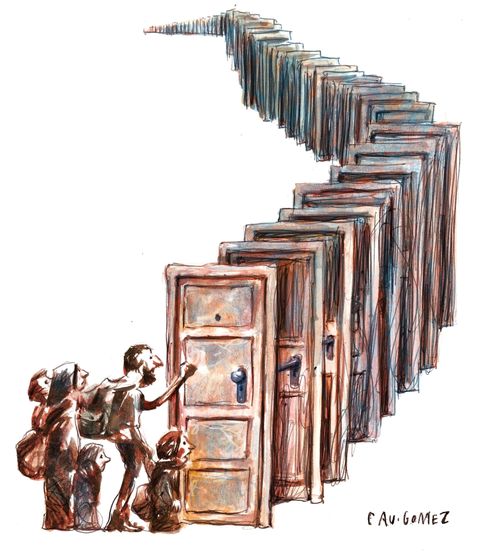
Picture Credit: Cau Gomez/Cartoon Movement
 Jindal Forum for International and Economic Laws
One thought on “A Case for Proportional Burden Sharing in Today’s World – Part I”