
Introduction
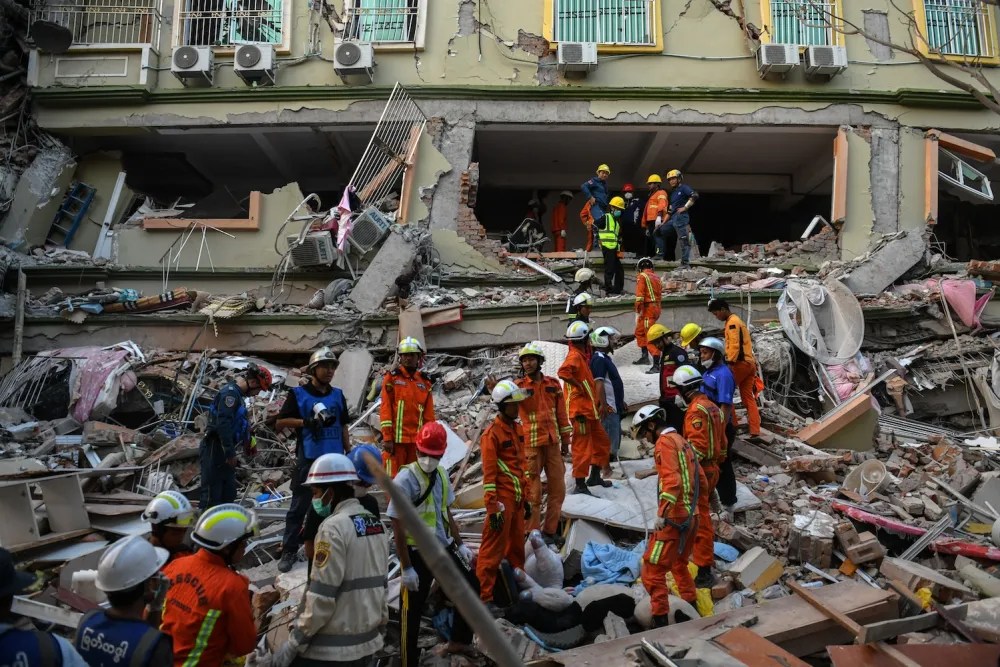
On 28th March 2025, a catastrophic earthquake with a devastating magnitude of 7.7 on the Richter Scale struck Myanmar, which took over 3700 lives. Myanmar civilians are facing acute hardship. For instance, the Sagaing region, providing shelter to one-third of the displaced population, is struggling with severe shortages of food, shelter, and sanitation. Further, the crisis is escalated by ongoing military insurgency, and the continued bombing by Junta-led military forces bombarded the areas that had already succumbed to natural calamities, which aggravated the suffering of common people. The continuous resistance to accepting international relief assistance despite urgent humanitarian needs also compounded the burden. The refusal obstructed essential aid and worsened the civilian situation.
Additionally, Myanmar’s topography is highly susceptible to recurring earthquakes. In such a vulnerable environment, the burden of armed conflict, internal war, and rebellion abandons the country without any means to recover or endure. This critique examines Myanmar’s authoritarian conduct, including violations of humanitarian norms during armed conflict and disaster response. The targeting of civilians, destruction of supplies, and obstruction of aid contravene international disaster relief standards, the Geneva Convention, and the International Humanitarian Law. It questions on strategies of shielding sovereignty which are applied during a crisis to hide evasion of international scrutiny. The common Article 51(2) of additional protocol I of Geneva convention, 1977 prohibits direct attack on civilians, and common Article 3 of Geneva convention 1949 prohibits against denying relief to wounded and sick.
These prohibitions are recognized as non derogable obligations constituting jus cogens norm, violation of which are evident in Myanmar military operation targeting civilians and blocking humanitarian aid. This violates the legal statutory framework and the spirit of the international community. We analyzed the role of regional actors by extending support to ensure relief access to promote cooperation through transnational oversight. Myanmar’s post-disaster response strongly demonstrates the extent to which the state leveraged sovereignty to conceal statistics of excessive humanitarian losses nullifying the process of receiving international aid. The military junta government (SAC) intensity of violence including continuous bombarding, large casualties combined with organized structure and taking regional control of ethnic groups with conduct of junta using deliberate airstrikes on civilians and blocking of humanitarian aid constitute a war crime under customary International humanitarian law.
The ICC is already investigating cross-jurisdictionally the situation in the region of Bangladesh due to incessant Rohingya immigration. In order for the international conventions to maintain relevancy, the international norms of human welfare must be prioritized over illegitimate demands of sovereign control, increasing risks in critical crises.
Background: Myanmar, A Nation abandoned by crisis.
The inception of the humanitarian crisis dates back to February 2021, with the collapse of Aung San Suu Kyi’s “National League for Democracy” by a military coup (coup d’état), which devoured Myanmar’s hopes of a robust democratic state. It coercively transitioned the country into a dictatorship of an official military-led group named Junta Dal. This government later imposed a nationwide emergency that poured out a nationwide movement, strikes, and rifts among common civilians. In retaliation, the ignited reactions were neutralized by the military and armed forces, resulting in a casualty toll of over 1000 deaths, 8000 wounded, and the displacement of 198,000 people.
This authoritative suppression was the commencement of a struggle between the oppressed ethnic class, repressed officeholders of the pre-coup, and the pro-Democrats against the military takeover. These three classes were united to form a joint declaration to recognize the federal government-established National Unity Government (NUG). These groups carried demands of eliminating the junta military establishment and advocated for a free electoral mandate with guidelines of specified objectives for making a federal union.
In August 2023, the movement named “Operation 1027” was carried out to remove the junta from power. Although the movement created a major impact by delisting 180 unauthoritative posts in the Shan region, it came at a cost of the displacement of 335,000 citizens, resulting in aggravated chaos. Similarly, between August and December 2024, in alignment with previous movements, many breakouts like the military takeover of Lashio city and Rakhine took place, against which the Three Brotherhood Alliance, a civilian-led armed rebellion, was formed. It was to detach the military authority in these areas; however, their presence in other regions remained firm, which continued the atrocities.
Relief Denied violating international laws under the guise of sovereignty
On 8th April 2025, “Kyaw Moe Tun,” a permanent representative of the Republic of Myanmar to the United Nations, stated that the refusal of humanitarian aid by the junta military government meant that earthquake victims could not equip themselves with necessary emergency assistance, adding that the intentional attacks on the earthquake-induced region posed a stage of vulnerabilities for civilians.
The Myanmar military’s deliberate obstruction of humanitarian relief in the earthquake-affected regions coupled with ongoing air and artillery strikes on civilian zones, flagrantly violates customary international humanitarian law, including Rule 55 of ICRC’s customary IHL, and constitute war crime under Article 8 of the Rome Statute. By combining jurisprudence of Common Article 3 of Geneva convention and case of Prosecutor v. Tadic(1995) where intensity of violence and organization of crime are the two criteria given to constitute Non- International Armed Conflict (NIAC). In Myanmar, the scale of armed confrontations, bombardment in civilian areas and controlling ethnic territory by junta government and organization of hostilities between Junta government and ethnic armed organization alongside civilians involvement satisfy both the threshold for constituting NIAC under International humanitarian law.
Moreover, Attacks on civilians, bombardment of undefended areas, obstruction of humanitarian aid and starvation as a weapon recognised under customary international humanitarian law, binds all states. The junta’s airstrikes on earthquake-hit regions, deliberate blocking of relief supplies, and targeting of civilians clearly fall within the scope of Article 8(2)(b) and (e). The ICC’s acceptance of jurisdiction in the Rohingya deportation case, based on cross-border effects into Bangladesh, further illustrates that Article 8 can serve as a framework to classify Myanmar’s conduct as war crimes. These actions form part of a systematic and widespread policy, which constitutes crimes against humanity as underscored under Article 7 of the Rome Statutes “extermination by deprivation”.
These measures also breach Myanmar’s obligations under the Article 6(3) of ICCPR, which states, guarantees that no one shall be arbitrarily deprived of life, a right that is absolute and non-derogable even during emergencies, arbitrarily refusing post-disaster grants violates the right to life. The ICESCR implies protection and maintenance of the rights to life, food, health, and key humanitarian norms articulated in the ILC’s Draft Articles on Disasters, UNGA Resolution 46/182, UNSC Resolution 2417, and ASEAN’s AADMER; all of which mandate that emergency assistance must not be unjustifiably withheld and must be facilitated.
Articles 14 of the ILC draft of 2013 mandate the duty of an aggrieved state to seek assistance from other states or recognized international organizations in circumstances beyond its control. It also obligates the crisis-ridden state to provide substantial reasons for denying international assistance. On parallel grounds, General Assembly resolutions 43/131 of 1998 and 45/100 of 1990 prohibit the abandonment of victims from humanitarian assistance, which constitutes an offense against human dignity. The Myanmar government’s justification for the denial of aid and inaction is based on implied reasons of political sovereignty and absolute authority, which represent a misuse of their sovereign prerogatives at the cost of human life. Without a substantial humanitarian justification for these acts, an invocation of responsibility to protect (R2P) with a timely intervention from the international community becomes essential.
Articles 42 and 48 of ARSIWA, in principle, implicated a role for both the injured state and the non-injured state to hold another state accountable for the non-fulfilment of responsibilities related to humanitarian assistance and international obligations. Neighbouring countries such as India, Bangladesh, and Thailand, burdened by the refugee crisis and cross-border instability, can invoke their liability against the Myanmar government as directly injured states. Conversely, the denial of relief engages wider international concern under the principle of erga omnes obligation, whereby a country owes its responsibility to protect the international community as a whole. Likewise, geographically distant countries can also invoke Myanmar’s responsibility for the collective interest of protecting human life. Meanwhile, the nature of these international bodies governing disaster management is obligatory. Currently, strengthening the inter-disaster management acts by removing duties and obligations and mandating strict punitive sanctions or diplomatic isolation for regimes that arbitrarily refuse to take aid and funds becomes essential.
Potential of Alternative Strategy with Cross-border humanitarian engagement
The junta government’s self-reliant approach and aversion to receiving foreign assistance from international organizations can be substituted. A joint or multilateral agreement with neighboring countries and signatory states with Myanmar could be claimed. A few examples are the Hyogo Framework for Action (HFA), in which Myanmar is a signatory with 167 other nations for disaster and risk reduction management, along with Myanmar being a member of the ASEAN subcommittee on disaster management and BIMSTEC. The junta government can look forward to strengthening its ties by collaborating on other cross-border agreements without harming its idea of sovereignty.
India as part of its Act East policy and Neighbourhood First in Operation Brahma, provided humanitarian assistance to Myanmar post-earthquake. A relief disbursement of 625 metric tons in food, water, and shelter, and volunteers were deployed for relief measures. Additionally, the QUAD, with its objective of prosperity in the Indo-Pacific region, provided USD 20 million in monetary aid to Myanmar as India urged partners to facilitate support. Similarly, the China Red Cross Society granted 1.5 billion RMB (206 million USD approx.) to the Myanmar Red Cross Society, and CIDCA, its native agency responsible for foreign aid and policies, sanctioned 1 billion RMB to the Myanmar humanitarian fund.
Meanwhile, these neighboring acts of support came with pre-existing economic interests levied on diverse infrastructure projects. For instance, the Kyaukphyu deep seaport endorsed by China in Myanmar joins the roadways of both countries with an access point to the Indian Ocean, making this deal a strategic investment for surveillance and security. These self-interest-vested approaches are usually involved in cross-border humanitarian crises. Highlighting that the idea of cross-border funding and assistance of neighbouring countries or treaty-based frameworks often comes at the cost of negotiating sovereignty and the interplay of give-and-take prospects.
Conclusion
Refusal of humanitarian aid to people dying of lack of support, in addition to constant bombings, violates international norms and obligations, which are actionable. The international community must rise against such crises to support humanity to prevent future crises akin to Syria or Ukraine by setting aside the political malignity in the system.
Assuming the military acceptance of financial aid, the usability of these grants for relief measures remains ambiguous, as military authority, with its free will and no oversight, can utilize the funds for militarizing the territories and enhancing artillery firepower, exacerbating the situation for civilians grappling with the post-disaster effects. To address this challenge, profound engagement with the international community is needed not only to secure fiduciary support but also to achieve political stability ahead of the 2026 elections. Ensuring fear-free elections will require both the support of neighboring countries and the necessary backing of the civilians of Myanmar. With competing interests from neighboring countries such as India and China, the current need of the country is to recalibrate its troubling situation arising from this humanitarian crisis, as ongoing internal conflict and terrorism have created a threat that transcends national boundaries. To solve this, the military-led junta government is standing at a decisional juncture to either devise a mechanism of claiming humanitarian aid without endangering its authority or become receptive to international grants and assistance.
Vagisha Mandloi and Nikesh Dubey are third-year law students at Dharmashastra National Law University, Jabalpur. They have a keen interest in international legal frameworks and their humanitarian aspects.
Picture Credit: Sai Aung Main / AFP via Getty Images
 Jindal Forum for International and Economic Laws