
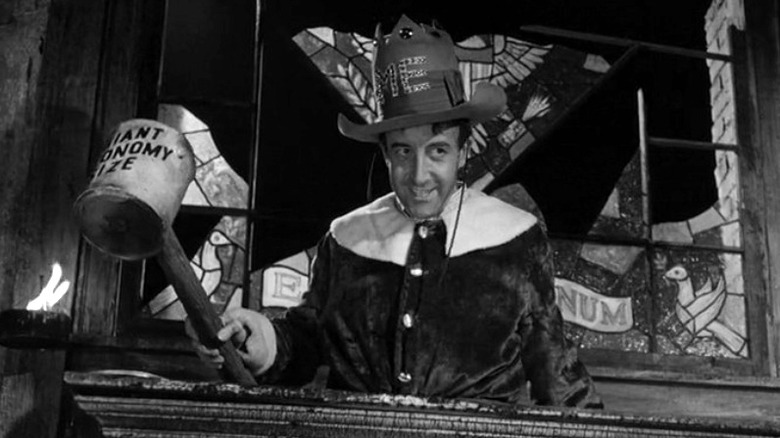
The world polity is experiencing a cornucopia of structural disorders. Wars, coups, tariffs, assassinations, and refugee crises are no longer the lingua franca of the academics but a part of crude, everyday parlance. The Ukrainian crisis, the massacre in the Middle East, and the American tariff system have drawn attention to familiar issues that professionals typically address. The growing skepticism towards international law and bewilderment at American foreign policy are central to this situation. Due to the culmination of complex events, serious concerns have emerged about the fate of multilateralism, peace, and international co-operation. The article assesses the idea of the Charter through the lens of pop culture and the currents of American foreign policy, aiming to provide theoretical insight into what might otherwise be a chaotic situation. Through the lens of cultural legal studies, the article assesses aspects of international law from the perspective of Rod Serling’s works.
As we approach the 80th anniversary of the Charter of the United Nations, the article reassesses its role through an unlikely source—the works of American television personality Rod Serling. Serling was prophetic in his assessment of the American way of life, and his words remain as valid today as they ever were. Today, American foreign policy raises serious concerns about human rights, immigration, and multilateralism. The hardened American stance on refugees, trade, and immigration, combined with the complex terrain of international law, provides a conceptual backdrop for Serling’s literary ideas. America’s recent policies will be used to contextualise Serling’s ideas and reflect upon the viability of the Charter.
The Existential Crisis of International Law
A lot is expected from international law. Due to the recent Palestinian travesty, enthusiasts even advertised its obituary. Coupled with this is the formidable nature of American foreign policy. It is interesting to observe that both of President Trump’s administrations have been hostile towards the idea of the United Nations and multilateralism. During his second term, the Trump administration has announced its withdrawal from the World Health Organisation (WHO), the Paris Agreement, and the Organisation for Economic Co-operation and Development (OECD). The White House has made controversial claims, such as proclaiming Canada a state of the USA, aiming to acquire Greenland, and reiterating claims over the Panama Canal. Callous statements like these undermine the force behind Article 2(4) of the Charter and the principle of jus cogens norms. International courts and tribunals are often viewed with suspicion. Trump’s inaugural address is clearly an ode to American exceptionalism and a nod to Morgenthau’s realism, which has been hovering over the Presidency since the time of John F. Kennedy.
The Work and Ideas of Rod Serling
A young scholar of international law and international organizations would now be tempted to think that national interests and military might reign supreme in international law, and the subject is nothing more than a glorified town-hall meeting. Upon its eightieth anniversary, this is precisely not how one should remember and cognize the Charter of the United Nations. The blog article has chosen an unconventional cognitive device to counter the majoritarian and overbearing voices of our times. The works of Rod Serling serve as a reminder that faith in international law is not only a sign of mature thinking but also a reflection of humanity itself. The motion picture ‘Carol for Another Christmas’ perfectly captures the tensions of the present conflict-driven world.
Rod Serling was a pioneer in the American television industry. A stellar playwright in his own right, Serling belonged to the iconoclast group, appropriately titled, ‘Angry Young Men’. The ‘Angry Young Men’ group was a reaction against the conformist tendencies that had crept into the television format. The group challenged the status quo, preferring. They preferred to tell stories of individuality and the oppression that were hard to detect. Rod Serling was a World War II veteran who eventually became a well-known anti-war activist and defender of human rights and racial equality. Being a paratrooper and having served in the 11th Airborne Division, Sterling had first-hand experience with the horrors of war.
Serling used these experiences to narrate various moral anecdotes in the groundbreaking television series, The Twilight Zone. The Twilight Zone was a reaction against the traditional television programming system, where programs were seen as extended advertisements. This format could not be divorced from the ‘baby-boom’ construct, where the depiction of an American dream overpowered any social commentary. Various episodes in The Twilight Zone served as a prelude to Serling’s cosmopolitan ideas in Carol for Another Christmas.
Deaths- Head Revisited ( Season 3, Episode 9, The Twilight Zone) adopts the moral tone of the Nuremberg Trials, where a former SS official, Captain Gunther Lutze, is condemned to eternal damnation by a supernatural judicial proceeding presided over by the ghosts of the victims of Dachau concentration camp. In The Passerby (Season 3), Serling interprets the ill effects of War by using the American Civil War as a backdrop. One of the soldiers laments and states, “ War is trumpets and drums, nothing but trumpets and drums.” Similarly, “The Thirty Fathom Grove” (Season 4, Episode 2) addresses the issues of moral guilt and PTSD. Praise of Pip (Season 5, Episode 1) is an anti-war commentary, criticising America’s involvement in Vietnam. The Encounter (Season 5, Episode 31), the most controversial episode of the series, deals with the issues of moral guilt, PTSD, and racial prejudices in the context of the Hiroshima incident. The episode can be related to the current concept of moral injury that has recently been incorporated into the DSM-5.
The Plot of Carol for Another
Carol for Another Christmas is an ode to multilateralism, peacekeeping, and the United Nations Charter. Rod Serling served as the writer of the film. The motion picture was part of the United Nations television film series used to promote the Organization. The story reimagines Dickens’ A Christmas Carol, with the plot set in the 1960s. The derision towards people experiencing poverty is replaced with skepticism towards internationalism and humanitarian aid. In place of Ebenezer Scrooge, the audience is introduced to the character of Daniel Grudge ( not a very subtle reference, though!) Daniel Grudge is a very contemporary figure. His views align with some of the policies of the current American Presidency. The first 15 minutes of the film are dedicated to setting the political silhouette of Daniel Grudge.
The conversation with Grudge’s cousin Ben portrays Grudge as someone who has criticized international cooperation, charity, and cultural exchange programs. Lamenting the death of his son during World War 2, Grudge has become a hardened critic of liberal views. He sarcastically queries whether his cousin had approached him to ask for more favors, such as donating the River Mississippi to the Sahara. For having cancelled the grant for the University’s faculty cultural exchange program, Grudge is labelled as a ‘high-powered ventriloquist’ by his cousin Ben. The dialogue here is reminiscent of an unapologetic capitalist pitted against a liberal academic with humanitarian values.
Daniel Grudge is the face of ‘American exceptionalism’ that mocks every aspect of universal brotherhood. Grudge openly states that he is “in no mood for brotherhood of man.” He goes on to call causes, involvements, and cultural exchanges instances of international freeloading. He advocates for the weapon industry when he states,” Let them know we have the biggest and the fastest.” The narrative sounds familiar, doesn’t it?!
Following the heated debate, a series of eerie circumstances led Grudge to encounter a series of apparitions. In a Dickensian fashion, he first encounters a soldier’s ghost who had been a part of the First World War. Initially, Grudge continues his harsh criticism of universalism by calling the American effort to get involved in World War I ridiculous, and the army was nothing more than “Uncle Sam’s sucker brigade”. The ghost of the past counters the arguments with pacifist logic by stating, “So long as you talk, you don’t fight”, “When we stop talking, we start swinging…” Grudge, however, rejects the idea and supports the policy of isolation followed by the USA. The scene then shifts to Grudge’s past when he was a serving military man in World War II and visited a hospital in Hiroshima where children’s faces had been disfigured due to bombings.
The second visitation is from the ghost of Christmas present, who is busy having a hearty feast right in the middle of an internment camp for displaced persons. Grudge shows annoyance at the sight of gluttony, and the ghost reminds him of his own words wherein he had argued why one should grieve over the haves and have-nots of the world. The second act is an allegory that justifies the cause of global justice and international aid.
In the third visitation, Grudge is transported to a post-apocalyptic world, where the ghost of Christmas night addresses him in a dilapidated town hall. It is here that the term ‘United Nations’ is used for the very first time (at 59:42-time stamp). The place now houses the survivors of a nuclear holocaust who are under the sway of an eccentric post-apocalyptic overlord, Imperial Me. Imperial Me rules the place with maniacal eccentricity and strict obedience. The leader has a twisted vision in which humanity is supposed to revert to its most basic survivalist tendencies. The idea of ‘We’ is to be weeded out and ought to be dominated by ‘I’. When Grudge’s domestic aid, Charles, tries to reason with the mob that co-operation and altruism are the only hope in a time of crisis, he is charged with ‘treason of involvement’ and the most serious offence of the ‘subversion of me’. Charles is finally shot to death by a gun-toting minor.
After encountering the compelling visions, Grudge wakes up as a transformed man who, during a second conversation with his cousin, reflects on his conservative thoughts. Here, the rigid mould of Grudge begins to crumble when he agrees that as long as there are children, there is hope. He even agrees that the idea of a family of nations is a possibility after all. He quotes John Donne’s words, “No man is an island”, and agrees with the cause of multilateralism and international involvement.
Serling’s Interaction with the Theories of International Law
The article is not overly optimistic that retelling Dickens’ tale will lead to a conceptual overhaul of the state’s foreign policy. Still, Serling’s work serves as a caveat for the audience to reassess the importance of international law in our daily lives. Apart from its formalist-positivist framework, international law is grounded in moral maxims that serve as a guiding principle for the global community. The ideas of Serling are not without precedents, as the motion picture can be seen as a contest between the various phases of American foreign policy.
Initially, Grudge seems to be a supporter of Washington’s isolationist policy. His skepticism represents a trust deficit in Wilsonian internationalism. Serling would definitely have opposed the present regime if it were not for his untimely death. The school of thought that, in the author’s opinion, comes closest to Serling’s literary ideas was the New Haven school. The school, as an aspect of American pragmatism, focuses on interpreting international law in light of societal expectations within the world community and considers the diversity quotient. The short-lived school of thought could use revitalization in the context of a conflict-driven world.
American academia underwent an interesting phase during the intermittent years of the Cold War. The 1960s marked the rise of the New Haven School, as well as the emergence of the Realist School. The New Haven approach employed a communitarian methodology, aiming to integrate national aspirations with international expectations. Its primary focus was on human dignity, while power, wealth, enlightenment, skill, well-being, affection, respect, and rectitude formed its foundational principles. It criticised the strict divisions between national and international law, focusing on the interdependent nature of the world polity. The focus on the interdependent nature of the world, along with human values, led New Haven to adopt a policy-oriented approach towards international law.
For New Haven, the perusal of human dignity meant a partial renunciation of the public sphere of the balance of power. The Realist school of international relations, on the other hand, represented the American anxiety of a post-war world order. One must be cautious when interpreting the thoughts of Political Realism, as led by Hans Morgenthau. It is convenient to dismiss the Realist model as an exponent of an egoist tendency solely driven by a blind pursuit of national interests. Hans Morgenthau instead proposed a theory based on a ‘common-sense’ approach that even challenged the pragmatist interdisciplinary ways to interpret foreign policies. Morgenthau is not just a disgruntled immigrant scholar of international law, but an advocate of a cautious foreign policy. His realism was a reaction against the positivist and legalist methods of international law.
He disagreed with the legal philosophy of his mentor, Hans Kelsen. He argued that legalism envisioned a world where disputes could be solved through the efforts of international organizations and the legal force behind treaties. This Wilsonian attitude of international relations tended to replace the world of the balance of power with a legalist solution. These universalist tendencies failed to take into account the particular national interests of the States and their actual behavior. This depoliticization of international relations ultimately led to the demise of the Covenant of the League of Nations and prepared the ground for the Great War.
Grudge’s mistrust of international cooperation can be interpreted as a particular outcome of Morgenthau’s skepticism. Grudge’s cousin, the three visitations, and Rod Serling’s writing, on the other hand, can be interpreted as an aspect of the ideas of the New Haven School, where preservation of human dignity is not merely an aspect of international legalism but a part of a wide-ranging policy-making. There is no a priori approach to solving the world’s problems, but rather a persistent effort through policy-making. The visitation of the second ghost is the most proximate example of the New Haven approach. The focus in the second story shifts not only towards the de-escalation of war but also towards the refugee crisis and the hunger crisis.
The article offers a novel cognitive tool for the international law audience —pop culture. The motion picture has been interpreted as providing arguments for the validity and effectiveness of the Charter of the United Nations. It is not just about the security of the State, but the well-being of human beings for whom the order has been created. Serling’s prophetic words (Obsolete Man, The Twilight Zone, Season 2, Episode 29) resonate when we approach the 80th anniversary of the Charter of the United Nations :
“…This is not a new world; it is simply an extension of what began in the old one. It has patterned itself after every dictator who has ever left a lasting imprint on the pages of history since the beginning of time. It has refinements, technological advances, and a more sophisticated approach to the destruction of human freedom. But like every one of the super-states that preceded it, it has one iron rule: logic is an enemy, and truth is a menace…”
Dr. Bhanu Pratap is an assistant professor at Faculty of Law, University of Lucknow.
Picture Credit: SlashFilm
 Jindal Forum for International and Economic Laws