
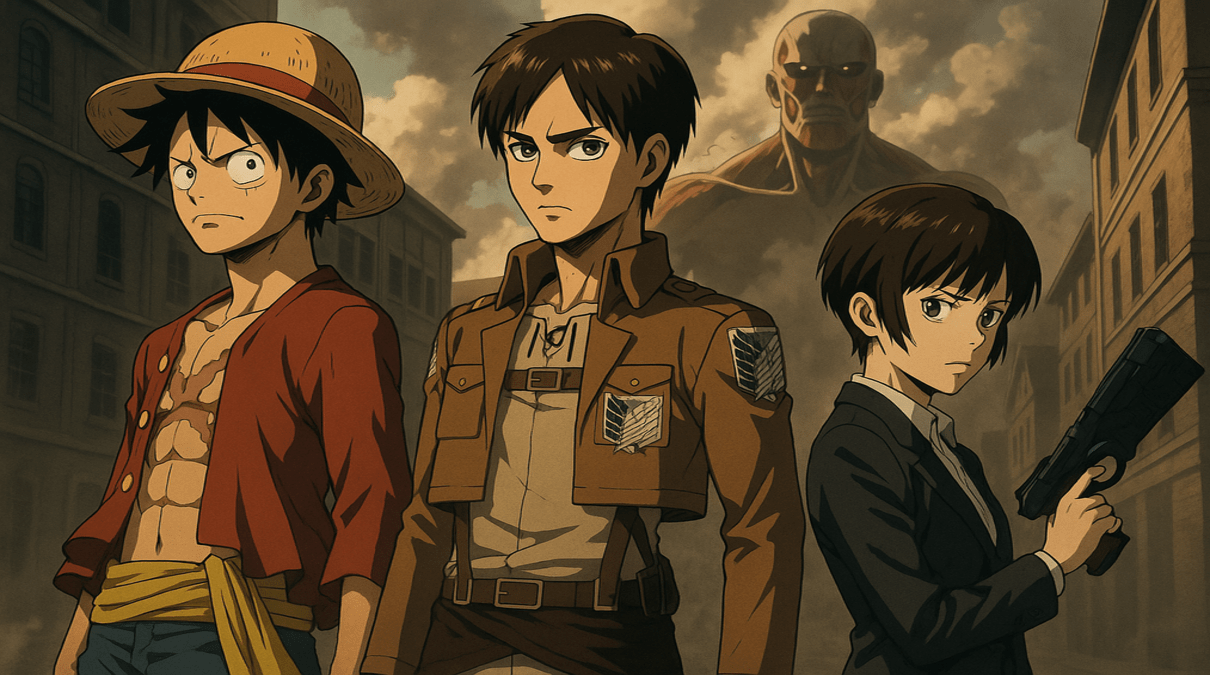
(Disclaimer: This essay contains spoilers for the following manga: One Piece, Attack on Titan/Shingeki no Kyogin and Psycho Pass).
I. Phases
One’s introduction to international law can occur in a variety of ways. Some are introduced through their life at home, some are part of the changing contours of international law, some approach it for the first time in their law school lectures or a moot, others like me get introduced to it through extra-curricular academic simulations in school like Model UNs. As the editorial piece in this segment rightly stated, one usually begins their journey into international law with hope. Trust in the process, systems and principles, many of which are agreed upon or supposedly have universal application. Once one realizes the implementation issues which plague the system, that hope turns into despair. However, there is another phase which many finally reach, indifference.
After the dust of law school settles, and the rhythm of everyday practice begins, international law and its ideals slowly drift into the background. No longer the grand, shimmering idea that once animated your imagination. It becomes something you mention in passing, perhaps while dissecting a headline about a global crisis with colleagues over coffee. The enchantment it once had of changing the world, and the resentment at it for not working, has faded. Just as not every love story finds its ending, not every admirer of international law lives within its practice, it survives only as a quiet belief, tucked away behind the urgencies of daily work. Fortunately for a few, fiction allows the romance to continue on the page.
Manga can serve as a source to re-ignites one’s imagination of international law. Not within the familiar confines of existing theory. But rather within these imagined societies, with their own sets of structure and logic, which allow you to consider hierarchical dynamics and power imbalances, that one usually does not imagine in the real world. It offers a new lens to interrogate existing beliefs on international law. To depict this re-imagination, this micro-essay utilizes the hermeneutic narrative approach, thus using realities far different from ours as mirrors to delve into the construction of law and order.
Commentators have contrasted international law with manga, re-imagining how principles from our reality would apply to the actions of the characters on the page (for example, a piece on the application of the Genocide Convention in the manga Attack on Titan can be found here). This micro-essay seeks to pursue a different aim, one which will not involve the specific discussion of any geopolitical events from the real world or traditional sources of international law. It rather focuses on how manga can turn our attention to the narrative architecture which scaffolds the legal order we live in. In fact, I had always been one to stick to doctrinal reasoning during my past entanglement with international law. Re-imagining it through manga offered a lens to explore how societies grounded in very different moral legitimacies from our own, construct their own versions of order, and how those internal logic translate into what led to the conceptualization of the legal order within their worlds. By bringing these frameworks backs into view, manga reminds us that even the most taken-for-granted legal truths are, at their core, narratives we once chose to tell, which we can choose to tell otherwise.
II. Nomos
Back in 1983, Cover wrote that we are part of a nomos i.e. a normative universe. He states that law relies on a set of narratives to sustain its authority. Such narratives control what we consider to be “order” and the means used to achieve this aim of “order.” A meaningful way to reflect on Cover’s nomos i.e. “order” built on narratives, is to examine a world with a different idea of “order” built on entirely different narratives.
The architecture of the World Government in the manga, One Piece, provides precisely such a contrast. In the One Piece universe, the “Great Kingdom” is destroyed by the Twenty Kingdoms during the “void century” (do keep this term in mind, it appears again), which then forms the World Government. The descendants of these royals have been given the title of “Celestial Dragons” and the World Government is run by the five highest-ranking Celestial Dragons, the Council. These “Celestial Dragons” have been given full and complete freedom to do whatever they wish, whether the act is legal or illegal for the other citizens. Further, the current time period is called the “Great Pirate Era”, as the name suggests, with lawless pirates dominating the seas. Since, the army of the World Government i.e. the Marines, had been unable to control the rise of pirates on all fronts, they have deputed some of their tasks to a group called the “Shichibukai” or the Seven Warlords of the Sea, who were, surprise-surprise, pirates themselves. These “Shichibukai” can do whatever they feel like in their own zones, with some running gambling rings and human auction houses, and they retain their position until they do not suffer a defeat.
Equally interesting is the concept of “void century” in One Piece. The World Government has banned all forms of research into this period of time and any actions to find out about it is considered as one of the “worst possible crimes,” apparently to prevent the revival of ancient weapons (doubtful). However, such powerful narrative is created to prevent disclosure of this period that even after knowing about the gap in historical record, everyone seems to believe that is it impossible to fill that gap.
One can clearly see how in this universe, the legal order is not determined by institutions or principles, but narrative. The legitimacy of the World Government and the Celestial Dragons rely on the narrative that they have created the current administration and era of stability, thus, are “Gods.” However, they ban any research into the era when it happened. This founding myth, never verified yet endlessly repeated, forms the moral core of the Government’s authority. By erasing the true history of that era and criminalizing any attempt to recover it, the regime ensures that its version of order remains uncontested. Even the deputation of pirates as “Shichibukai”, criminals legalized for the sake of convenience, extends this logic. The concept of “order” here accepts the “Shichibukai” actively running criminal enterprises for profit, like running human auction houses, as long they keep other pirates in check for the World Government. One Piece depicts how law can be bent to the narrative of preserving “order” at any cost.
III. Containment and Control
While One Piece sustains its world order through a narrative of myth, the manga Attack on Titan (also popularly known as Shingeki no Kyogin) creates a world which runs on the hierarchy of fear. The Eldians were a race who could transform into titans i.e. massive, colossal creatures capable of widespread destruction. The Eldian Empire went about conquering the whole world with these powers. Due to betrayal by the Eldian King Fritz, who was sick of the constant conflict and led the majority of the Eldians into seclusion, the remaining Eldians were taken over by the nation of Marley.
The nation of Marley made Eldians into second-class citizens for the historic atrocities their ancestors committed. However, what follows is a paradox, the same Marley which demonized the Eldians for having titan transforming capabilities, began using these Eldians for conquering other States. The Eldian containment and exploitation mirrors the mechanism through which modern legal systems create a picture of the “other.” Anghie has stated, albeit indirectly, that such a system of the “other” is used by colonial powers to rule over a group of people with the pretext of civilization but exploit these same people for the colonizer’s gain. Anghie argues that imperial sovereignty progresses by inflicting domination while speaking in a moral language. Power justifies itself through the very harm it claims to prevent.
Marley’s legal system is a textbook example of this logic, wherein Eldians are considered a danger to humanity and their status as “dangerous” justifies them being treated as second-class citizens, wherein if they even walk without their identification bands, they are brutally killed. While this same characteristic of them being a “danger” is used by Marley for their own advantage in conquering other States. Further, Marley rewards the Eldian’s who fight for Marley as “honorary Marleyans” who are trying to redeem themselves. Such a logic produces another paradox, as how does a class of people condemned for mass killing, redeem themselves by mass killing?
On another note, such a paradoxical treatment of Eldians, using them as indispensable instruments of war, while simultaneously despising them as existential threats, resonates with the treatment of migrant/foreign workers. Motomura’s assertions on how States commodify labor for economic benefits, while withholding belonging resonates with Marleyan policy. From a TWAIL lens, Pahuja argues that international law itself emerged from imperial practices that treated colonized peoples as productive resources within a global order that denied them sovereignty. The modern migrant regime finds a reproduction of Marleyan policy on a smaller scale, wherein migrant workers from the Global South maintain economies which simultaneously depend on and criminalize their presence.
IV. Surrendering to the Algorithm
If Attack on Titan exposes control and exploitation through fear, the manga, Psycho-Pass imagines a quieter tyranny with the willing surrender of the human mind to the algorithm. In the Psycho-Pass universe every person is monitored by a vast network which predicts criminality and stands as an omniscient adjudicator of morality called the “Sibyl System”. The Sibyl System constantly scans the “Cymatic Scan”of every citizen to determine their “Psycho-Pass”, which is a color-coded psychological index quantifying mental stability and “latent criminality” through a “crime coefficient.” When an individual’s crime coefficient exceeds a certain value, they are categorized as latent criminals even if no crime has been committed. Law enforcement officers have a procedural role wherein their weapons i.e. the “Dominators” use AI to connect with the Sibyl System and determine whether to stun or execute an individual depending on their crime coefficient.
What is most striking, however, is the late revelation that the Sibyl System is not an impersonal machine at all, but a network composed of human minds, specifically those of individuals whose psychological profiles cannot be read by the system. These people, considered to possess exceptionally high cognitive ability, are immune to its surveillance and occupy a position beyond its jurisdiction. They determine who is classified as a latent criminal and who remains innocent. Thus, while the system claims neutrality, it is built on the foundation of those it cannot measure.
This concealed collective, who determine crime coefficients while being inherently immune to their own determinations exemplifies what Johns describes as the management of order through systems that exist outside law’s accountability. Johns argues that such architectures are not merely regulatory voids, but a space for regimes of “expertise” to converge to produce governance not bound by the checks of legality. The Sibyl System operates in a similar fashion to contemporary technocratic institutions, which concentrate power within select members whose decisions are isolated from the accountability of their own systems. In this sense, the manga’s revelation reflects the real-world paradox of global governance wherein regimes of expertise claim impartiality while operating beyond the reach of the very norms they enforce.
On another note, while discussing the Sibyl System, one cannot help but connect it to the current debate on autonomous weapon systems with commentators echoing the insufficiency of current legal frameworks, especially IHL to regulate these systems (this subject has been discussed on this blog here and by the author in chapter 16 here).
Furthermore, what is particularly introspective is that the people in the manga, Psycho-Pass have wholly internalized the authority of the Sibyl System. In a world where employment, social standing and even personal relationships depend on the color of a person’s Psycho-Pass, people are self-disciplined into compliance. At this point, one is reminded of Hart’s discussion that law’s legitimacy does not depend on the correctness it might attract from a reasonable standpoint, but on the acceptance of the people who live under that law.
Hart asserts that individuals possess an “internal point of view”, wherein rules are not followed as a result of coercion, but by those rules being regarded as a standard of behavior that the individual internally believes must be complied. The faith of the citizens in the Sibyl System reflects Hart’s notion of the “internal point of view,” where individuals follow rules not because they are coerced but because they regard them as standards of behavior. The individuals have reached a stage where those questioning the Sibyl System itself are viewed as problematic and the idea of an individual existing outside the purview of the system is unimaginable, whilst the system itself is run by those outside its scope of accountability. The pursuit of psychological purity becomes both a civic duty and a condition for survival. In effect, coercion is replaced by self-regulation, what Foucault describes as the internalization of surveillance and the transformation of power into habit. The result is a society in which obedience is no longer enforced by fear of punishment but by the quiet compulsion to remain legible to the system.
Such a reflection becomes particularly striking in the present age, where AI systems are increasingly being proposed as tools for legal adjudication and decision-making. What demands closer scrutiny is not merely how these systems function, but who determines the data that governs them. In Psycho-Pass, it was the minds that the system itself could not judge that dictated how others were judged. Similarly, in our world, those who design, train, and regulate decision-making AI may come to shape the very contours of the rule of law.
V. Convergence
Each of these manga universes reveal, in their own way, how order is framed beyond the traditional set-up of formal rules and through narratives that sustain belief in its necessity. One Piece exposes how law can be shaped by myth and stories a regime tells to justify its power. Attack on Titan reveals how that power endures through fear. Psycho-Pass shows the next evolution in a world where belief is placed in calculation, the same belief bordering on such epistemic submission that no one even thinks of considering what factors are driving these calculations.
The purpose of this piece is to depict how everyday fiction like manga can make one re-connect with international law and experience it by contrasting different worlds, different narratives and different conceptions of order. Within our own normative reality, we live through narratives so deeply woven into the fabrics of our comprehension that they have become invisible. Cover and Koskenniemi have asserted that law’s authority is derived not from its textual precision but from the narratives that sustain its moral coherence.
These narratives provide the guiding light for what constitutes peace, progress and legitimacy, and while there is no denying that they can serve a positive purpose, they end up limiting what we can imagine as alternatives. To step outside of them and confront different worlds built on varied moral and logical structures allows us to step outside this fabric and see its seams. Such reckonings allow us to push the boundaries of our thought to remind us that every legal order, however rational it appears, is only as enduring as the narrative it refuses to question.
In that sense, reading international law through manga is not about re-enchanting the law through stories of magic and adventure, instead it does so by making the structures which govern us more visible. It invites us to see beyond treaties and judgments and to confront how stories, both real and fictional, shape what we call order. Perhaps that is how the enchantment returns, by recognizing and accepting the vulnerabilities international law suffers from, and through that acceptance, re-imagining its possibilities.
Ahan Gadkari is an associate at MGCO Advocates. He formerly served as an Editor at JFIEL (2022-2023)
Picture Credit: The image is AI-generated.
 Jindal Forum for International and Economic Laws