
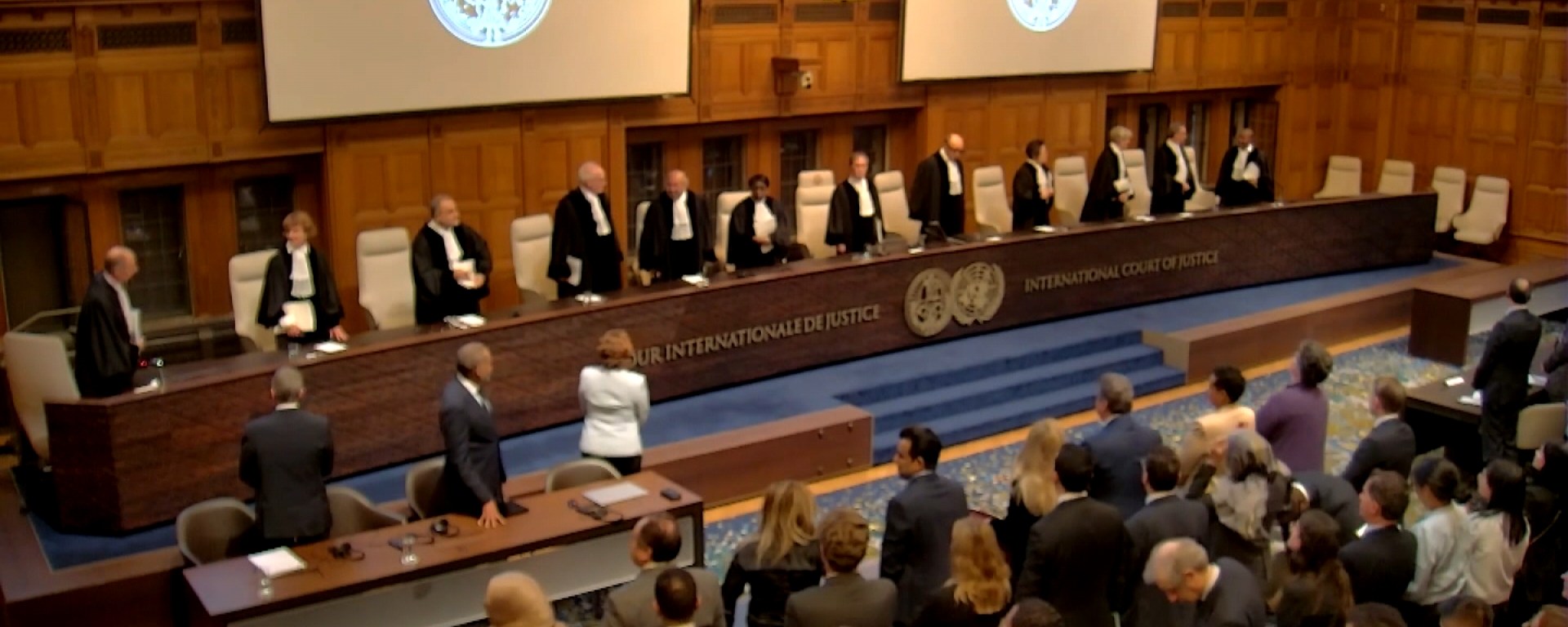
The International Court of Justice (ICJ) Advisory Opinion on the Legal Consequences of Israel’s Policies and Practices in the Occupied Palestinian Territory, including East Jerusalem, is a landmark verdict in international law. The Opinion establishes the illegality of Israeli settlement policy but also reaffirms the binding character of the States to uphold the principles of territorial sovereignty, self-determination, and non-acquisition of territory by force. Whereas most of the debate appropriately centered on Israel’s obligations and the Occupied Palestinian Territory’s legal status, one key remains in the third-party States’ and international organizations’ obligations and roles.
The Court specifically referred to the obligation of States not to recognize “the illegal situation” brought about by the ongoing settlement activities and not to provide aid or assistance in perpetuating the situation (para. 159). This raises serious questions about the extent and realization of such third-party obligations, particularly in an international political order where political will, more than strict legal coercion, is generally the determinant of compliance. The Opinion therefore calls for closer examination of how principles of state responsibility and customary international law interact with international cooperation and collective enforcement approaches.
This article seeks to embark on this overlooked but crucial aspect of the Advisory Opinion by examining third-party responsibilities, enforcement challenges, and possible compliance measures.
Third-Party Legal Responsibilities
One striking and often-neglected feature of the ICJ Advisory Opinion is its definition of States’ responsibilities beyond the immediate parties to the occupation. The Court was particularly keen to highlight that third States have independent legal obligations under public international law, mainly not to recognize and assist the illegal situation brought about by Israel’s settlements. According to the Opinion, “States are under an obligation not to recognize as lawful a situation brought about by the illegal conduct and not to give aid or assistance in perpetuating that situation” (para. 159).
This is premised on general international law on the responsibility of States, which demands that no State should aid another in the commission of internationally wrongful acts. The Opinion therefore brings established norms into harmony with the particular circumstances of occupation and territorial integrity, underscoring the perception that complicity in violations of international law constitutes a violation.
The Advisory Opinion mentions the issue of international organizations’ responsibilities, in particular those of the United Nations. They are reminded of their responsibility not to declare the settlements illegal and to adopt sufficient steps within their sphere of competence to verify compliance (para. 178). This is a reflection of obligations under the UN Charter on Member States and organs to uphold international peace and security.
Yet these bans on recognition and aid raise difficult issues about their functional application. What is “recognition” or “assistance” in an age of deep political, economic, and diplomatic intercourse is far from self-evident. This ambiguity is not new: the same questions arose in the 2004 Wall Advisory Opinion, where the ICJ similarly required third States to refrain from recognizing or assisting the illegal situation. As several commentators have noted, the obligation of non-recognition, though grounded in customary international law and affirmed in the Court’s Namibia opinion, lacks precise operational guidance. Academic works have attempted to unpack the meaning of “recognition” by distinguishing between formal and implicit forms, examining whether activities such as economic cooperation, trade flows, or diplomatic engagement could amount to assistance. Others argue that without clearer criteria, States can selectively interpret these obligations in a manner consistent with their political and economic interests. This reveals a fundamental problem: although the obligation appears strong at the level of principle, its implementation requires a doctrinally informed framework capable of differentiating between lawful interaction and impermissible support. The challenge therefore lies not merely in reiterating the obligation, but in articulating workable standards that States can reasonably follow and that international institutions can monitor. How extensive are such obligations when third States have diverse political stakes?
By invoking the third-party obligations directly, the Court widens the scope of responsibility and conveys the importance of universal observance of international law. Yet the enforceability of these obligations lies in the volition of States and organizations, and hence there is a need to explore mechanisms that can bridge the gap between legal obligation and actual compliance.
Enforcement Mechanisms and Challenges
Although the ICJ Advisory Opinion self-evidently establishes third-party obligations in the context of the Occupied Palestinian Territory, it also necessarily emphasizes the challenges of their enforcement in reality. International law conventionally is dependent on States’ good faith observance, diplomatic negotiation, and political pressure for implementation. However limited binding enforcement mechanisms do exist; most notably, Security Council resolutions adopted under Chapter VII of the UN Charter, which are obligatory for all Member States.
The Court refers to general principles of state responsibility, such as the prohibition of assistance in maintaining an internationally wrongful act. However, while such principles define obligations, there is no centralized enforcement mechanism or reparatory body with the power to compel compliance globally, the Security Council’s authority to take measures under the UN Charter remains limited and often constrained by political considerations.
States, regional organizations and the United Nations, may resort to sanctions or collective measures within their respective legal competences. While Security Council-mandated sanctions require political consensus and are often blocked by geopolitical alignments, this does not exhaust the enforcement toolkit. States retain the sovereign prerogative to impose unilateral or coordinated sanctions, and regional organizations such as the European Union and African Union, or the regularly adopt sanctions regimes without Security Council authorization. Although the Organization of American States does not have a formal sanctions regime, it has taken regional collective measures, including the suspension of member state participation that function as political sanctions.
These decentralized forms of enforcement, grounded in domestic or regional legal frameworks, demonstrate that meaningful action does not always depend on formal UN mechanisms, although their effectiveness varies considerably depending on political will and state capacity. The Advisory Opinion’s focus brings normative expectations underlining the interplay between legal obligations and political realities.
Additionally, the Opinion responds to the legal difficulty of determining what shall be considered “recognition” or “assistance” in each of its many forms, whether economic, political, or military. Such vagueness makes it problematic for monitoring and ensuring compliance since States may do things which provide indirect assistance to the illegal situation without necessarily violating the obligation not to recognize or assist directly.
This gap in enforcement requires fresh ways of ensuring accountability. Potential options lie in greater recourse to international judicial institutions, enhanced mandates for regional organizations, and innovative use of universal jurisdiction on individuals involved in violations. The Opinion, in upholding norms, thereby reveals the imperative to close the gap between legal norms and means at disposal to ensure them.
Innovative Avenues for Compliance
In light of the enforcement difficulties brought to fore by the Opinion, there is increasing acknowledgement that conventional mechanisms on their own might not be adequate to guarantee third-party compliance with their legal commitments. This fact necessitates out-of-the-box measures that use legal as well as political mechanisms to boost accountability.
One likely direction is through the increasing application of international judicial tools outside of the ICJ. For instance, universal jurisdiction by national courts could potentially hold persons or entities accountable for enabling violations, indirectly enforcing third-party obligations.
Regional institutions may play the most important role in operationalizing compliance as well. Their tools such as sanctions, resolutions, monitoring mechanisms, and suspension of membership provide avenues for collective pressure that do not depend on the Security Council. Their localized influence and tailored sanctions can be more effective. The reference to the UN’s role by the Opinion suggests that multilateralism remains supreme but must be reformed to overcome veto-politics and make it more responsive.
Advances in technology and greater transparency provide new weapons. While improved monitoring can expose the movement of arms or dual-use goods that enable an unlawful situation, this alone does not clarify the allocation of responsibility. States bear primary obligations under international law, but corporations and individuals occupy an uncertain space: their liability often depends on domestic laws, and only rarely do their actions amount to crimes under international law. This fragmented responsibility structure means that monitoring, though useful, does not automatically translate into enforceable accountability unless linked to specific legal regimes- sanctions, export controls, or criminal prosecutions. While these mechanisms expand the landscape of potential responses, their legal basis varies considerably, and not all of them fit neatly within the traditional doctrinal framework of international law; many operate more as political or practical tools than as strictly legal enforcement mechanisms.
Lastly, the Opinion itself calls for reflection on the norm-generative capacity of international law, how norms in the law influence State conduct over time through persuasion, reputation, and building a rules-based order. Encouraging diplomatic discourse, public campaigns, and global solidarity movements can reinforce official actions, incrementally leading toward increased compliance.
Although these methods are not a silver bullet, together, they might help to substantially bridge the enforcement gap highlighted by the ICJ, making pronouncements in law more effective realities on the ground.
Policy and Scholarly Implications
The ICJ Advisory Opinion’s focus on third-party legal obligation and the consequent enforcement issues opens up significant considerations for both policy and academia. From a policy point of view, the Opinion sets out a normative standard for States and international institutions beyond the immediate parties in the Israeli-Palestinian dispute, the Israeli and Palestinian leaders emphasizing the collective nature of compliance with international law.
This extension of responsibility requires States to review diplomatic approaches and foreign policies that in turn could be implicitly condoning or facilitating violations of international law. Governments have to navigate in tension between political stakes and their international legal obligations, particularly with respect to economic cooperation and recognition. International organizations can improve mandates and monitor and sanctioning mechanisms for violations in order to enhance legal compliance and international governance.
Academic literature gains from this wider scope also, especially in the area of representing state responsibility, international enforcement, and the relationship between international law and politics. The Opinion encourages a closer study of the enforceability of customary international law in forcing State conduct, and this question is raised on how norms in the law are internalized and institutionalized in various actors.
Additionally, the ICJ’s vagueness concerning the operationalization of third-party obligations is fertile soil for doctrinal progress and empirical inquiry. Discovering creative models of enforcement, such as the functions of non-state actors and transnational judicial procedures, enriches theoretical analysis and practical suggestions to strengthen international legal accountability.
Conclusion
The ICJ Advisory Opinion on the Legal Consequences which follow from the occupation of Palestine by Israel is an important reaffirmation of basic international legal principles and a call to collective responsibility. Although a great deal of focus has been on the duty of Israel in the immediate sense and the fate of the Occupied Territory, the expression of third-party legal obligations in the Opinion considerably widens the scope of accountability.
Yet, this growth also comes with deeply rooted enforcement deficits and the complex realities which underlie compliance in international law. The challenges of defining, monitoring, and enforcing third-party obligations underscore the imperatives of innovative solutions blending legal, political, and technological options.
Lastly, the Opinion provokes deeper academic and policy research with how the global community can implement such legal principles in practice, achieving the balance between normative ideals and functional mechanisms. These challenges have to be met for the rule of law to be preserved, vulnerable groups protected, and collective peace and justice to be promoted.
Diksha Singh is a third-year law student at National Law Institute University, Bhopal.
Picture Credit: UN Media
 Jindal Forum for International and Economic Laws