
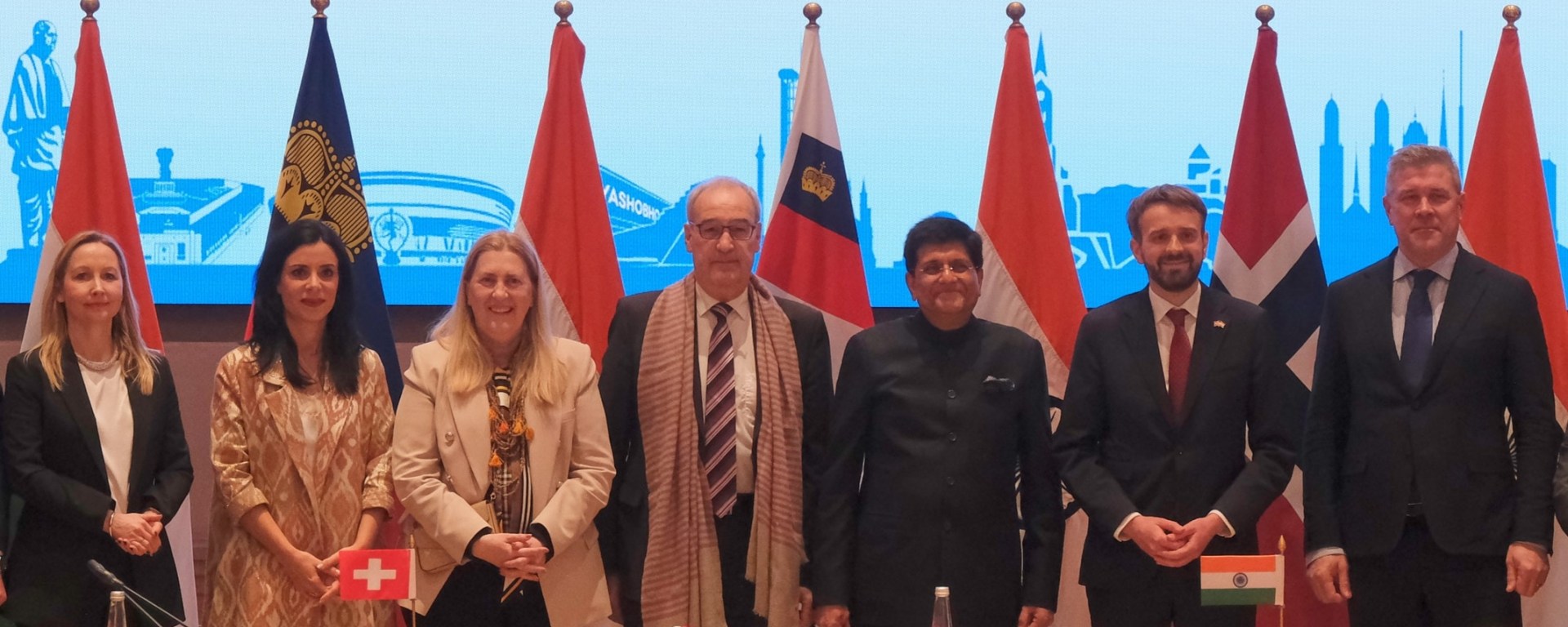
Recently, a free trade agreement, the Trade and Economic Partnership Agreement (TEPA), was signed between India and the European Free Trade Association (EFTA), taking effect on October 1, 2025. This agreement was formally signed in March 2024 following a 17-year-long negotiation. The first round of discussions took place in 2008, when an attempt was made to develop an economically pioneering agreement that would benefit both parties further in terms of economic development. The European Free Trade Association comprises of four state members: Iceland, Liechtenstein, Norway, and Switzerland, with the aim of promoting free trade and financial integration among its members and with other globally oriented countries. This marked India’s first significant trade deal with developed economies in over a decade, with a massive investment of $100 bn promised over 15 years. However, even after all these efforts, one of the biggest questions that persists is whether this deal will come as a game-changer for India’s export and import sectors, or whether it will be an adjustment that outweighs the benefits.
India–EFTA TEPA: Deal at a Glance
TEPA has been generally characterized as innovative and forward-looking trade agreement and is the first-ever broad and large-scale Indian free trade agreement with four developed European economies namely Switzerland, Norway, Iceland, and Liechtenstein. The Indian government has framed the agreement as a historical move to diversify trade relations with developed economies especially in this period when the global supply chains are going through rebalancing processes. According to the invitation by the Commerce Minister Piyush Goyal, TEPA has a promise of USD 100 billion in foreign direct investment in fifteen years, which can create one million jobs as direct employment. The conscious avoidance of foreign portfolio investment is a strategic choice of long-term and stable capital inflows to promote technology transfer, manufacturing depth and job creation as opposed to financial turmoil in the short-term. The agreement is strictly coordinated with the Make-in-India programme, which will empower domestic manufacturing and provide Indian exporters with a systematic entry into the European market and the world market. Of particular importance is the role of Switzerland in which more than forty percent of its trade is directed into the European Union, making TEPA an indirect entry point of Indian companies into the broader EU value chains.
The agreement has fourteen chapters that touch on the following aspects; goods, services, investment, intellectual property, trade facilitation, SPS and TBT measures, and sustainable development. However, its focus is mostly at the access of goods in the market by liberalizing tariffs, cooperation in customs, and rules of origin, which are vital in avoiding deflection of trade as well as true value addition. EFTA has made tariff concessions on 92.2 percent of its tariff lines, 99.6 percent of Indian exports and India has done so on 82.7 percent of its tariff lines, 95.3 percent of EFTA exports. Meanwhile, the sensitivity of the dairy, soy, coal, selected agricultural products, and the gold duties are not listed, which indicates that India is very careful with both the openness and domestic economic and rural stability.
In addition to goods, TEPA liberalizes services in 105 sub-sectors and promotes the delivery of trade in digital format, commercial presence, and professional mobility. Mutual recognition of qualifications provisions promotes labor mobility and cross-border cooperation, and TRIPS-level intellectual property undertakings (without patent evergreening) safeguard the generics ecosystem of India and prioritize the public health concerns. Sustainability and technology-cooperation provisions give additional indication on the transition of tariff-based trade to more integration in global-value chains, which is in line with sustainable and long-term competitiveness and industrial transformation in India.
Winners and Losers: India’s Economic Recalibration under the India–EFTA Trade Partnership
According to the model of an India-EFTA Trade and Economic Partnership Agreement (TEPA), the changing trade environment exhibits a subtle interface of gains in the sector and adjustments pressures. On the positive side, one among the major beneficiaries is the pharmaceutical sector. It is already a large drug supplier of generic drugs to Europe with India making a huge percentage of off-patent drug use in various EU markets. Liberalized tariff and regulatory environment under TEPA will make India better connected with the high-income EFTA economies, and exporters will be able to move beyond the volume-oriented trade to the higher value formulation, and contract manufacturing to the advanced markets.
Textile and clothing industry is no exception and is well placed to gain more especially because India has a comparative advantage in manufacturing which is labor intensive. The downward labor costs enable Indian manufacturers to be price-competitive as European consumers resort more and more to sustainably produced and ethically sourced clothing. TEPA enhances the predictability of the market to the exporters and aligns the Indian producers to European sustainability standards that increase their competence in high-end market. Likewise, engineering goods and auto parts manufacturers will also benefit as the demand in the EU-equivalent markets will increase due to the growing manufacturing environment in India, and the support of the policy, in the form of initiatives like Make in India and production-linked incentives. There are also good complementarities in the IT and services industry, especially on artificial intelligence, fintech, and green technologies, where India with its digital talent pool can merge with EFTA advanced innovation platforms.
These opportunities however come with adjustment challenges. Livestock and agriculture producers might be exposed to competitive influences of highly subsidized and advanced in terms of technology Swiss and Norwegian producers in case of tariff barriers mitigation, thus capable of influencing rural livelihoods. The short-term impact of the rise in imports of luxury goods like watches, precision equipment and advanced machinery could lead to the widening of the trade deficit in India. This is likely to push small and medium enterprises to face more compliance expenses because of strict intellectual property, quality, and technical standards in EFTA economies. Moreover, fluctuation of currency, especially the fluctuation of rupee against Swiss franc and euro may undermine the competitiveness of exports and margin stability.
Beyond TEPA: India’s Strategic Leap in the Global Trade Arena
The India-EFTA Trade and Economic Partnership Agreement (TEPA) is not just another isolated economic event; it is a landmark in India’s evolving trade structure. In light of the continuous negotiations with the United Kingdom, the European Union, and the Gulf Cooperation Council (GCC), TEPA reflects New Delhi’s aspiration to expand the range of partnerships and assert a more prominent voice in global value chains. This external strategy will ensure access to the market, attract high-standard investments, and match domestic industries with international standards of competitiveness.
The changes in global economics contribute greatly to the relevance of TEPA. The China+1 strategy is being hastened by the post-pandemic supply chain realignment and increasing geopolitical uncertainties in which India is becoming a plausible manufacturing and service alternative. TEPA reinforces this by providing EFTA investors with regulatory stability, long-term investment guarantees and a secure market access. At the same time, the introduction of artificial intelligence and automation is radically changing the world cost base, which could undermine the traditional IT and back-end service labor-based competitive advantage of India. The fact that TEPA has focused on technology cooperation, more advanced skilling, and higher valuable service is thus paramount to maintaining competitiveness of India by means of innovation and not cost arbitrage. Furthermore, sustainability and green trade especially in Europe have increased environmental and compliance standards with the increase in their level of focus. Although these requirements raise the adjustment costs of Indian exporters, the sustainability provisions of TEPA serve as an impetus towards cleaner productions, better governance and greater penetration into superior international markets.
To achieve the long-term success of the India-EFTA Trade and Economic Partnership Agreement, the government, industry, and micro, small, and medium enterprises should coordinate their efforts. The government is to focus on mass investment in workforce skilling, reinforce institutional enforcement of trade, and create means against currency volatility. Creation of export facilitation and digital trade service centers would also make India more competitive in the global market. In a bid to make ‘Made in India’ a symbol of quality, sustainability, and innovation, rather than just cheap manufacturing, the industry should put efforts into upgrading its technologies, diversifying its products, and repositioning its brands. In the meantime, MSMEs will require specific assistance to be integrated into global value chains, including support with technical standards, access to credit, and the integration of digital operations. All of these measures will create a more flexible and future-proof trade ecosystem.
Conclusion
The India-EFTA Trade and Economic Partnership Agreement are not a one-time spurt in trade and investment, but a long-term investment in competitiveness and structural change. The true potential behind it is that it helps India become more embedded in global value chains and also provides sufficient protection to vulnerable sectors. The real winners in an era of global trade will be those who adapt the most in a world where technological disruption, environmental standards, and financial volatility shape the landscape of international trade. TEPA therefore remains a roadmap to the next stage of economic development in India based on resilience, innovation and collaboration globally.
Shubham Shrivastva is a third-year law student at Dharmashastra National Law University, Jabalpur.
Picture Credit: Efta.Int
 Jindal Forum for International and Economic Laws