
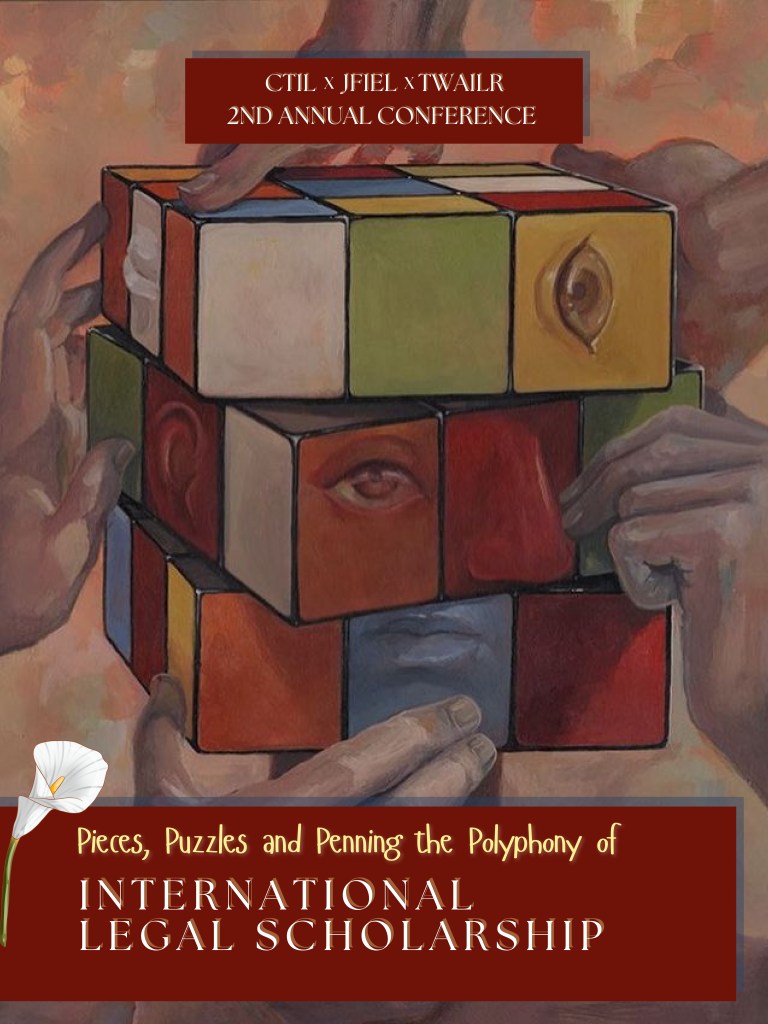
A Foreword: Our 2025 Conference
Every time we sit down to write about international law, we feel its weight – its promises, its paradoxes and its politics. It is a discipline that supposedly speaks the language of universality, and yet, so often, invisibilizes a plethora of identities. Our histories, our contexts, our concerns are often missing from its dominant narratives. Even within these constraints, however, there remain opportunities to imagine otherwise – to speak, to write, and to engage with international law not as a fixed object, but as a contested space of possibility.
Our 2025 Conference, titled ‘Pieces, Puzzles, and Penning the Polyphony of International Legal Scholarship’, has been conceived with this ethos in mind. We recognize that international law today is perceived through multiple, sometimes conflicting, vantage points. Doctrinal analysis, economic interpretations, and institutional analysis coexist with feminist, Marxist, TWAIL, Fourth World, and decolonial perspectives, amongst others. Each brings to the surface distinct commitments, critiques, and imaginaries. In this landscape, no single narrative suffices. What is needed is a polyphony – of voices, traditions, and positionalities, that acknowledges this complexity.
As a student-led platform based in the Global South, JFIEL has long been attentive to the exclusions that mark international law’s formation and operation. But we are equally invested in the generative act of writing for international law, not merely critiquing its failures, but engaging with it as a site of reform, resistance, and reimagination. To write, after all, is to participate. It is to make an intervention, however modest, into how the law is thought, taught, and practiced. It is to challenge the invisibilization of certain peoples, histories, and claims. It is to affirm that international legal scholarship, when plural and grounded, can speak to the urgencies of our world.
In curating this space, we are guided by the belief that the journey from partial to fuller knowledge (Rohini Sen, 2024) is only possible through inclusion and listening – of those at the centre, and those long left out. We see this conference as one step towards building a more inclusive and reflective community of international legal scholars. Importantly, a community where disagreement is welcomed, positionalities are acknowledged, and diverse epistemologies are given room to flourish.
From 26th to 27th April 2025, we were privileged to host a series of conversations, papers, and provocations from students, scholars, and practitioners who responded to our call to ‘piece together’ international law in all its disorderly richness. Whether through doctrinal engagement or critical interrogation, participants shared insights that not only revealed the puzzles of the discipline, but also pointed to its potential.
Introducing the 2025 Symposium
The first panel titled ‘Reclaiming Economic Governance in Climate, Labour, and Digital Governance,’ critically examined how international economic frameworks continue to perpetuate systemic inequities affecting the Global South.
Dr. Vinayak Jhamb and Nitika Upadhyay, Assistant professors at VIPS, opened the discussion by analyzing the persistent disparities in climate financing, emphasizing that despite minimal historical emissions, developing countries disproportionately suffer climate impacts. They highlighted how the Global North’s failure to fulfill financial commitments necessitates cooperation among vulnerable states to pursue environmental justice, positioning climate governance as a crucial site for reclaiming economic agency. This theme of external dominance was echoed by Piyush Singh and Manasvi Pant, undergraduate students from Nirma University, who examined digital globalization in China and Africa. They argued that tech superpowers exploit weak legal frameworks in the Global South, leading to infringements on sovereignty and privacy.
Continuing the critique of economic power imbalances, Alaknanda Mishra, an LLM Student at South Asian University, focused on ISDS mechanisms that disproportionately favor investors, often from developed countries. This bias undermines the regulatory autonomy of developing states, exemplified by costly energy-sector claims in South Asia. Similarly, Rongeet Poddar, a PhD Candidate at WBNUJS, critiqued how labour rights are systematically undermined by IFI conditionalities that prioritize capital accumulation over worker welfare, reflecting a modern iteration of colonial-era labour suppression.
Concluding the panel, Kamya Vishwanath, a Young Professional at the Centre for WTO Studies, questioned the neutrality of international technical standards under the WTO TBT Agreement, highlighting their neocolonial resonances and their tendency to impose compliance burdens on developing countries.
The second panel titled ‘Human Rights at (in?) the Margins: Cultural Reservations and Regional Responsibilities’ addressed the challenges of safeguarding human rights within diverse cultural and regional contexts.
The first paper, by Sumaiya Mohammad Ahmad, a PhD Candidate at JNU, examined how OIC member states interact with the UNCRC, highlighting reservations linked to Islamic legal principles.. The study revealed a tension between universal human rights standards and religious interpretations, ultimately underscoring a Muslim World’s Approach to international obligations. Shifting focus to South Asia, Apoorva Vijayvargiya, undergraduate student at ICFAI University, critiqued the systemic violence against marginalized communities and emphasized the absence of a dedicated regional human rights mechanism. She argued that robust regional frameworks are essential for addressing discrimination and promoting accountability.
The third panel titled ‘The Violence of Development and Reconfiguration of Humanitarian Law’ examined how development, particularly technological advancements in warfare and resource extraction, perpetuates violence against marginalized communities, highlighting the limitations within existing legal frameworks.
The first paper, by Ishita Ghosh, Academic Fellow at NLSIU, argued that lethal autonomous weapons systems (LAWS) perpetuate colonial power structures embedded within international law. She illustrated how the development and use of LAWS, primarily by Western states, reflect historical patterns of exclusion and violence against non-European populations. Drawing parallels between colonial weaponry and modern LAWS, she highlighted the racial and regional biases inherent in technological advancements. Taking forward, Vedant Gupte, undergraduate student at DNLU, examined how states in the Global South use civilian vigilante groups to facilitate resource extraction while bypassing international humanitarian obligations. Using the Salwa Judum case in India, demonstrated how hybrid actors exploit legal ambiguities to commit violence against indigenous communities, revealing gaps within IHL when addressing such state-supported conflicts.
The fourth panel titled ‘Who Speaks the Law? Interpretation, Power, and Culture in International Justice’ explored how cultural contexts, power dynamics, and interpretative practices shape international law.
Suhani Agarwal and Akansha Daki, undergraduate students at Pravin Gandhi College of Law, argued that international law often reflects Western cultural norms rooted in colonial legacies. They contended that frameworks like the UDHR risk being perceived as universal while overlooking cultural diversity, advocating for a culturally pluralistic approach to enhance legitimacy and compliance. Nittyam Modi and Kashvi Choudhary, undergraduate students at JGLS, critiqued neutrality in international law as selectively applied to favor powerful states. They argued that neutrality, traditionally seen as impartiality, is often manipulated to maintain the status quo, disadvantageous to Global South states. Finally, Shashwat Singh, an LLM Student at Rashtriya Raksha University, examined how international courts often conflate determining and interpreting law, with interpretations shaped predominantly by Western legal traditions, thereby reinforcing power imbalances in shaping legal norms.
The fifth panel titled ‘Rethinking Resource Ownership and Obligations From Above, Beyond And Beneath’ critically examined how international law governs resources across diverse domains – the earth’s surface and atmosphere (“Above”), outer space (“Beyond”), and the deep seabed (“Beneath”).
Aditya Bhura, undergraduate student at Amity University, initiated the discussion by analyzing the “Common Heritage of Mankind” (CHM) principle. While intended to promote equitable resource distribution, CHM governance, such as UNCLOS for seabed mining and the Moon Agreement for space resources, disproportionately benefits technologically advanced states, leaving the Global South with minimal influence and bearing environmental burdens. His critique of structural inequity set the stage for the subsequent analysis of space governance. Building on this, Gauri Lachiramka and Avani Bhandari, undergraduate students at JGLS, highlighted the risks of space commercialization, where agreements like the Artemis Accords allow powerful nations to claim cosmic resources. Khushi Doshi, undergraduate student at JGLS, examined similar inequalities within climate governance. Just as in deep-sea and space contexts, technology essential for addressing climate change remains concentrated in the Global North, restricting access for the Global South and reinforcing historical disparities.
The sixth panel titled ‘Critique as Praxis: Power, Knowledge, and the Coloniality of International Law’ brings forth a nuanced examination of how international law, often perceived as a neutral and universal force, is deeply entwined with colonial power structures and knowledge systems.
Dikshit Sarma Bhagabati, PhD candidate at Cambridge University, set the stage by questioning the universality of human rights, highlighting their imperial roots. Through ethnographic insights from Ladakh, Bhagabati showed how marginalized communities strategically deploy human rights language to reclaim agency and recognition, not as a mere adoption of legal doctrines but as a reimagining of justice from within their own contexts. Dr. Sudhir Verma, professor at JNU, and Saniya Khanna, researcher for the Permanent Mission of Qatar to the WTO, argued that the purportedly universal norms in international law mask power asymmetries, particularly reflecting the Global North’s dominance. Both pieces challenged the assumption that international law’s universality naturally aligns with justice.
This critique deepened when we turned to Sarah Mathew and Vaibhaw Raj, undergraduate students at Christ University, demonstrating how colonial legal codes, framed as modernizing tools, continue to shape South Asian legal systems, revealing a troubling continuity between colonial control and postcolonial governance.
Finally, Dr. Bhanu Pratap, Assistant Professor at University of Lucknow, closed this conference with his piece which further interrogated the conceptual foundations that underpin these structures. By critiquing how European spatial logic and proprietary frameworks shaped international law’s core concepts, Pratap revealed how sovereignty itself became a colonial tool to legitimize control.
Acknowledging our Gratitude
As we reflect on the 2025 JFIEL Conference, we are filled with a deep sense of gratitude. Bringing this event to life was not just an academic endeavour but a collective effort marked by commitment, passion, and unwavering support from a community that believes in the spirit of dialogue and scholarship.
First and foremost, we are profoundly thankful to our Faculty Coordinator, Professor Mahima Balaji, whose unwavering patience and guidance was instrumental at every step of this journey. We also owe a special debt of gratitude to our Faculty Advisor, Professor (Dr) Rohini Sen, whose insights shaped the conference theme and whose support remained constant throughout. Much of this conference was conceptualised in Professor Rohini’s magical classrooms in her elective course the ‘Many Faces of International Law’ and through our engagements and conversations surrounding the infinite pool of material she has exposed us to. We are also grateful to our Faculty Director, Professor (Dr) Pallavi Kishore, for her belief in JFIEL’s vision, and Professor (Dr) S.G. Sreejith for playing a pivotal role in helping us shape the theme with numerous comments.
We are truly indebted to our commentators for the six panels, whose expertise and thoughtful engagement significantly enriched the discussions. Our sincere thanks go to Professor Mahima Balaji, Professor (Dr) Rohini Sen, Pushkar Reddy (Co-Founder), Professor Rahul Mohanty, Professor (Dr) Rohit Roy, Professor (Dr) Kasim Balarabe, and Professor Thibault Weigelt. Their perspectives and feedback added depth to the conference proceedings, fostering a space for critical and constructive discourse.
We also extend our gratitude to our esteemed partners, TWAILR and the Centre for Trade and Investment Law (CTIL), for their collaboration and support. Their association with the conference greatly enhanced its reach and impact. We are also extremely grateful to our panellists, and all those who have engaged with the conference by submitting their abstracts and sharing with us their ideas, your trust and faith in our initiatives mean the world to us.
We would like to acknowledge the remarkable efforts of our exceptional team of Editors: Charunivetha, Marushka, Smruti, Nandana, Vishnu, Akshath, Shuban, Shefali, Hayagrivaa, and Pranav, whose commitment and hard work were pivotal in bringing this conference to fruition. We also express our sincere appreciation to Abhijeet Shrivastava, former Editor-in-Chief, and present director, for his invaluable assistance in reviewing papers and providing insightful feedback during the workshop. As we continue to cherish beautiful memories from this conference, we also eagerly wait to see the places the next team takes the forum’s initiatives.
Signing off, with our warmest regards to the forum, its mentors, and supporters,
Adithi Rajesh and Garvit Shrivastava
(Editors-in-Chief, 2024-25)
The brochure and primary design for the 2025 JFIEL Conference have been created by Nandana Nebhu and Sriraksha Murali.
 Jindal Forum for International and Economic Laws