
Introduction: The Concrete Challenge to a Paper Doctrine
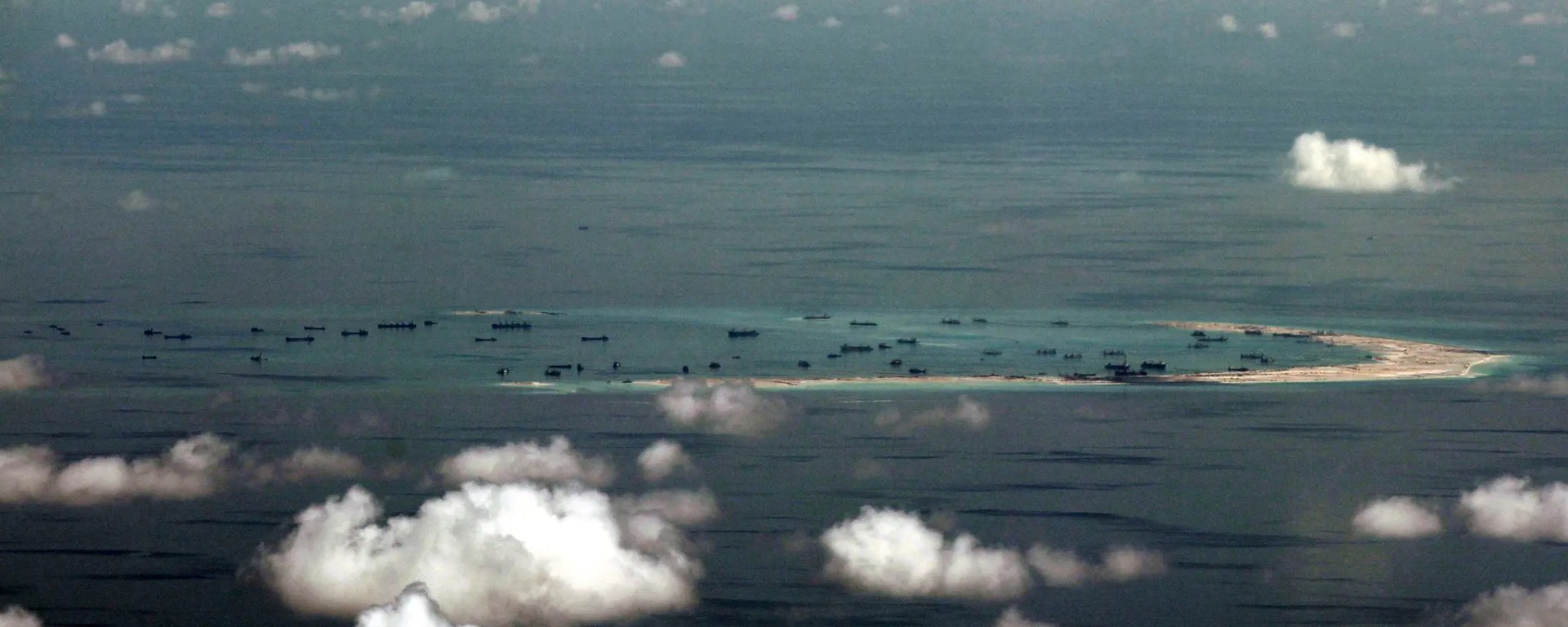
In the vast expanse of the South China Sea, a new reality is taking shape. Upon what were once submerged reefs and shoals in the Spratly Islands, China has engineered a series of sprawling island fortresses. Sophisticated military outposts now sit on Fiery Cross, Subi, and Mischief Reefs, features that were previously underwater at high tide. Each is equipped with 3,000-meter runways capable of handling any aircraft in the Chinese fleet, deep-water ports for naval vessels, hardened aircraft hangars, and advanced sensor and weapons arrays. This physical transformation of the seascape presents one of the most pressing challenges to the international legal order of the oceans. At the heart of the issue is a stark contradiction – the tangible, militarized presence of these man-made features versus the clear, written principles of the United Nations Convention on the Law of the Sea (“UNCLOS“).
The Convention, often called the “constitution for the oceans,” was meticulously drafted to prevent exactly this kind of unilateral alteration of maritime geography from upending established legal rights. Under Article 60(8) of UNCLOS, artificial islands are expressly denied the legal status of natural islands. Consequently, they cannot generate a territorial sea, exclusive economic zone, or continental shelf, nor can they serve as a basis for sovereign claims. Yet, China’s strategy of creating “facts on the water” aims to do just that: to establish a de facto control that hopes to one day become de jure right.
However, the challenge to the convention is not singular. While the South China sea represents a crisis of geopolitical expansion, a parallel dilemma is emerging regarding territorial preservation. As sea levels rise, low lying atoll nations face an existential threat that may necessitate the construction of artificial land not for power, but for survival. This creates a profound legal tension, i.e. Can the same rules designed to stop aggressive island-building accommodate a humanitarian exception for states facing extinction.
This article argues that this growing disconnects between established law and evolving state necessity is a foundational challenge to the integrity of UNCLOS itself. By examining the Convention’s clear legal framework and contrasting it with the deliberate ambiguity being created in the South China Sea with the emerging legal justifications for climate survival, we can understand the profound risk this practice poses to the rule of law at sea and the stable, predictable maritime order it was designed to protect.
The UNCLOS Framework: A Deliberate Distinction
The “UNCLOS” framework is a carefully constructed legal architecture designed to ensure stability by grounding maritime rights in a natural geography. The drafters foresaw a world of increasing technological capability and deliberately built a system to prevent wealthier or more powerful states from literally constructing new territory to expand their maritime influence. The central logic is that sovereignty flows from natural land, a principle often summarized as “the land dominates the sea.” The conventional treatment of islands is the primary expression of this logic.
While the “naturally formed” criterion in Article 121 was intended to base maritime entitlements on actual geography rather than engineering, the interpretation of this term has been a central point of legal debate, a controversy largely settled by the 2016 South China Sea Arbitration award which established that a feature’s status must be determined by its “earlier, natural condition, prior to the onset of significant human modification”.
Conversely, Article 60(8) functions as the system’s essential firewall. Its declaration is a deliberate legal mechanism to neutralize any attempt to create sovereignty through construction. This is the critical negative rule; if a feature is man-made, it has no rights, regardless of its size, permanence, or the facilities built upon it. This distinction serves as a foundational safeguard of the Convention, ensuring that maritime entitlements remain grounded in natural geography rather than artificial expansion by technologically capable states.
The 2016 South China Sea Arbitration Award provided the crucial judicial affirmation of this architecture. The case addressed the direct contention between the parties, where Philippines argued that features like Mischief Reef were naturally low-tide elevations (LTEs) incapable of generating maritime zones, while China’s extensive construction treated them as foundations for new, rights-bearing islands. The tribunal’s most vital contribution was its resolution of this issue. By concluding that land reclamation cannot transform an LTE into an island, the tribunal unequivocally sided with the Philippines, reasoning that the legal status of a feature must be determined by its natural condition. This analysis reinforces that the core purpose of UNCLOS is to maintain a legal order based on authentic geography, thereby rejecting any claim that sovereign rights can be manufactured from sand and cement.
Case Study: The Strategy of “Facts on the Water” as a Legal Challenge
China’s island building campaign in the South China Sea is a sophisticated legal and geopolitical strategy. It is an attempt to create “facts on the water” that is a new de facto reality of physical control established through massive, permanent, and militarized installations on features like Mischief and Subi Reefs. This strategy directly challenges the “facts on paper” that is the established de jure legal framework of UNCLOS which prohibits such actions. By creating a tangible and seemingly irreversible presence, China hopes its exercise of state control will eventually erode and overwrite the legal prohibitions over time.
The analytical key is to see how this strategy mimics the traditional elements of establishing sovereignty over territory. By building runways, stationing troops, installing administrative buildings, and using these bases to project coast guard and maritime militia power, China is demonstrating “effective control” – a classic criterion for sovereignty claims in international law. The goal is to make these features appear, for all practical purposes, as sovereign Chinese territory, thereby making the legal prohibitions in Article 60(8) seem abstract and disconnected from the reality on the ground. This creates a dangerous ambiguity, forcing other nations to choose between confronting the physical reality or tacitly accepting it, which could eventually lead to acquiescence.
The international response must also be analyzed as a series of legal countermoves. The 2016 arbitral award was the definitive legal rebuttal, stripping China’s actions of any claim to legitimacy. Freedom of Navigation Operations (“FONOPs”), conducted by the United States and other naval powers, are not merely military exercises; they are a critical form of state practice with a corrective function. By sailing warships within 12 nautical miles of these artificial islands, these states are legally demonstrating their non-acceptance of any illegitimate territorial sea claim. This is essential because, under international law, consistent objection to any state practice acts as a tool to neutralize and prevent the formation of a new customary norm. This public rejection ensures that China’s illegal acts cannot solidify into a new, accepted norm through the acquiescence of the international community. The conflict in the South China Sea is thus a battle between a strategy of physical presence and a counter-strategy of legal principle, with the future of the maritime order hanging in the balance.
Emerging Horizons: Climate Change, Technology, and New Dilemmas
While the South China Sea presents the most acute challenge, the legal questions surrounding artificial islands are expanding. Climate change poses a novel and profound dilemma for the strict rules of UNCLOS. For low-lying island nations like Tuvalu and the Maldives, which face existential threats from the sea-level rise, the construction of potential artificial islands or platforms for surviving is not an act of expansionist ambition but a potential necessity for national survival. This raises a critical legal question – can the absolute prohibition in Article 60(8) accommodate a humanitarian exception for a state seeking to preserve its very existence? Tuvalu has already begun exploring the concept of a digital nation, but the prospect of building new, elevated landmasses to maintain a physical state presence forces a direct confrontation with the Convention’s text. The legal framework of UNCLOS was designed to prevent the construction of islands for the purpose of territorial acquisition, a safeguard against aggressive state expansion. However, it is now confronted by the profound challenge of construction for territorial preservation, a defensive act of survival for nations facing extinction from rising sea levels.
Fortunately, emerging legal justifications are beginning to offer a path forward. As the work of the International Law Association (“ILA”), the report of the International Law Commission Study Group on Sea-Level Rise (“ILC”), and the International Court of Justice’s 2025 Advisory Opinion indicate, international law is evolving to meet this crisis. The recognition of the stability of baselines suggests that maritime entitlements should remain fixed even if coastlines recede, while the presumption of continued statehood implies that a nation’s legal identity can persist despite the loss of its physical territory. These developments offer a critical legal foothold: they suggest that measures taken to preserve a state’s existence whether through “digital nation’s” or physical reinforcement are fundamentally distinct from the aggressive territorial expansion prohibited be Article 60(8), rooted instead in the primary right of a state to survive.
Moreover, the physical act of building islands in itself is unlawful and bears legal consequences. To construct these islands, extensive dredging of sand and coral is required, causing catastrophic, sometimes irreversible damage to marine ecosystems. This directly implies a state’s Part XII commitments to preserve and protect the marine environment. The 2016 arbitral tribunal found that China’s conduct violated these obligations. This provides another ground for proving illegality to the construction and serves as a reminder that actions at sea are governed by a web of various interlinked obligations, not just those related to sovereignty.
Ultimately, rising technologies and libertarian ideas such as “seasteading” i.e. the establishment of private, politically independent floating cities on the high seas, will strain the limits of the UNCLOS regime even further. Though still in the realm of speculation, these projects reject traditional notions about jurisdiction and sovereignty, prompting questions about who governs and controls such entities. These future challenges underscore the need to affirm the basic pillars of UNCLOS now, before the vagaries created among states are used to advantage among non-state actors tomorrow.
Conclusion: Defending the Constitutions for the Oceans
The ongoing proliferation of artificial islands, driven by both geopolitical ambitions and climatic imperatives, constitutes the greatest test of the UNCLOS in over a decade. The immediate challenge is the disconnect between the transparent de jure rules of UNCLOS and China’s creation of a militarized, de facto reality in the South China Sea. To allow these “facts on the water” to stand unchallenged is to risk the slow erosion of the maritime legal order, trading a system based on law for one based on power. A robust, coordinated response, combining Freedom of Navigation Operations with diplomatic and economic pressure is therefore essential to prevent illegal state practice from hardening into new customs.
Yet, even as the international community must stand firm against this territorial expansion, it faces a more tragic dilemma. The same act of construction, when undertaken by a low-lying state like Tuvalu, is not an act of acquisition but one of preservation. This forces a profound tension upon the law, pitting the rigid text designed to prevent aggression against the humanitarian need to prevent state extinction. Defending the constitution for the oceans requires a dual approach; one is an unwavering resolve in rejecting sovereignty built for power, and the second is the profound wisdom in considering sovereignty built for survival. The future of the rules at sea depends on our ability to manage both challenges, and that time starts now.
Anahita Panda is a third-year law student at Hidayatullah National Law University, Raipur, with a profound interest in Public International Law, particularly the evolving jurisprudence of the Law of the Sea.
Picture Credit: Ritchie B. Tongo for NYTimes

