
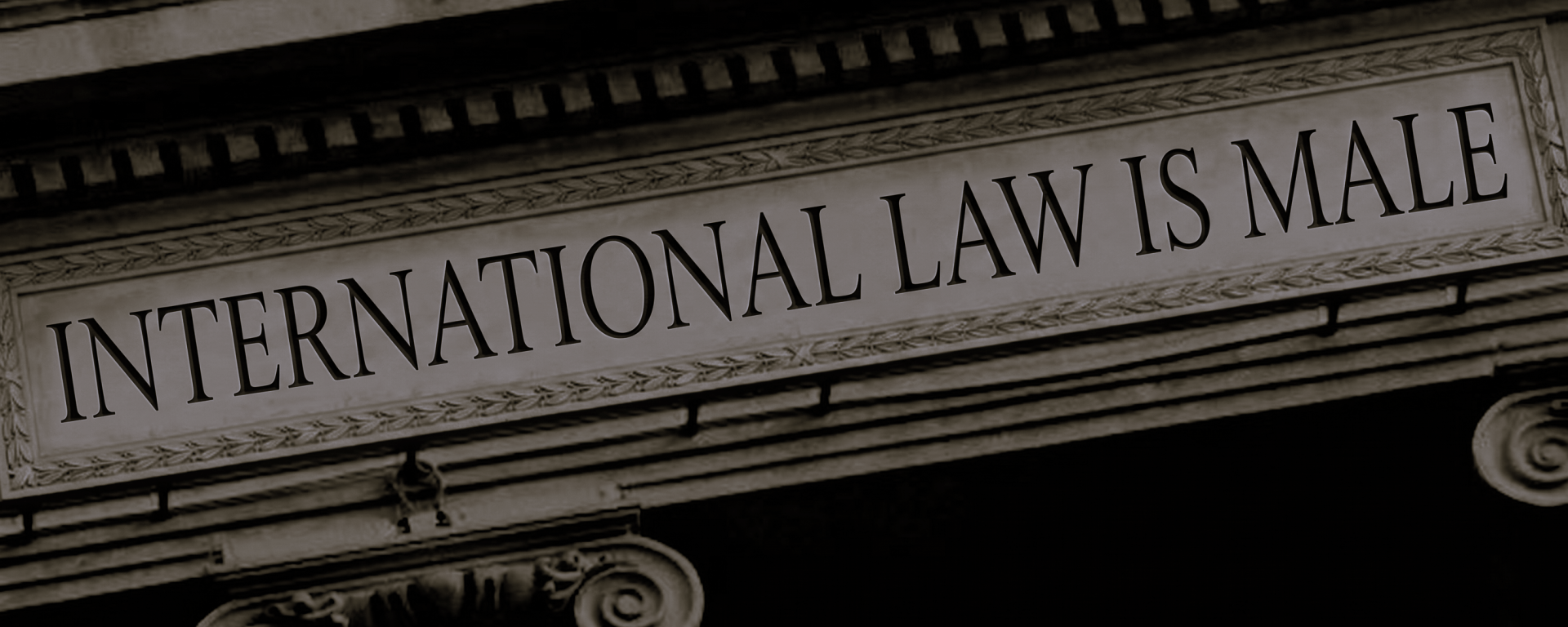
A distinct bias in International Law underlines feminist international legal theory, and constitutes the prerequisite for the exercise of a sweeping and often comprehensive critique of the entire structure of international law. As Ms. Swati Parmar mentions in one of her lectures, many She(s) have been turned into He(s). Law is male as it takes the experiences, actions, and reactions of males for laying down standards and principles. International Law is not only made of men, in the sense that they occupy most of the positions of power and visibility. It is also a law that is made by men for men only. Since the foundations of International Law are based on a Eurocentric understanding of the law, it is assumed to be patriarchal, imperial, colonial and capitalist.
Rohini Sen argues that queering highlights the real nature of international law as systemic representation of European Christian male and other objects, subjects and structures’ legitimacy depends on how closely they align with the central figure. Though this male and patriarchal image was formally abandoned but is still reflected in hidden acts of war, policing, sexual violence and even state sovereignty. For instance, reinforcement of gender hierarchies is visible from the mechanisms such as placing males at the centre of lawmaking and control and subordinating non-male identities by placing them in heteronormative frameworks.
Manifestation of Law as Male
Rohini calls the state a product of competing masculinities and masculine anxieties. The very working of institutions like the UNSC highlights this masculine nature of International Law, where one can find a group of male representatives of hegemonic states sitting in a well-lit room and making decisions without caring much for those affected by it the most. Even when it comes to the use of force in a regime, it is the male visualized as playing an active role and women and children are nothing more than subjects of rescue, pity and male patronage. Even in the capitalist regime of the WTO, it is the rational and economic minded male who imposes trade embargoes and sanctions as part of administrative violence. Additionally, even in techno-capitalism, every new technological breakthrough reinforces the image of the male protector, often revered as the nation’s savior. Male dominance remains the most normal and acceptable form of existence. The legitimacy and how strong the identity of others depends on how male they are. As also noted by Ratna Kapur, “these inclusions and exclusions have been produced in and through law, either by emphasizing the difference of the subaltern subject (women in the present case) as incapable of choosing or consenting, and thus, incapable of exercising rights, or as backward and uncivilized, to be redeemed and incorporated into the liberal project through the process of assimilation.” However, as Nussbaum critiques, even liberalism has not been nearly individualist enough when it comes to women and family. It has tended to focus on the autonomy of males and the development of the public and private spheres.
Caricature of Law as Male
Further, the international human rights law’s public-private distinction is not an objective qualification and has gendered consequences, as it is the men who dominate the public sphere, with women left with the private/domestic sphere of home and family. For instance, the definition of torture, in the Convention against Torture, confines sexual violence against women as abuse of human rights only when it is connected with the public realm (e.g., when women are raped by people holding public positions), while not paying equal heed to the existence of such acts happening to women even at greater frequency in the private sphere. The WHO Violence against Women Prevalence Estimates, 2023, concludes that in 2023, almost one in three women (840 million) have been subjected to physical or sexual violence, or both, by an intimate partner or sexual violence by a non-partner, at least once in their lives. The number, despite being myriad, is ignored as even marital rape remains unaddressed in the domestic violence laws of several countries. This blots out the experiences of women and silences their voice in international law.
Additionally, International law creates a distinction between laws operating in times of armed conflict (International Humanitarian Law) and those operating in peacetime (Human Rights Law). The International Humanitarian Law during armed conflict strictly factors out issues that do not relate to the warrior caste. Example- for the International Committee of the Red Cross (ICRC), the Taliban’s exclusion of women from any workplace in Afghanistan was not its major concern, and the oppression of women had nothing to do with it. The Human Rights Law, though expanding, does not make much of such improvement as it too has a limited response to harms faced by women than men. Though the Vienna Declaration and the United Nations Declaration on the Elimination of Violence Against Women are profound steps in the reconceptualization of gender violence, the gap still exists as focus is on condemnation and need for reform, resulting in limited state accountability due to failure to treat it as enforceable as “torture”. Unfortunately, International Criminal Law, being an amalgamation of both these laws, has also inherited these blind spots. For instance, in cases before International Criminal Tribunals of Yugoslavia, to account for the collective dimensions of mass atrocity, the idea of ‘identity’ was used to establish systemic and collective criminality.
As a result, the ICTY sees women through the identity that the perpetrator assigns to them, regardless of how the women saw themselves or which dimension of identity they privileged before and at the time of the crime. In International Humanitarian Law, the language used is such that indicates that women’s honor should be protected as their men’s property and not because the act constituted violence. Language used is for protection from violence rather than prohibition of violence, Article 27 of the Fourth Geneva Convention places states under an obligation to protect women in international armed conflict “against any attack on their honour, in particular against rape, enforced prostitution, or any form of indecent assault, thus, indicating a protection instead of a prohibition on such an act of violence. However, unlike the use of the word ‘honour’ in Article 27(1), the present paragraph directly links the concept of ‘honour’ with sexual violence against women. Its use in this context has been strongly criticized for providing an inappropriate understanding of sexual violence. The formulation of Article 27(2) has also been criticized for perpetuating discriminatory notions of women as weak and powerless, for characterizing women survivors of sexual violence as less ‘honourable’, contributing to social stigma, and for essentializing the experience of women in armed conflict to the narrow experience of sexual violence.
It is not just that some of the rules of international law are biased, such as the provisions of International Humanitarian Law that tend to regard sexual assaults on women as attacks against the honour of the community to which they belong, rather than acts of physical and psychological violence against women. It is also that the fundamental structures of the international legal order are irremediably flawed for their lack of gender balance. For instance, the idea that the sources of international law are conceived and presented as a hierarchical abstract model is coded by feminist scholars as male, according to the feminist practice of coding based on gender-based models of behaviour. In particular, the patriarchal structure of its institutions is self-evident, with ruling elites and decision-makers, both within states and at the international level, being primarily, and often exclusively, constituted by males. The very notion of sovereign power over territory and the exclusive use of force within it are manifestations of patriarchal modes of social organization.
TWAIL’s Attempted Reactions to Masculinity of Laws
TWAIL has long challenged the Eurocentricity of law, yet it often falls into the same trap of ignoring the gendered reality of the people it claims to protect. TWAIL does not account for feminist ethos and practice. Ideally, this should not have happened, and the possibility of such ignorance by the TWAIL should have been bleak, as the third world is not free from such gender bias even within its domestic domain. This has been well-scrutinized by the feminist writers who have exposed the provisions of law that appear to be gender neutral on the face of it.
Ved Kumari, one of the leading feminist voices in India, discusses the bitter truth of Law being a male-biased subject, the gender-neutral provisions in the Indian Penal Code (now Bharatiya Nyaya Sanhita) being non-gender neutral. In reality, a woman’s construction under the criminal law, and the contribution of the lawyers in developing feminist lawyering in India. She admits that “law as a male”, at first glance, does not make sense, as there is no sex of a law. However, it is the very nature of a law as its primary subject has a biological categorisation between them i.e., the sex division, and the characteristics attributable in accordance with the sexes, define what a gender is. With such division, two major questions arise: Does the body of the human being have any function in the meaning of the law? And which human body is the ‘normal’ human body? The default construction of the human body in law is male, and the female body requirements are seen in context/comparison of the male one, and are treated as “special requirements”.
For instance, in the Bhartiya Nyaya Sanhita (as in the erstwhile IPC), the private defense law is uniform for all, this is problematic as there exists a considerable difference in the context of proportionality, imminent danger and time taken for recourse to public authority for both the genders. Similarly, the circumstances in which murders are committed by males and females differ too in the case of grave and sudden provocation. One of the accepted cases over a period of years is when you find your spouse in an illicit relationship or compromising position with another person. As we derive from the Nanavati Case and other similar cases from the past, it is primarily a male reaction to kill and murder, women generally would leave for the maternal house. It is not a human reaction to kill, as not all humans (women) react in such a manner. But the threshold has been set this high due to the male reaction, ignoring the fact that there is an alternate way to react as well. Several other examples speak for themselves, including the adultery provision, the male control on sexual acts of women, mothers being deprived, and using the two finger tests for the prosecutrix in sexual offences. Even though approaches such as TWAIL and liberalism attempt to bring to the forefront voices of the unheard, none of them seem to comprehensively accord attention to the feminist ethos and masculine character of law as it deserves.
Searching through Silences
A solution to this conundrum could be reliance on feminist methodologies of “searching silences” for identifying such gaps. This feminist approach to international law asserts on giving the inherent yet concealed silences, equal importance as positive rules and rhetorical structures. These silences do not mean that women are completely absent, rather, they find their acknowledgement in specified areas such as the women’s human rights law. However, this again is problematic as it narrows down the view of women solely as victims, particularly as mothers, or potential subjects in need of protection. If mainstream law is built on this specific European male identity, then a feminist approach does not just ask for ‘inclusion’, it questions the very objectivity in a system that effectively excludes women’s voices, thus challenging the entire architecture of the system.
Therefore, the Feminist methods cannot be placed beside other methodologies from positivism to critical legal studies, as the latter silences women’s voices and reinforces the globally observed domination of women by men. They fail to consider the position of women as an international issue, and they believe that the so-called “neutral” and “impartial” standards set are synonymous with male perspectives and filter out many issues that touch women’s lives in particular.
Epilogue
The blatantly gender-biased world of International Law is presented as neutral, autonomous, universal, impartial and liberated from any exogenous factors. However, the autonomy, universality and objectivity of International Law have been called into question by the feminist methodologies that question the very existence of objectivity in a system that proficiently excludes women’s voices. Every state has created a separate set of laws to deal with the issues faced by women, which somewhat reflect the International Law Principles. However, even if almost all the nations follow almost all the Principles and International Obligations almost all of the time, as stated by Lou Henkin, why do the countries not follow the rules established for gender crimes? Why do men create these laws and then proceed to disobey them? The grey area created when men disregard their own laws forces the victims to suffer in silence.
Nehal Yadav and Dishita Singh are undergraduate law students at Dharmashastra National Law University, Jabalpur.
Picture Credit: Erin/Pinterest edited by JFIEL

