
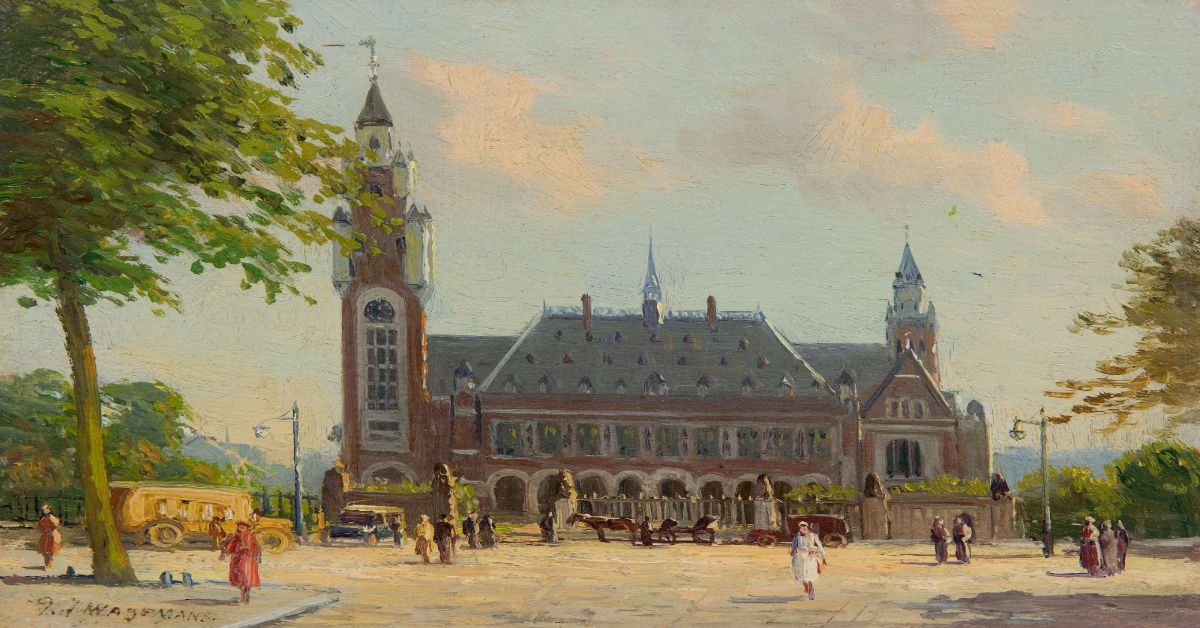
In this interview, we speak to Edward Watson and Karin Arana, both of whom have been part of the 2025-26 cohort of Judicial Fellows at the International Court of Justice. The Judicial Fellowship programme is a highly competitive scheme that allows fellows to work on a full-time basis under the supervision of a Member of the Court, alongside the Member’s primary legal assistant. The duration of the fellowship is approximately ten months, from early September to June of the following year. The Court generally selects 15 participants nominated by universities across the world. For more information on applying for the fellowship, click here and here. In this interview, we speak about what brought them to the Court, what their past year has looked like, what gives them hope to continue practising international law, and the advice they have for those hoping to follow in their footsteps.
Adithi: Hello! It is so nice to finally meet both of you! Can we start with what drew you to international law? Can you also walk us through your academic path, from law school to the fellowship?
Karin: For me, my region, is very important in the field of human rights. I say this because I was recently at an ILC seminar, and while a lot of the other regions were focused on international law more broadly, almost all points raised by the Latin American commissioners were contributing were rooted in human rights. That’s typically how people get into international law in Latin America.
My background is in human rights within the Inter-American system. I have been an intern at the Inter-American Commission on Human Rights and the Inter-American Court of Human Rights, and I’ve also interned with another organization called CEJIL, which litigates cases within the Inter-American system. My first real step into broader international law came with the ICJ, but before that, it was all human rights — that’s where it began for me
Edward: For me, I think the main attraction of international law, was the fact that it was a law that (at least purported to) speak across different cultures and languages and backgrounds. And I think that was really attractive to me — you know, coming from a family background with multiple cultures.
I went through a few different other paths first. The Jessup Moot competition was an important early experience in university. Then I did a student placement through university in a community legal clinic that worked on youth justice criminal law — so criminal law involving criminal defence for young defendants, where some of these ideas around human rights were a really important aspect of the discourse around youth justice. I then did another volunteering role with an environmental law clinic where, again, when I was there, the incorporation of principles of international law into domestic environmental law litigation was notable. Later, while I was working at a law firm, I had the opportunity to work on a transitional justice project, where I wasn’t working so much on international legal research or the application of international law, but more basic skills you can contribute as a lawyer — trying to figure out exactly what happened, the movement of military units, the gathering of witness statements, and things like that. I think that was a very formative experience as well.
Separate from working or volunteering in roles that touched on the international, I also had a bit of involvement with the Australian Red Cross, which gave me some exposure to international organizations and the kind of work they do in the context of international humanitarian law. So, it was a real patchwork of little bits and pieces that I was doing alongside my main job of being a domestic lawyer. This eventually prompted me to apply for a role in the Australian Foreign Ministry, which is where I work now in international law.
Adithi: Wow such interesting, diverse paths! What would you say drew each of you to the Judicial Fellowship specifically? Karin, I understand it’s extremely rare for someone to take on the fellowship straight out of undergrad — and I believe you’re the first Guatemalan judicial fellow at the Court! What kind of space does an opportunity like this hold as a career trajectory in your country? And Eddie, was the fellowship something you’d always had your eye on, or was it a path you’d seen others take before you?
Edward: The fellowship has definitely been a very impactful experience. In terms of how it fits into a broader career path here in Australia, it’s a path that’s been taken by others before — even in the team I work in at the Foreign Ministry, there are a few alumni of the Judicial Fellowship Programme. But it’s certainly not widely advertised, and not a lot of universities in Australia offer up a nomination to the programme or fund it. So, it was very fortunate that my undergraduate university, the University of Queensland, was able to secure some funding for that. I think that was a fortunate coincidence of events — right place, right time.
In terms of whether it’s something I always wanted to do, I don’t think so. I came to find out about it because a couple of my seniors had done it, and both had a really good experience. But I always knew it was an opportunity that’s not just competitive, but also involves a fair amount of luck, just in terms of being nominated and then selected — there are so many worthwhile candidates out there. So, it wasn’t front of mind as something I absolutely wanted to do. But when the opportunity came up to apply, or to be nominated by the university, I grabbed it with both hands.
Karin: For me, it was a little different. I never dreamed of going to the ICJ, because that wasn’t a possibility in my world at that moment. I decided to apply because my dean called me and told me, “You’re the only one — we’re going to send in your application, so you have to do it.” I was a little skeptical, because I’d seen the list of past fellows and they came from these big universities — most of them were PhD candidates from Cambridge, Oxford, Harvard, Columbia, NYU, and others. And I was like, I just have a bachelor’s, I graduated one month ago, and you want me to apply? I thought, okay, I’ll do it, but this is impossible.
I applied and then honestly forgot about it. I started seeing that other universities were posting that their students had been picked, so I assumed I obviously wasn’t going to be selected. Then one day, when I was about to go on a hike, I got an email saying, “Can we interview you?” And I got it.
Something important that Eddie said that I really want to highlight: you can have all the academic background needed, all the professional background needed, but at some point, you enter a pool where a lot of people are really good, and it’s extremely difficult to compete with everyone. At some point, it’s just about luck. I think Eddie and I were both really lucky — at the end of the day, that’s what it comes down to.
Adithi: I am curious as to how both of your journeys to the court (which are of course, so different) have shaped how you come to the fellowship and your experiences within the fellowship itself?
Edward: I think the experiences I’ve had to date all really helped with the fellowship, because working for a judge of the ICJ — for members of the Court — there are a lot of different streams of work, if I can call it that. Of course there’s the fundamental legal work, like legal research, but there’s also more of an assisting role, where you’re trying to synthesise all of the information that’s come in on the case file and provide it to the judge in a way that’s helpful for their consideration of the case. I was working in the President’s office, so there was also outward-facing, more diplomatic work — preparing for bilateral meetings with ambassadors or UN officials. And then a lot of collaborative work as well, especially during the process where the Court is considering its decision.
So I think it required me to draw from a lot of those previous experiences. A particularly important one was working in a domestic court as a judge’s associate, which is the equivalent of a clerk in the U.S. system. I think that really taught me to think about the reader’s perspective — does this make sense from their point of view? Thinking about what they would already know, what they wouldn’t know, what they need to know. That’s obviously required in many other jobs, but the focus on doing that in the associateship role meant I was very conscious of it coming into the judicial fellowship.
Likewise, both in the associateship role and even at the Foreign Ministry, you become very pedantic about what words mean and what they convey. I think that kind of pedantry is important when you consider how many people read an ICJ decision, pore over it, and really interrogate every single word to figure out what it means. So that was also a very important skill I learned and brought with me.
Karin: I agree with Eddie that every opportunity you have is important because it shapes everything you go on to do. Sometimes we don’t see it in the moment, but then later it’s like, “oh, this skill I picked up in a place that seemed unimportant actually helped me navigate challenges with my coworkers and colleagues.” That’s a real advantage.
For me, a lot of things were new at the ICJ. The most important was that it was my first time working fully in English. At first, what everyone else did in 30 minutes, it took me two hours. But I got into the practice and eventually managed to work at the same pace as everyone else.
I’d say something that really stood out in my background — and I think it was important for the ICJ, and part of why I was selected — was that I had the opportunity to work with the Deputy Registrar, who is now the Registrar of the Inter-American Court and the director of Monitoring compliance with judgment. That experience gave me a lot of grounding in how to talk to judges, how to work with the registry, how to manage things. I think that was a real advantage, and something they were looking for. For me, that was the most important aspect in my background that helped me get the fellowship.
Adithi: What would you say is the most useful piece of advice you got before starting, or advice you wish you’d gotten?
Edward: I can’t say I had specific advice going into the Judicial Fellowship, but something that’s really stuck with me is from when I worked as a judge’s associate. A senior colleague told me when I was starting out at the Australian court: everything you produce ultimately goes through the judge. They’re the ones making the decision, the ones putting words on paper for the written decision. So, you almost must set aside your own sense of self, your own ego. When that gets in the way, that’s when you start making mistakes — you start offering what satisfies you rather than what’s actually the best advice for that person. You need to put that to one side, put yourself in the judge’s shoes, make yourself an extension of the judge, and give the best help and advice you can. Hopefully that makes sense, I’ve only had my first coffee!
Karin: On my side — the first thing that came to mind, again tying into imposter syndrome, which was very present for me before going to the ICJ: there’s a lawyer here in Guatemala who’s quite well known. I saw her before I left and told her I was scared because everyone there would be better than me. And she said, “Yes, they will be better than you.” That sounds harsh, but honestly, it was such a relief to hear. She said, “Of course they will — they’re studying at the best universities in the world, they have a much better education system than we do here. You have to be sure of that, don’t even question it.”
But then she told me: not every space is for you to show off — some spaces are for you to go, observe and learn. And that stuck with me ever since. I didn’t have to go there and prove myself. I would go there to learn from everyone. That really helped take the pressure off needing to be the best or needing to bring something to the table. In the end, you always bring something because of your own experience and what you’ve seen.
Edward: I just want to say that’s excellent advice from Karin. I completely agree. The more inexperienced you are, the more teachers you have around you. Though I think the flip side matters too— the more experienced you become, the more you need to help and teach others.
Adithi: I’m sure our readers will really benefit from this advice! Speaking of learning from each other, has working alongside each other changed how you see your own background? Has it made you appreciate something about your own legal education that you hadn’t before or notice a gap in your own system?
Edward: As for what I learned from working with others: in this kind of role, you’re working in quite small teams — usually one, two, three other people around a judge — so you become very familiar with everyone’s subconscious and conscious biases around how they approach the law. It made me appreciate that you can only learn so much at university, and it’s important: both while you’re there and especially afterward — to really take ownership of your own learning. There were moments where I felt I’d skipped over something basic that I should have taken more time to revise.
Being able to test your own understanding against people from different backgrounds is incredibly useful. And culturally, it was amazing working with people from so many different backgrounds. It almost surprised me — we’re told so much about how different our cultural identities are, yet at the Court, everyone was from somewhere else, and we all intuitively knew how to navigate those cultural differences. That was reassuring, it showed international law really can be international.
Karin: I remember reading the material for a case and thinking, “This is so easy” — because I came from a human rights background, and the human rights law was already fully developed on that topic. But others were raising points I hadn’t even considered, and it got more and more difficult. So much depends on whether you come from a civil law or common law background — you’ll have different views on the best way to interpret something.
For me, the biggest difference was between people who were extremely academic and people who had more professional experience. I had different instincts than the very academic people, and I learned a lot from them. My instinct was, “This is the issue, this is what we need to answer, we don’t need to look at anything else” — efficient, get it done. But they’d point out something I thought was irrelevant, and it actually mattered. I just hadn’t seen it because I was focused on working quickly and efficiently. At the Court, you have to look at everything. That was a learning curve for me.
Now, whenever I read something and think “I already know this,” I remind myself to dig further and further to be sure — because after the Court, I’m genuinely less certain about what I know and don’t know. It’s incredible to see how people from different legal traditions, as well as from the Global South and other regions of the world, bring different views. You can see that reflected in the separate opinions of the judges. I think that’s the real value of the Court.
Adithi: Absolutely. Eddie, can I borrow from Karin and ask you— do you see the Court any differently now to when you first started off? Have you felt a switch in a particular form of thinking as well?
Edward: That’s a good question. As many young lawyers, I can get carried away being cynical about institutions. There is merit to that, though — you do need to question authority, you do need to question assumptions about the system you work in. Just because things have been done a certain way for a long time doesn’t mean it’s the best way.
It’s easy to be cynical about this Court because it’s consent-based, it’s voluntarist, it doesn’t have an enforcement mechanism. Even the fact that judges are elected and term-limited — from an Australian sensibility, these are things we try to avoid with our courts. So in that sense, there was a lot I was cynical about.
But being at the Court, when you have that inside perspective, you really see how hard people work — how hard the judges work, how much they care about fulfilling their mandate, how well they understand the potential impact of their decisions and how much they’re thinking about that. That was very reassuring to see, and it mellowed a lot of the cynicism I had. You also see it when you come to an oral hearing and watch the parties send quite senior officials, retain lawyers, and put real effort into arguing these cases — you start to see the bigger picture of why it’s important to have an institution like this to resolve disputes between states peacefully.
Adithi: It’s really interesting that you came to the Court cynical. In India, being in the Global South, I think we tend to put these institutions on a pedestal — we look at them so favourably that we often end up disillusioned with the system when we view it in close proximity. So it’s interesting that you went the opposite way— from cynicism to optimism. Karin, did you have a similar experience?
Karin: In Guatemala too, we tend to see the Court as this almost celestial body that knows everything.
I didn’t come to the Court with a cynical view — I saw it as something significant, and I still do. What was different for me was seeing how much academic commentary exists around “the Court did this because of that” or “these judges will think like this” — when often the real reasons behind decisions are completely different from what people outside assume.
Adithi: For my last question, what gives you hope to keep working within international law, given that so many people are now calling it a crisis of the discipline?
Karin: One person asked this really good question to Judge Gómez Robledo at a conference we had, and he gave an answer I found interesting. He said a lot of people claim international law is in a crisis. But he thinks international law is more alive than ever — because even the countries that disrespect or do not comply with international law try to base their actions under international law. So for him, it’s not dead. I kind of agree with him.
I think it’s a time for reformation, and because it’s a time of reformation, I think we need to study more what the reformation of international law will be. This is me being optimistic, but I do think international law is and will always be important. Even if it changes — for Latin American people, I always say: okay, if the UN system stops working, we still have the Inter-American system. It doesn’t have the same effect as the UN, but regionally we can find spaces where we can still make it work. We have to find these places and work from those places. And if we cannot work from there, then work internally — take positions at the national level that will make these bigger things work, because at the end it’s people from our own countries who are deciding this. So there’s a space — nationally, regionally, or at the UN level. Yes, it’s hard, it’s difficult, but you will find a space to do it.
Edward: I think that’s a great answer, finding space to confront the crisis. I think the language of crisis can be helpful to an extent — it rallies people, highlights problems that need solving, adds urgency and focus. But it can be unhelpful when it leads to the assumption that international law has some kind of permanence. Historically, the current system is relatively young. The UN system is only about 80 years old, when you think about how long some domestic legal systems have existed and how many iterations they’ve gone through. So it’s wrong to assume permanence.
I think it’s important to think about the value proposition of international law — why is it important in its current form, why is it worth protecting, and worth interrogating the parts that work and the parts that don’t. That’s similar to what Karin was saying. Then finding a place where you can make that contribution becomes really important; it doesn’t have to be a specific position in the UN or in government.
Karin: I had this really good advice from a lawyer I really care about, Dan Saxon, a professor at Leiden. One day I was complaining that working in the human right’s field here in Guatemala was just studying, doing research, and then coming to court just to lose, again and again, because of corruption and many other structural challenges. I was really tired. He told me: you have to learn how to travel through the waves in life. He gave me examples from history, times when things were working out well and times when they weren’t — life just goes like waves. Some things will go well, and some won’t, and you’ve to learn how to navigate both. I think that’s really important advice, especially right now. There will be many things you cannot change, and I think you’ve got to learn how to travel through all of it.
Adithi: Absolutely! Thanks so much for joining in this evening. These are such diverse and interesting insights; I am sure our readers would benefit from your reflections!
Interviewed, transcribed and edited by Adithi Rajesh, Director.
PC: Piet Wagemans, Gezicht op het Vredespaleis in Den Haag

