
“The Gods had condemned Sisyphus to ceaselessly rolling a rock to the top of a mountain, whence the stone would fall back of its own weight. They had thought with some reason that there is no more dreadful punishment than futile and hopeless labor.”
– Albert Camus, The Myth of Sisyphus
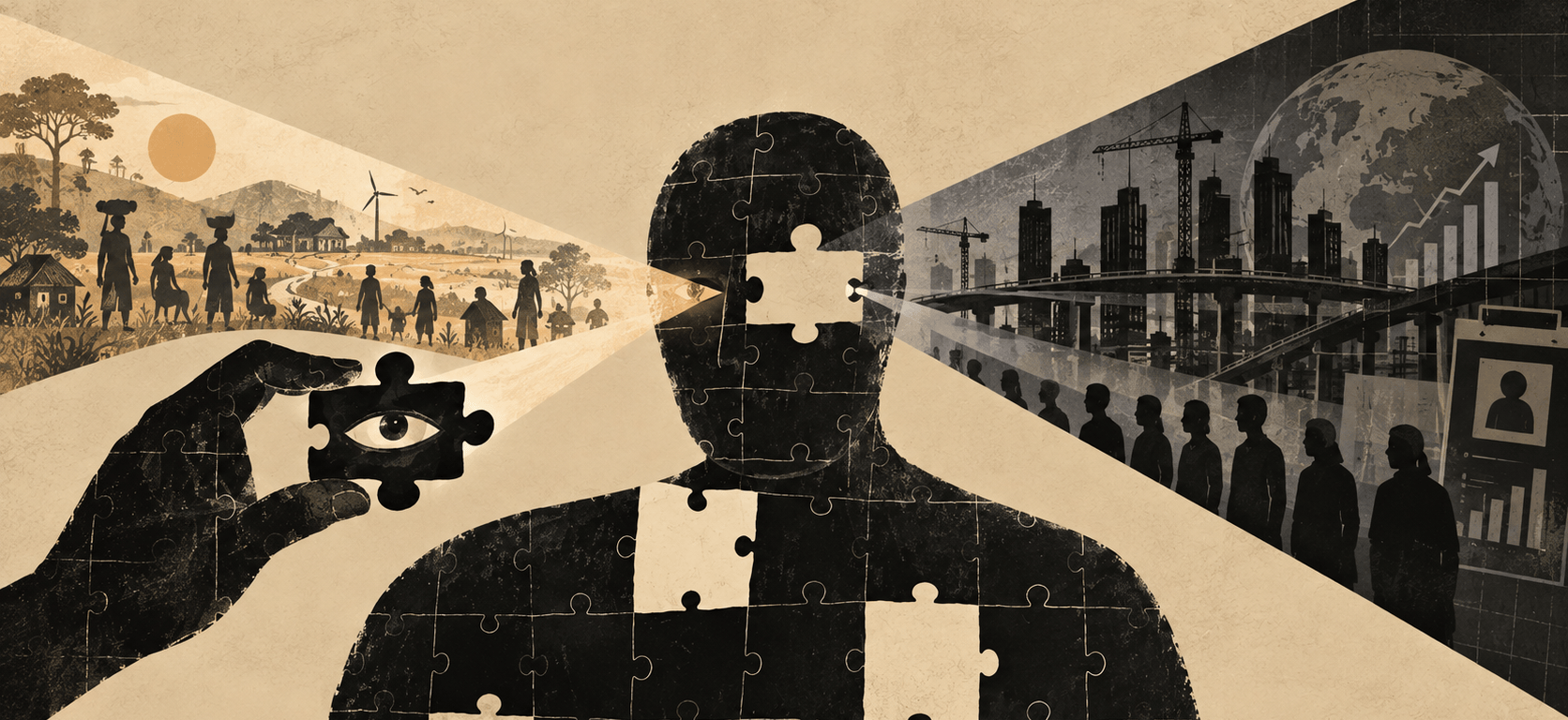
We are condemned by demigods of development, to push the heavy rock of development up a hill for eternity, only to watch it roll back down over us. But as Albert Camus shows how Sisyphus accepts his fate to push the rock uphill, owns his struggle and thereby, defies the life supposed ‘built-in meaning’, the Global South needs to (re)assess the built-in logic of development and own our struggle.
The daybreak after a dark night makes things appear as they are. We need to harness the same threshold visibility to see what development holds for us. The underlying rationale, the semiotics and the yardstick of development remain hidden in the mainstream scholarly sight. And when development and positivism are deeply embedded in and operate through international law, strengthening and supplanting each other, they erase the possibilities of visibilizing what development holds.
The dichotomy of developed-underdeveloped as a replacement of the civilized-uncivilized was made to appear seemingly scientific and economically rational. It is no coincidence that all the civilized states were now the developed and the uncivilized were the underdeveloped or developing. The colonies physically exited, but the colonisation of material resources still existed in the neo-colonized worlds (the former colonies) (See Bedjaoui). The control over material resources was legitimised by the language of development. The works by Said, Bhabha and Mudimbe set the context for locating the synergy between capitalism and neo-imperialism in the meta image of development and those by Bedjaoui, Headrick, Escobar and Anghie provide us the visibility to problematise development. On the same lines, Pahuja provocatively reveals the foundational myth of development that universalises international law.
Drawing on their arguments and lens, this post is driven by two questions: how we see development and how development sees us? The post presents a few illustrations around these two questions: by highlighting the creation and measuring of the underdeveloped/developing others on objective yardsticks; and the pooring of individuals, and the attunement (and ousting) of the dignity of the poor to (and from) development. This post then holds two primary, out of the many other reasons– of normative autonomy and the paces of diverse sub-sets of international law – accountable for the way development engages with and in the Global South. These two reasons can lay out of sights within the folds of a normalised detached view of the sub sets of international law.
Creating and measuring of the other
The logic of development convinced us to view more than half the world’s population into a problem to be solved through the “vigorous application of modern scientific and technical knowledge”. One of the most subjective signifiers of human race, human progress, was deduced to objective, quantifiable, myopic (Euro-American) internationalised standards of development—those brought into existence and recirculated from various points in the following decades by the Bretton Woods Institutions. The World Trade Organisation, International Monetary Fund, and the World Bank systematically create the Global poor (See also this). However, if we were to put on the glasses from John Carpenter’s 1988 cult classic They Live, the deliverance promised by the development apparatus gives way to something more sinister. Behind the vibrant posters of “Inclusive Growth” and “Rights-Based Development”, the ideological lenses reveal a starker command: consume, accumulate and conform.
Horkheimer’s critique of instrumental reason—as a form of subjective rationality concerned only with the most efficient means to given ends, and indifferent to whether those ends are just or humane, offers a vocabulary to understand how development became the de facto logic of the world. This diagnosis is now quite well known as the concept of development as ideology—a global faith that reframed poverty as a pathology and the Third World as a governable object of deficiency. The objective of this faith was to preach as Nandy described it, “a secular theory of salvation”.
The statistics of this ideological success are staggering. While the industrialized North represents 26% of the population, it accounts for 81% of world energy consumption. One US resident consumes as much energy as 900 Nepalis. In Brazil, the 20% richest consume thirty-three times more than the 20% poorest. Since the 1982 debt crisis, the South has paid its creditors an average of $30 billion more each year than it received in new lending. Development has not ended scarcity; it has multiplied and globalized it. The question, then, is not why poverty persists despite development. It is: first, whether the very architecture through which development travels helps constitute the condition it subsequently names as poverty; and second, the deepening of gulf between the economically advantaged and disadvantaged by the systemic agencies of development. This is where the idea of pooring becomes useful, allowing poverty to appear as a condition that can be institutionally produced, distributed, and normalized.
Normative autonomy and the paces of International law
International legal frameworks have played an important role as distributors of the underlying logic of development. This distribution has been facilitated, among other things, by means of compartmentalization. The WTO governs exchange, the ILO governs labour, the International Bank for Reconstruction and Development governs development finance, while international human rights law speaks the language of dignity. Each regime appears normatively autonomous, yet together they reproduce a singular developmental rationality by isolating questions that are, in lived experience, inseparable. Fragmentation thus acts as the technology that makes development appear politically neutral, informing us that we must first strip away the ideological tint before the architecture of development can be seen for what it is (See They Live).
The development logic looming over international law often ensures the pace with which sub-fields of international law develop. For instance, despite its earliest origins across several ancient civilizations of the world, international human rights developed at a slower pace (in measurable terms of a designated international organisation, a dispute settlement body, and a dense treaty network that states overwhelmingly accept) than international trade and investment law. The same is true of refugee and migration laws. The laws that have underlying capitalist motivations for the State, derive higher moral, political, social, and institutional contributions from the State. In this scheme of weighing international laws on the development rationale, the laws that demand a State’s actions to be on radar, obviously are relegated by the States. This systemic slowing down of the pace at which diverse sub-sets of international laws develop has rarely drawn scholarly attention in the mainstream. The autonomous normativity of the laws allows this disjunctive development of laws to pass through without any critique or attention. Under this grammar of international law, Horkheimer’s instrumental reason acquires institutional form as capital becomes universally mobile while exploitation remains territorially local.
The Escazú Agreement, Saramaka People v. Suriname and Endorois v. Kenya, are a few illustrations of departures from eulogising development merely due to it promises growth or compensation. The 2018 Escazú Agreement, a Regional Agreement on Access to Information, Public Participation and Justice in Environmental Matters in Latin America and the Caribbean, offers us a glimpse into how such a rethink may be embodied within legal instruments. The logic of monolithic development does not simply dictate who may speak. Rather, it puts into place the permissible sequence in which varied legal claims may be allowed to emerge without disturbing the sacrosanct ends of such monolithic development. Escazú attempts to upend such sequencing and exemplifies environmental democracy. Unlike the Declaration on the Right to Development, it does not use public participation as an empty talk. While staying within the existing logic of compartmentalization and selective pacing of environmental programs in the larger aspirational canvass of development. Instead, it squarely refuses to relegate participation to the fag end of the development process, after the contours of a project have already been decided. It avoids postponing environmental concerns to the end of developmental process or as a procedural assessment to be complied with [such as the way States empty the promise of Environmental Impact Assessment (EIA)].
Article 7 of the agreement requires environmental decision-making to open itself to public participation from its early stages, with adequate information, reasonable time and an obligation to take the observations received into account. Participation is thus attached to the making of the decision itself, rather than merely to its social management. By mandating the generation and dissemination of environmental information, Article 6 marks a step towards reducing the information asymmetry that is pivotal to informed participation and mitigates the abuse of privileged information. Even the Agreement’s own institutional life carries this logic forward. Its Action Plan on human rights defenders was developed through an open-ended working group with significant public participation, particularly involving indigenous peoples and local communities, before being placed before the States Parties for adoption. By championing pluralistic governance, Escazú makes the monolithic developmental order answerable to otherwise peripheral epistemes.
Labour and leisure, and development
The globalized form of scarcity has permanently altered labour, leisure, and the everyday experience of time. Bedjaoui asserts that the “Third world pays for the rest and leisure of the inhabitants of the developed world”. Development resembles a Hobbesian Leviathan whose injustices are explained away through its alleged inevitability, its appetite for land, labour and resources naturalised as the price of modernity. At an individual level, development is less a promise of emancipation and more an apparatus for redistributing exhaustion. Samir Amin argues that imperialist-capitalist development multiplies the number of tabs that must be kept open and managed—so that human presence is demanded simultaneously in diverse spaces. At a personal level, we become mega-consumers, drawn into an ever-expanding field of choice over commodities we may never have needed, each choice quietly connecting us to workers whose labour, wages and safety are organised by distant entities. The commodities we buy connect us to forced labour. Many such commodities are produced at the cheapest possible rates via illicit labour from the developing countries, as in the fashion industry (see this, this, this), and supply chain workers (see this, this).
The collapse of Rana Plaza in Bangladesh exposed this fragmentation. Global trade had made the garment supply chain extraordinarily efficient; the legal responsibility for the conditions under which that efficiency was achieved remained extraordinarily dispersed. The workers that create development are projected as poor and are poored by development–they were poor not outside the global economy, but through their position within it. Nandini Joshi’s intervention in the debates surrounding the New International Economic Order makes the point, as early as in 1980, more starkly. By placing power versus poverty rather than development alone at the centre of international economic relations, she asserts that poverty was too readily treated as a subscript of development, a transitional cost to be managed, rather than as a condition sustained by the international economic order itself. Pooring begins precisely at this point of disappearance; when the condition produced by an order is recast as the deficiency of those living within it.
The bourgeois character of development creates these spaces as exclusionary, ousting the same labour that built them. This is not limited to the ousting of the poored labour class, rather this phenomena has become common in the giant tech-companies with the advent of artificial intelligence, such as Amazon, Meta, Microsoft, Oracle, LinkedIn, among others. The inevitability and caricature of development normalise the ousting of the poored from these developed spaces, thereby occupying no physical space even in the news—whereas the ousting of white-collar job employees, at least, occupies space in the news, and even in the courtrooms worldwide. But even for the thousands of affected employees, who reach to the courts and labour tribunals, the logic of development has crafted the developer-suited laws (see this).
In urban-city development, it is no coincidence that all the dwellings of the poored are situated near the garbage dumping zones and landfills. The sight of a poored child playing in the stench of the rotten garbage at the foothills of the garbage mountains is normalised, but the sight of the same child playing in the park in an urbane developed residential area would become a matter of concern. The slum dweller’s presence in such parks as a gardener or a cleaner is permitted, but the sight of the same individual entering the park as a visitor would be a concern.
The transition brought by the process of pooring, and the exclusionary model of modernity is disproportionately felt in the Global South. Development fundamentally transformed these societies into governable objects while simultaneously eroding vernacular ways of defining sufficiency and community. The glossing over the discomforting creation and pooring of the global poor (see Bedjaoui) is enabled by the way tangible outcomes of development are portrayed. The construction of the language that development uses denote how organic things in their state of nature require improvisation, and fine-tuning, after which they deserve their worth. Jungles are seen as rogue, but eco-tourism in the same jungles is not. Indigenous communities are uncouth, but the handlooms they produce are sold at exorbitant prices by the high-end fashion houses as ethnic. An Environmentally sustainable wooden and terracotta house in rural landscape is considered rudimentary, but the same in a high end resort is viewed as exotic. The way we construct things as–ethnic, rare, exotic–to commodify them, while disdaining (referring things as rogue, uncouth and rudimentary) at the same things in their natural environments, is how development alters our imagination.
The uneasy co-existence of monolithic development with dignity
Hannah Arendt describes ‘natality’ as the potential for newness or novelty; the capacity to initiate something unforeseen. When development reorganises labour and leisure into incessant consumption and managed productivity, it does not merely tire bodies; it constrains this capacity to begin and act. In the Arendtian sense, development-induced globalized precarity thwarts the very conditions that make plurality and political freedom possible. If natality and plurality are considered to be the ontological roots of dignity, then a developmental order that manages populations as objects of growth rather than subjects of action must inevitably treat dignity as decorative.
Therefore, while several international human rights treaties, including the UDHR and ICCPR to the ICESCR, CEDAW and CRC emplace dignity as a cross-cutting international law norm, on a normative-contrariness, the logic of development cultivates social and legal perception in a way that thins the idea of dignity precisely where development is at stake.
The fallouts of such thinning are starkly visible in our urban landscapes, such as skyscrapers, industrial zones and efficient transport systems that are celebrated as signifiers of development, but they depend on labour that is systematically excluded from the spaces it builds. The Ahmedabad wall erected ahead of Donald Trump’s 2020 visit is emblematic of such exclusion. The wall literally removes the appearance of certain bodies from the developmental gaze, denying them the right to be seen as co-inhabitants of the city. This reveals how the placement of human dignity in the black letters of law has become perfunctorily customary to express our moral sentiments.
The Declaration on the Right to Development itself is a case in point. The Declaration recognises the entitlement of every person and all peoples to participate in, contribute to and enjoy development, and connects development to active, free and meaningful participation and the fair distribution of its benefits. Yet participation cannot be meaningful where the objective, scale, technology and distribution of a project have already been decided. A community may be allowed to comment on the route of a dam, the compensation for a mine or the resettlement plan for a transport corridor without being able to ask whether the project, its scale or its ownership structure should exist at all. Rights then become a form of aftercare for decisions already made by a few. Feminist political economy exposes another limit of predetermined development. Diane Elson’s framework of recognising, reducing and redistributing unpaid care work shows why adding women to labour markets is not enough when development transfers more reproductive labour to households. A social reproduction approach to global value chains similarly shows how economic upgrading can coexist with deteriorating working and living conditions.
This also reveals how the placement of human dignity in the black letters of international law has become customary to express our moral sentiments, but still the doctrine of utilitarianism (though ‘development’ is not maximum utility for maximum number, rather maximum utility for the minimum elites) looms over the doctrine of human rights.
Conclusion: Hope, not optimism
Development was emplaced in the international public consciousness as an aspiration–later legitimised and universalised from various vantage points, including international financial institutions (see Anghie) and international law (see Pahuja). The universalised discourse on development is not, then, limited to the corridors of the Bretton Woods institutions, but has become an aspirational choice of the remotest poored village on the world map. In that sense, development as an aspiration has become more international than international law itself.
The development logic supplants and is superimposed on the frame of law. It operates through law, and conditions it at various junctures. Problematising development allows us to see the law’s complicity in pooring; spiralling out the humane out of law in the service of capitalist projects; prioritising value in its myopic and objective sense. We must rethink development to attune it to the language of solidarity—by evaluating its artificial-coercive constructs on the organic and natural state of being, and rewriting its grammar to prioritize care, redistribution and ecological reciprocity over myopic capitalist terms of development, progress and growth.
These diversely placed sights of interaction of development with the Global South and the poor, exposes how development sees us and how it shapes our imaginations counterintuitively to see development in the way it wants us to see it. Building upon the existing scholarly work and exploring the promise of Escazú, we reinforce how we can see development through what it holds for the Global South and the Global poor.
Swati Singh Parmar is an Associate Professor at Chanakya National Law University. Her areas of engagement include international legal history and theory, and critical international law. She has published book chapters, including invited chapters for books published by OUP, and Edward Elgar. Her works find home in journals including the International Journal for the Semiotics of Law, Indonesian Journal of International Law, EPW and others. Her current international legal history projects include through a semiotic deconstruction of British Indian Paintings, and Asian cities.
Vishwam Prakash is an Assistant Professor of Law at Chanakya National Law University, Patna, with research interests in labour laws, human rights, constitutionalism, and social justice. He was recently invited to contribute a chapter on human rights in crises to an Edward Elgar Publishing handbook and has an accepted chapter on waste workers with CRC Press, Taylor & Francis. He served as Convenor of the CNLU committee that drafted Bihar’s Ease of Doing Business Bill and the CNLU consultation committee that assisted the Government of Bihar with Deregulation 2.0. He also contributed to the drafting of the Bihar Jan Vishwas Act.
Picture Credit: Pinterest/edited by JFIEL

