
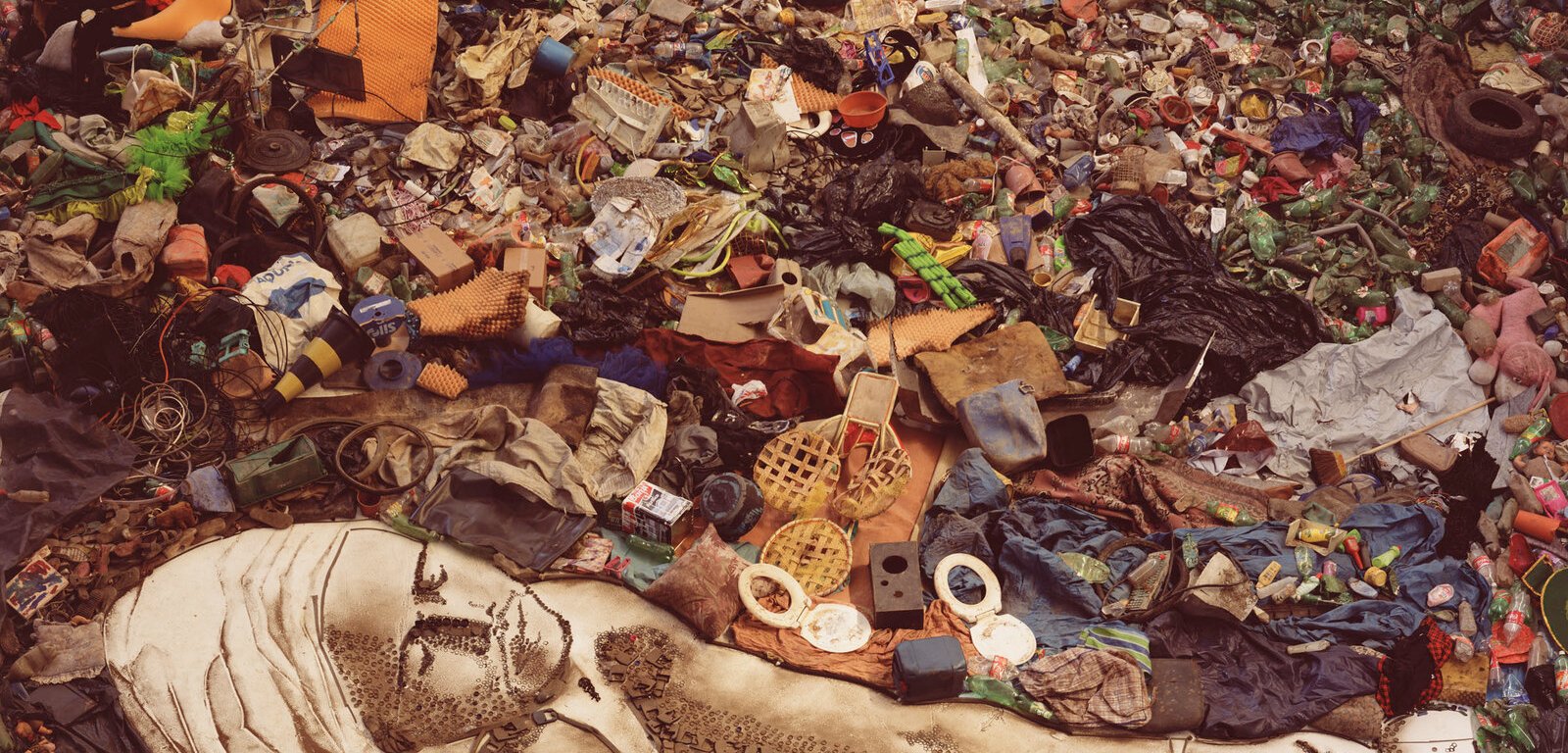
You’ve made all this effort to get to a place where the ugly, shit end of capitalism won’t be present, only to discover that your quest has been futile. A bit of rubbish has found its way into paradise and exposed all your yearnings for purity as doomed to failure.
Gay Hawkins, The Ethics of Waste
During the G-20 Summit in 2023 and the BRICS Summit in 2026, the Indian Government “made poverty disappear” in New Delhi. They razed dwellings off pavements, planted flowers willy-nilly, and covered slums with plastic sheets to hide them from plain sight. This semblance of pristine order (far from the ground reality of India’s otherwise characteristic organised chaos) is the long and short of it: the quest for development is ultimately one of aesthetics.[1] The underside of this—and an oft unasked (and unanswered) question—is what cost this order comes at.
There is a close relationship (beyond proximity) between waste and the people compelled to handle it. Without seeking to oversimplify either of these concerns, I propose that a close look at waste, a material object, would offer unparalleled insight into its generation and treatment as well as into the socio-political implications of outsourcing it to an Other. Most importantly, it would highlight cracks in existing development law and policy. This is revealed in the absence of a universal understanding[2] or global legal framework for Waste Management.[3] Seeing waste as a by-product of production has, thus far, enabled a partial effort towards development. However, it neglects waste pickers and what waste reveals about consumer attitudes at large (and how little we know about it). This piece confronts the hypocrisy of wanting more while flagrantly ignoring its consequences. Turning to a Sociology of Waste via Discard Studies, I consider waste the vantage point to reimagine development in international law quite literally from below.
A reflection
International law and development on waste
I think the economic logic behind dumping a load of toxic waste in the lowest wage country is impeccable…
Lawrence Summers (Former Chief Economist of the World Bank) in a memo
The world generates over two billion tonnes of municipal solid waste every year, potentially doubling by 2050 (World Bank, p xv). Economies of varied shapes and colours (i.e., circular and green) then swing into action to reimagine its value. Technically speaking, waste is only valuable when it regenerates profit or when removed; even if that entails hiding it or shipping it to the Global South. Yet waste production (and its trade) is measured by weight while that of goods as Gross Domestic Product. This is the defining distinction of the present moment, of object vs objective, reiterating what Pahuja argues in Decolonising International Law when she says that the “putatively scientific” measure of Gross National Product maintains the economic hierarchy without consciously invoking racial or civilisational superiority (p 138).
The evolving concept of Sustainable Development (including in bilateral free trade agreements) prioritises environmental considerations, transcending its former objective and “secret twin”, economic growth (Pahuja, p 171). Indeed, the Global North remains on top of these metrics. However, the World Bank’s 2026 study of the current state of municipal solid waste management records that high-income and upper-middle income countries generate nearly 70 percent of global waste (with 2.25 kilograms of waste generated in North America per capita per day) (World Bank, p 14). This waste almost entirely undergoes treatment—including incineration—while that in low-income countries (predominantly organic, biodegradable wastes) remains uncollected or unmanaged (World Bank, p 21). Processes like incineration (that are widely adopted across the Global North), Pyyhtinen and others argue, “serves as an act of effacement; as a radical mode of waste elimination [to] create an illusion of waste ceasing to exist once it leaves the confines of the home”. These metrics must also be read with the practice of waste trade from OECD countries to developing countries (mentioned only on one page in the 384-page World Bank study). The international legal imagination lacks a vision beyond production/productivity.
Much of International Environmental Law (“IEL”) (that Barsalou and Picard establish is, in effect, Waste Law) recognises that the pollution and proliferation of chemicals and hazardous waste is irreversibly dangerous. It even prohibits developed countries from dumping toxic waste into developing countries and grants all states the autonomy to allow or prohibit such import or export. However, IEL posits a one-dimensional definition of wastes as “substances or objects which are disposed of or are intended to be disposed of or are required to be disposed of by the provisions of national law” (Art 2(1), Basel Convention).[4] A similar definition is adopted in domestic laws across the Global North (see Australia, Canada, the EU, Switzerland, the UK, and the USA) and the Global South (see India, Indonesia, Kenya, and South Africa.[5] States like Australia and South Africa adhere to a “waste hierarchy” that categorises waste management options from most to least preferred, ranging from prevention to dumping in landfills. The irony is not lost: one wants only to get rid of waste, but it remains an invaluable resource to the extent of fostering a clean economy. The vocabulary remains that of growth while speaking the language of development.
Notes from the field: Socio-legal insight
While waste management is the prerogative of local bodies within domestic legal frameworks, waste is a result of additional consumption through development and globalisation (World Bank, p xv). This argument is neither far-fetched nor novel. In 2001, it was already understood that an increase in the GDP of a country resulted in a simultaneous increase in the amount of municipal waste generated. Nearly a decade ago, Lekha Sridhar and Parul Kumar established this nexus between consumer economies, the impact of waste on their environment and people, and the larger costs that these countries face overall.
Soon after, Allison Lindner studied the implications of Sustainable Development on the lives of waste-pickers (informal workers in landfills or on the streets collecting almost 90 percent of recycled materials) in South Africa. Her “Economic Sociology of Law” or ESL approach recognised the law and economy as social phenomena, relying on a Polyanian understanding of the social as an integral part of economic systems and relations. Lindner found Sustainable Development policy inadequate for waste-pickers in South Africa because of its inability to encompass complex social dynamics (p i). Importantly, her study reiterated how waste-pickers were left out of the discourse around international environmental law, trade law, and even, disappointingly, human rights law. Human rights discourse has long been “captured” by the development discourse: a “developmentalization of rights”, as Balakrishnan Rajagopal termed it, that compels a “market-oriented vision of human rights” towards economic liberalisation and globalisation. The focus remains on the economy rather than constituting the environment through its own elements, forgetting, as Hervé Corvellec and David Bevan observe, “that the physical environment is the condition for social life and the economy is part of that life” (Corvellec and Bevan, p 9) It is necessary to look at waste on its own terms without rushing to get rid of it—literally and otherwise.
A refraction
Waste as critique
What kinds of waste are generated, and by whom? What does this suggest of the political economy, of the public’s tendency to have somebody (typically someone from a marginalised community) dispose of it, or of a State when it chooses to ship it? Discard Studies, Waste Studies, and humanist studies on waste see waste as a verb (to waste or wasting). In considering the political economy of waste, they question all that is taken for granted, such as the geographical proximity between waste-pickers and waste, stigma around sanitation work, and psycho-social attitudes towards it (Corvellec and Bevan, p 4).
The law’s—domestic or international—reluctance to sit with waste as a conceptual category has translated into bad policy. Improving the living conditions of people and the environment requires seeing waste as a phenomenon indicative of culture (Corvellec and Bevan, p 4). Thus far, international law’s anthropocentric subjects and methods have failed to encompass larger structures. To this end, I have leaned heavily on Hervé Corvellec’s edited work Waste as a Critique. Their collection adopts “waste as an epistemological lens through which the social world may be critically examined and reassessed”, moving towards a “critical waste-based epistemology” (Corvellec and Bevan, p 1).
Waste (and wasting) is a human experience. Corvellec and Bevan note that it is “fallacious to propose an ontologically hygienic separation of human beings from (waste) materiality” (p 9). This subsequent creation of ‘ontological hygiene’ (Pyyhtinen and others) ruptures the connection between individuals and waste as a result of human-centric thinking. Pyyhtinen et al have called for a posthuman critique, recognising waste as ‘othered’ despite being the fundamental aspect of what makes us human.
The existing framework within international (trade) law further titrates the trading process through robust standards necessary for quality control. However, Nadine Arnold argues that these standards inadvertently generate waste. Acknowledging that standard-setters do not consciously encourage wastage, the systems of hierarchisation ultimately embed aesthetic considerations under the garb of safety and risk management. It is important to ascertain how exactly waste differs from other “useful” objects before being discarded.
In their unique material analysis of bananas, smartphones, and armchairs, Taru Lehtokunnas and Elina Närvänen argue that objects possess a ‘wasteness’ independent of disposal (p 68). These objects possess meaning (or, to put it reductively, the way an object has historically been used influences how it continues to be used thereafter). There is a dialectical relationship between individuals and objects, where “imagined and real histories of old objects often shape consumers’ relationships with them” (p 68). A similar study is lacking once they turn to waste. The authors propose that attitudes towards commodities are determined based on “thick” or “thin” relationships that they share with them. A thick relationship is an active relationship with the object, while a thin one only sees it as a passive commodity; both of which, Taru and Elina argue, are owing to the virtuality or inherent ‘wasteness’ of objects yet to be actualised. Rethinking development, therefore, also requires seeing the value of a product at the time of its eventual disposal (since nothing today is built to last—perhaps deliberately). While such an understanding is more accessible for goods like bananas, most consumer goods have opaque lifecycles, breeding further indifference (again, perhaps deliberately; see the clamour around the semi-conductor industry, for instance).
Conclusion
Waste offers additional resource towards understanding the exclusion of communities that are treated just the same. It reveals the racial undertones involved in the existing development narrative and the racialised conditions that shape international law. In India, for instance, waste-pickers and sanitation workers are predominantly Dalits. Marisa Solomon argues that wasting is simply racism realised through the technocracy, and where it is located “both produces dispossession and makes dispossessed people seem as if they are the waste problem themselves” (p 129). Untrammelled consumption and production have produced excessive waste: a seemingly irreversible problem for the world. Just as IEL is, in effect, Waste Law, development in and through international law determines which peoples, places, and objects can be afforded importance—often dictated through capitalist structures. A complete decolonisation of international law entails rethinking “cleanliness”, with the weight of its racist (and casteist) implications. It requires an understanding of the inherent “wasteness” of objects throughout their life cycles. It demands dislodging growth numbers and statistics from development, focusing on things in and of themselves. For a reimagination, one must be willing to get their hands dirty.
Kamya Vishwanath is an International Lawyer exploring the many intersections of law and the humanities. Her research broadly centers the margins as a (re)source of knowledge production, bringing caste, law, and socio-legal relationships to the forefront in order to rethink legal epistemology. Previously, she served as an International Trade Lawyer to the Government of India at the Centre for WTO Studies, New Delhi (2024-2026), where she focused on WTO TBT and SPS Agreements.
[1] See John Clammer and Ananta Kumar Giri, The Aesthetics of Development: Art, Culture and Social Transformation (Palgrave Macmillan, 2017). It is also telling in the headquartering of International Development Organisations in the Global North or in opulent localities of the Global South.
[2] One might, however, question the desirability of universalising waste management process and instead allowing local efforts to impact international law in turn. See Allison Lindner, cited later in this piece.
[3] Philippe Sands et al, Waste, in Principles of International Environmental Law, Cambridge University Press 554-576 (2012).
[4] This must not be mistakenly read as “hazardous waste”, which cannot be condoned and is expressly prohibited under the law. The point of this piece is to understand how “waste” more generally is categorised in legal terms.
[5] A noteworthy deviation is China’s definition of solid wastes as substances “generated in the course of production…which have lost their original use value, or are discarded or abandoned although they have not lost use value”(Art 124, Law of the People’s Republic of China on the Prevention and Control of Environmental Pollution by Solid Wastes).
Picture Credit: In “Marat (Sebastião),” Vik Muniz reimagines Jacques-Louis David’s “The Death of Marat” by depicting a Jardim Gramacho worker using recycled pieces from the landfill. This project was a subject of the documentary “Waste Land.” Vik Muniz and Sikkema, Jenkins & Co. Gallery
 Jindal Forum for International and Economic Laws