
Garvit (JFIEL): Professor Pahuja, thank you so much for joining us today, it really means a great deal to have you here, since so much of the work we try to do draws directly on yours, and your writing has shaped how many of us have come to think about international law in the first place.
My first question comes from some of the discussions I have had with my peers. Whenever we think of International Law, it tends to get pictured through the dialogues that have taken place at the United Nations, or through what is going on in international courts, and similar institutional settings. You, however, have extensively written about the everyday life of International Law and how it operates in rather mundane ways. I would love to know what everyday encounters with International Law first led you to engage with the questions of development and now global corporations.
Prof. Pahuja: So, the phrase ‘everyday life of International Law’ was not mine. It was of my collaborator’s, Luis Eslava. I don’t think I had thought in terms of the ‘everyday life of international law’ before I started writing with Luis, which is not to say that I had not thought about the way that international law shapes life.
A different type of origin story for what led to me thinking about development would be when I started studying international law at Melbourne University in 1993. That moment is important because it was just when the Cold War had ended. And in a country like Australia, I think we were being taught International Law in a way for us to go forth and save the world with a sort of cosmopolitanism and human rights. There were very strong assumptions – that international law was good, that the Cold War was over, that the institutions that were dysfunctional because of the Cold War would now be able to fulfil their promise. It was interesting, at the same time as we were being taught international law in this deeply optimistic mood, nobody really was talking about colonialism or imperialism at all, even in the context of Australia, which is a settler colony.
In the law school at that time, none of the people who taught me spoke about colonialism as part of what we were inheriting as legal scholars. So, I was searching for a way to make sense of the dissonance I felt, being possibly at that time one of the very few non-white people in the law school, and also because my father had been a refugee during 1947 during the partition of India, and had a complex experience with post-colonial state making. There were all these contradictions that I was experiencing, that the idea of nation state formation was a very different thing to me, or in my house than it seemed to be in the very optimistic discourse in the classroom. It wasn’t until way down the line that I started to puzzle through this question, and connect it to the supposed universality of International Law, and why it didn’t make sense to me and to think of how I could make it make sense.
I did a masters degree in Canada and I was lucky because one of my teachers was Karin Mickelson. Nobody was talking about ‘TWAIL’, or Third World Approaches to International Law at that time because the idea hadn’t quite escaped the confines of a conversation amongst the graduate students and visiting researchers at Harvard who dreamt it up, but Karin was one of my teachers and so was Ruth Buchanan who had done her own doctorate under David Trubeck at Wisconsin (whose focus was on law and society, law and development). When I started to do my masters, I wanted to write on the World Trade Organisation and about the idea of including human rights obligations or labour obligations in the trade treaty. I wanted to piggyback on the parts of International Law that were understood to be enforceable (like Trade, then) and bring the “good stuff” to those areas. But it wasn’t until I saw a news report of the Asian debt crisis happening in Indonesia in the late 1990s, that I realised that while a lot of left-leaning people were studying human rights, nobody I knew had a clue of what an entity like the International Monetary Fund was doing in the world. This started a fascination with the International Monetary Fund and the World Bank that led me to interrogate the question of development more deeply.
Then, it wasn’t until quite a lot later when I started writing with Luis that we started talking about the everyday life of international law because Luis took a law and anthropology approach to the question of development. But I guess it was that long chain of events that led me to start thinking about development. It was through the institutional question of what work the International Monetary Fund doing and why didn’t I know anything about what it was doing when it was wielding so much influence in the Global South in particular.
Garvit: I think it’s interesting that you talk about the promises that had a role to play in how you thought of International Law, which also takes me to my second question. Your work has shown that the universal, emancipatory promise of International Law is often neutralised when it is tied to the concept of development and its “secret twin”, economic growth. For readers who are encountering this critique for the first time through this conversation, why has development historically been such a double-edged sword, especially for the Global South? What changes when we begin to think of development as a way through which international law organises political and legal imaginations?
Prof. Pahuja: I wonder whether behind your question lies one of the things about development that makes it such an insidious concept, which is the idea that it does describe a process of betterment, but this process has kind of been captured. But in my argument, that’s not how development works. When I start teaching my course on International Law and Development, I start off with a brainstorm and I say to people, “Think of the first word that comes into your head when I say the word development,” and it’s really interesting. Either they say things like growth or health or justice or betterment, or they say things like roads or bridges or IT or they say things like corruption and poverty.
This is a very powerful example of how development as a concept organises the way we think about the world. But development has become a proxy for the way we think about human wellbeing as well. If we think about the invention of development as an institutional project, it’s a moment in which a particular kind of word, ‘development,’ gets applied to a way of understanding the world and then deeply naturalised that way. So, in other words, it carries with it a patterning of geopolitical relations – where knowledge is produced, what kind of knowledge is relevant, what we should aspire to and what we want to escape from. It’s a way of thinking about the world that masquerades as a history of the world. But it isn’t a history of the world, and it implies that there’s a universal way to improve the conditions in which we live, and that’s where its insidiousness lies.
Historically, it’s very closely connected to colonial modes of thought and to the ways in which the world was being reshaped at the end of the colonial period. It became a way for European forms of knowledge to maintain their claim to being universally true in the face of the obvious fact that those ways of living were not universal at all. When imperialism was being successfully displaced by struggles for independence, wealthy countries wanted to maintain their privileges and the United States wanted to get in on the act because Britain and European empires were becoming weaker and the United States was becoming stronger. And into that mess, the idea of development emerged as a way of thinking about the difference essentially between Europe and non-Europe, including communist bits of the European knowledge scheme that maintained Europe as the source of knowledge and everybody else as lacking something because they didn’t have that way of life. So, for me, development is a double-edged sword because it became the language of betterment, but it was a language that couldn’t escape its colonial history.
Garvit: I understand that development, as you mentioned, has a certain meaning in the way we approach it. For instance, when we think about it from a human rights register, we come to a different meaning of development as opposed to how we might think of it through the register of economics. Your more recent work has been shifting towards attention to global corporations, and you talk about this concept of “travelling corporations,” which is really interesting. Can you tell us a little bit more about what you mean by travelling corporations and how this concept naturalises the fact that we don’t realise the amount of power that corporations are holding over our lives at this point?
Prof. Pahuja: The travelling corporation is an idea, or a label, that I came up with to try and describe the idea of the way that a corporation can carry its legal personality across the boundaries of the nation state in which it’s incorporated. For example, say you enter into a contract with Google. If you are in Australia and you contract with Google in Australia, you won’t be contracting with an Australian company. You’ll be contracting with an entity that’s incorporated elsewhere – possibly in Ireland because I think that’s where Google pays the least tax. So, you are actually contracting with a foreign entity, and you can contract with them in Australia because their legal personality is recognised outside the state of incorporation. Now that idea seems to have become so completely naturalised that I wanted to try and disentangle how that happened.
I have been writing about the fact that at the turn of the 19th century in the United States, it was not the case that a corporation incorporated in the state of Delaware could carry on business in the state of New York, for example. I wanted to understand why this idea that was so highly contested and debated inside the United States and even across European states, was simply not a question at the end of the colonial period. I’ve been trying to write about this idea to make it strange because it seems to have been so completely naturalised that even when you start talking about it, people say, “What are you talking about? Of course, a company can carry its legal personality across borders.”
But I have been trying to tell that historical story about how a corporation could carry its legal personality from one place to another in the context of the United States, but also in the context of colonial companies. So how could a French colonial company carry its legal personality, for example, to a British colony? Or how could European companies be recognized? Or what techniques were engaged such that European companies would have their personality recognised in non-colonial but non-European spaces like Japan or China? And then what happened to those, what happened to that at the end of Empire and why did it not get disentangled? Why did states in the Global South not say, “Bad luck, you can’t be recognised here at all?”
One of the answers emerging is that the way development was mobilised was one of the discourses and institutional structures and financial levers that normalised the idea that companies should carry their legal personality across borders. I have just co-authored a piece with one of my collaborators, Caitlin Murphy, that’s going to be published in the Oxford Handbook of Global Corporations, to flip the idea that corporations are good for development and to make the argument instead that ‘Development’ is good for corporations, because it was development that naturalised the idea that corporations should be able to carry their legal personality across borders during the colonial, and during the decolonization period in a sense. (Editorial Note: For more on travelling corporations, you may watch The MacDermott Lecture, here)
Garvit: This really makes me think about how this same naturalisation plays out in the classrooms, where corporations tend to get taught as a background feature of international law rather than as something whose history is worth unsettling. I want to teach in the future, and I think a lot about how a subject like this, international law and its relationship to global corporations, could be taught differently, and what problems lie in how it’s being taught right now, if you had any thoughts on that.
Prof. Pahuja: Well, that’s a fantastic question because I think the question of legal pedagogy and the question of the transmission of legal knowledge are very understudied as part of the way in which law works to shape the world. One of the things that I have been writing about lately is the way that law professors (even the boring ones) are not just technicians, but are world makers. The world did not get made in the 19th century. The world is made and remade every day through how we live in it and what we do. When we teach law, what we’re doing is not describing a settled thing, we are participating again in an ongoing process of authorization and authoring. It’s particularly visible in a place like Australia, where there’s a contestation around the question of sovereignty itself. When we teach law in an Australian classroom, and we simply say that the law is what the state says it is, we are not stating a fact, we are performing the assertion of authority by that sovereign state. We are participating in the displacement of Aboriginal law in that statement.
If, by contrast, we said that the Australian state makes a claim to be the only lawmaker and a lot is at stake in that claim that we continue to re-perform in this law school, then something very different happens. This is true when we talk about global corporations as well, because one of the things that we keep doing when we teach law is keep re-inscribing this thing, the public-private divide, for example. We teach law as though there are public law subjects and private law subjects. We say public law is the law that governs the relationship between the individual and the state, and private law is the law that governs the relationship between individuals. But if we think of something like property law and we think that property law is a private law subject, what we are doing is erasing the state violence that sits behind the guarantee of those rights between individuals. If we were an Indigenous person and we were talking about property law, we would never think of property law as a private law subject. We would say it’s absolutely a public law subject.
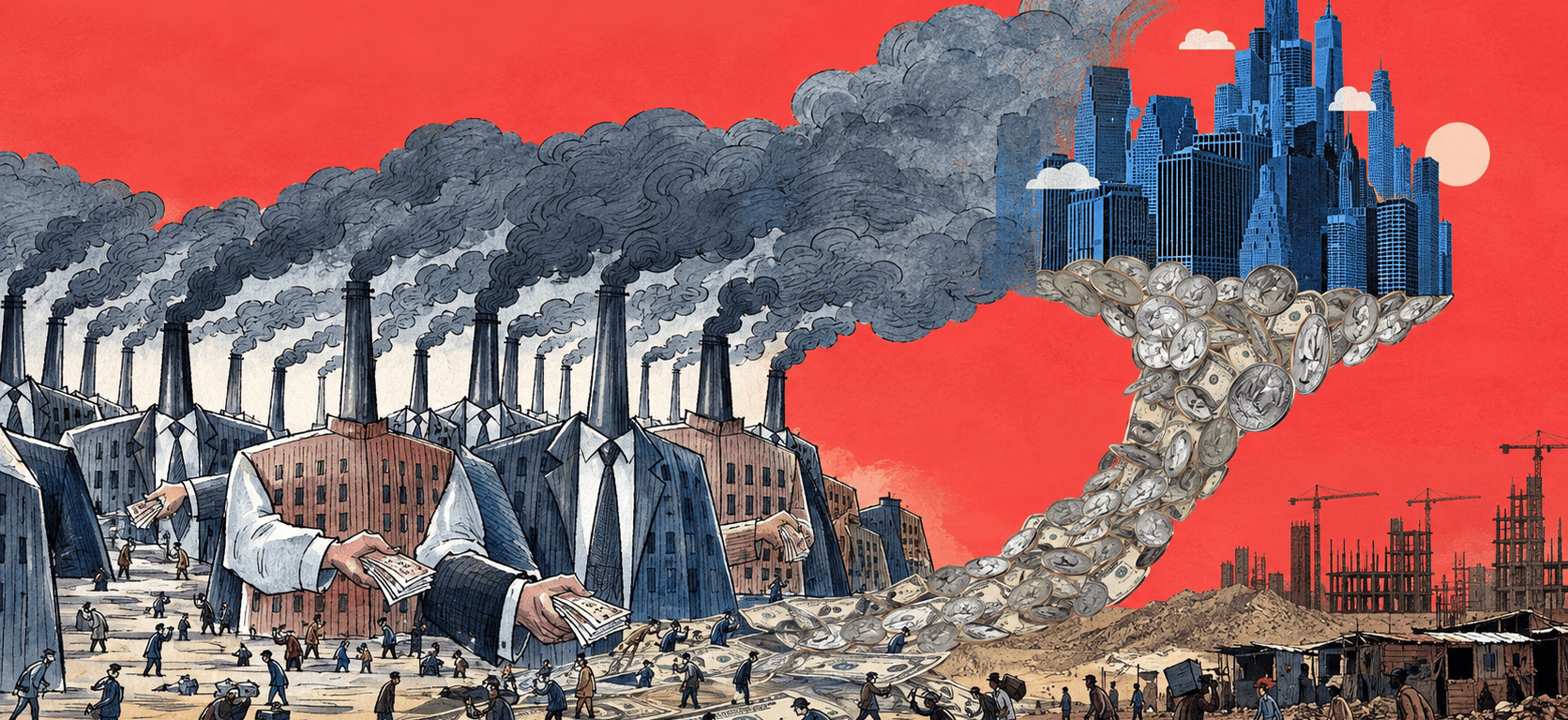
The way the distinction between public and private gets performed and conveyed tends to operate in many different settings and for many different reasons in ways that naturalise corporate power and invisibilize the techniques and mechanisms that elevate corporations and make it much harder for people to change things about corporations and also leads us to tend to treat corporations as economic entities rather than creatures of law. Once we start treating global corporations as economic entities, or we think of them as ‘too big to fail,’ they become these monoliths that we can’t attack. But if we think of them as creatures of law, then we actually can see more political and policy possibilities for holding them to account, making them work in the public good, than we can see if we don’t look for – or notice – the legal threads that make many small things into a big thing.
Garvit: That resonates with feminist thought as well, which has also had to challenge the public-private divide in exactly this way. But even with that kind of reframing available, a lot of my friends who study international law still end up disheartened once they’re exposed to how its universal promises carry colonial tendencies. Some have moved away from the field altogether because of it. During the creation of the concept note, one of the questions that bothered our team the most was whether development is even a concept worth retaining or whether it should be retired altogether. In your work, you describe development and economic growth as the transcendent ground that absorbs, neutralises, or de-radicalises political demands. Given this framing, what keeps you hopeful about the possibility of reimagining development in international law?
Prof. Pahuja: So, there are a lot of things in that question that are possibly many questions combined. Let me reframe the question slightly because for me, ‘is it a concept worth rescuing?’ is a version of a sentiment that is widely experienced, which is a disillusionment with international law. And the same could be said of development. Now, anyone who reads my work carefully and those of many of my scholarly fellow travellers, would understand that the idea of whether international law can be ‘rescued’ or development can be rescued or recuperated or redeemed is the wrong question, because the question should be, how do we engage with the concepts to promote the sorts of political ends that we might be seeking to promote? Now that is a different question because we don’t depart from the idea that International Law is a virtuous entity that will save us. We rather think of it as a productive pattern that makes the world the way it is.
If you think of international law and development as world making, then the point of engagement is not that they should be redeemed as sites of rescue or promise, but it’s that they cannot be ignored because the world is being made. And so, you have to say, “Well, what political struggle am I fighting?” I can’t think of political struggle in terms of a romance. There will be no great overcoming. There will only be struggle, all the time. And how does international law play into that struggle, for better or worse? So, if somebody wants to think about how to make the world a better place, they don’t say, “Well, should I turn to international law or not?” They don’t say, “Is international law enforceable or not?” They don’t say, “Can I make good the promise?” They say, “I’m interested in thinking about the question of inequality or suffering, the distribution of suffering in the world. My question must be an analytical one rather than a normative one, which for an international jurist is how does international law produce that distribution, and does it offer spaces for political engagement that are useful or not? And even if it doesn’t, I still have to engage with it as a site of production for the types of patterns that I am trying to challenge.” It’s quite a different relationship to where International Law fits into the idea of hope because hope then becomes a political position rather than something we can invest in a juridical formation. (Editorial Note: For more on hope and international law, you may read Mickelson’s piece, here)
Garvit: Even during the process of brainstorming for this concept note,, we realised that we couldn’t really let go of the concept as a whole because it still holds meaning and it is nonetheless required for us to engage with it. More importantly to reimagine what it could mean otherwise in different areas of International Law. It also makes me think about your recent work on the archive of The UN Centre on Transnational Corporations (UNCTC), since going back into historical material seems like another way of engaging with international law as a site of production rather than rescue, did working through that archive reveal alternative ways of thinking about development and global corporations? Were there moments in it that made you feel the world could have been organised differently?
Prof. Pahuja: The world can always be otherwise. People won’t look back in 100 years or 50 years and live in the same world that we are living in now. And for the last 10 years, I have been involved in writing a book on the Cold War with my two collaborators, Gerry Simpson and Matthew Craven which has just been published. It’s called ‘Rival Legalities, International Laws of the Cold War.’ (Editorial Note: Now available, here) One of the most fascinating things about that project was the endless examples of how third world countries were trying to use international law to make the world a better place, as Africa and Asia were decolonizing. From the 1940s to 1980s, the number of amazing attempts that the Third World was engaging in to try and make International Law help as a project to make the world a better place is inspiring. One of the things we have done in that book is try to tell stories to offer resources that we can recuperate as ways to engage in international law – and engage with international law. This will really help us reimagine stuff, because doing something different begins with reimagining, imagining that things could be otherwise.
So, the UNCTC came across my radar when I was looking at what happened to Salvador Allende and what happened to the New International Economic Order (NIEO). I had never really realised when I was a younger student that corporations were a big piece of that puzzle and I was really surprised when I started to read about the UNCTC, because I went back and then looked in the indices of international law textbooks for instance, and it was never mentioned. It was hardly even located as a footnote to the New International Economic Order. So, I started trying to write stuff on the UNCTC and I didn’t really realise that there was a missing archive. (Editorial Note: For more on NIEO, read here)
I had been reading about the UNCTC directly through UN documents and very painstakingly with my collaborator and research assistant, Anna Saunders at the time. She had very painstakingly been going through UN documents to look for traces of the UNCTC and it wasn’t until we had a visitor in the Laureate programme last year – Shahd Hammouri, that we even learned that there was this missing archive and that somebody had the archive in digital form in their possession. It was because of Shahd that we learned about that. And then I said to her, “Well, the Laureate programme must support it because it’s such an important archive.” It was a case of an old interest coming together with an exciting project that a young scholar was engaged in.
The Laureate programme was able to support the UNCTC archive coming back to life. And I would really encourage people to read it as part of an effort to recuperate the amazing, amazing things that the Global South or Third World was doing just after decolonization, because I think those are the most exciting stories. And, you know, the book ‘Bandung, Global History, and International Law: Critical Pasts and Pending Futures,’ edited by Eslava, Nesiah and Fakhri is another really amazing resource for finding ways to engage with International Law that can engender hope, and a re-imagining of how to use the powers of International Law for goodness instead of badness. (Editorial Note: Find the UNCTC Archive here, along with TWAILR Symposium on the Archive here)
Garvit: That idea of recuperating those Third World attempts as resources for reimagining feels like a good place to end, and it makes me want to ask one last thing. For the younger generation of scholars, students, and even practitioners who are trying to think and live differently within international law right now, not just write about it differently, what could the everyday practices of that reimagining actually look like, and where might we begin?
Prof. Pahuja: For me, I would say absolutely students are the best part of my job and I feel very hopeful when I meet young people, including my child who is only 17, and her friends who talk a lot about global politics. I feel like there’s a very strong wellspring to live differently than had been the case in the neoliberal period. I think reading books and cinema and finding creative ways to engage with the world that exceed the limits of International Law as a discipline can be very enlivening for how we think of International Law. I would encourage people to think creatively rather than technically about international law, even when they are thinking about the technical stuff, think of the technical as technique rather than technicity.
Draw inspiration as widely as you can and let your mind go, let your mind make connections. For me, one of the best things about being a scholar is how free we can be in drawing connections between film and music and literature and law and history and that’s absolutely a gift in the way international legal scholarship has really opened up to allow that. And I noticed on your own blog; there’s a lot of moves in that direction. So, I would encourage people to think and keep doing that.
Garvit: That way of drawing connections across disciplines is something I have seen you do directly, since I recently came across one of your lectures on architecture and international law, which struck me as exactly this kind of move, finding international law in places you wouldn’t expect it, in the everyday spaces we usually miss. I will add the link to that lecture in the transcript (here) since it was genuinely useful for me. This conversation means a lot to those of us hoping to engage with international law in a more equitable way, so thank you so much for taking the time to speak with us Professor!
Sundhya Pahuja: Thank you so much for having me! Before I go, I just want to say, keep reading the scholarship coming out of the Third World, because that is where the more exciting alternate possibilities for international law are being imagined and worked through right now, often in ways that don’t get the attention they deserve in mainstream legal education. There is so much there to draw on, so much that unsettles what we think international law has to be, and I would really encourage all of you to sit with that work rather than move past it too quickly.
Sundhya Pahuja is the Director of the Laureate Research Program in Global Corporations and International Law and the Director of Studies for the master’s programs in International Law, and Law and Development. She is a Fellow of the Australian Academy of the Social Sciences. From 2016 – 2023, she was the Director of Melbourne Law School’s Institute for International Law and the Humanities (IILAH). She is a global faculty member of the Harvard Institute for Global Law and Policy, and has served as Director of Studies in Public International Law at the Hague Academy of International Law. Read more about her here.
Interviewed by Garvit Shrivastava, Editor-in-Chief (2025-26) and Director.
Transcribed and edited by Avani Varma Datla, Editor.
Picture Credit: Edmon de Haro and Ingram Pinn. Composite, editing and adaptation by JFIEL.

