
Four decades ago, the United Nations General Assembly declared the right to development “an inalienable human right by virtue of which every human person and all peoples are entitled to participate in, contribute to, and enjoy” development. The Declaration on the Right to Development (DRTD) was a promise of futures based on dignity. Four decades later, perhaps it’s worth asking: whose dignity? And whose futures? Bangladesh provides an answer – not from an archive, but from the streets.
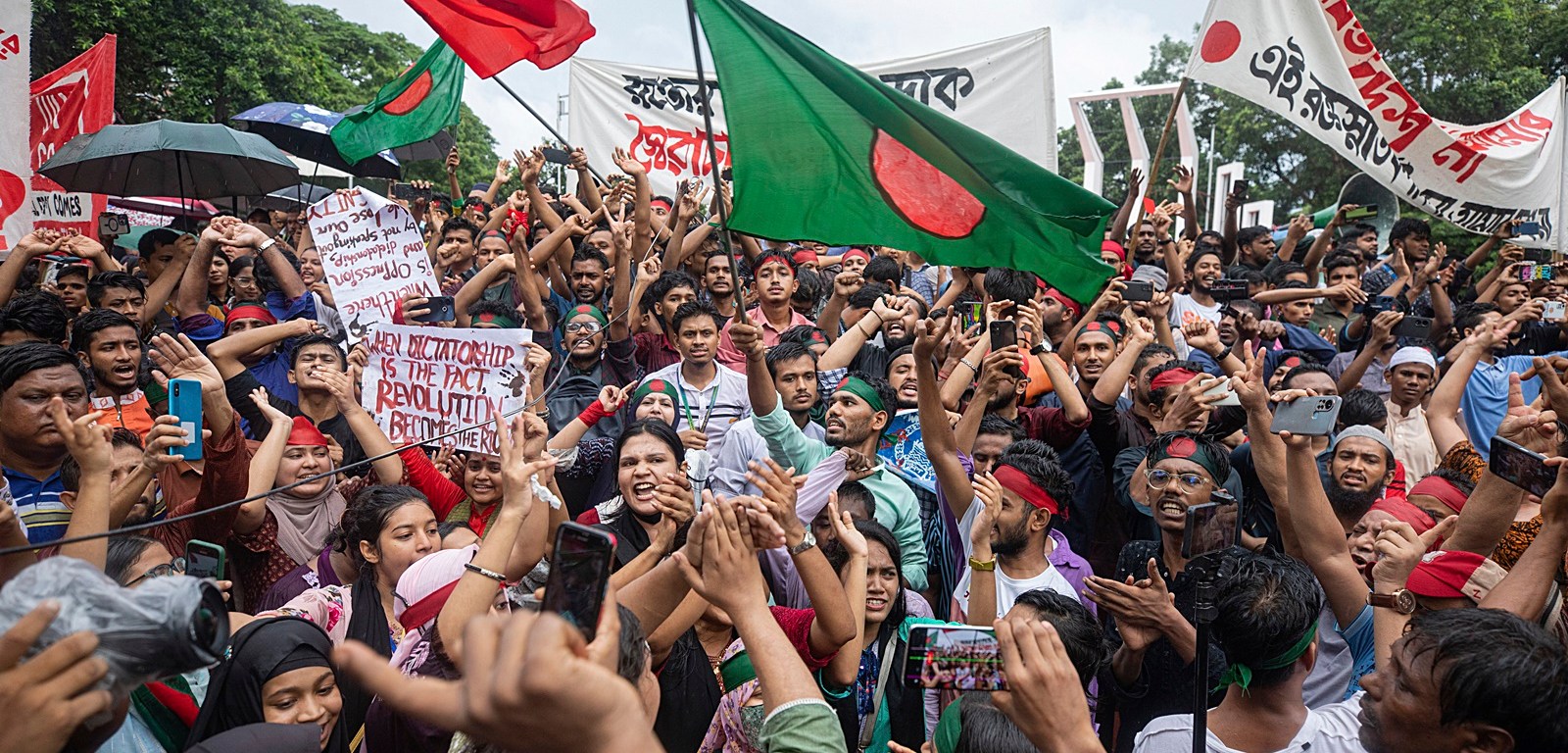
On 5 August 2024, the students took over the country, forcing the resignation of the then Prime Minister Sheikh Hasina after fifteen years of Awami League rule. What began as protests against a discriminatory system of public sector job quotas exploded into a comprehensive rejection of a regime that had mastered the science of weaponising development. The developmental state, in short, had spoken with its full vocabulary – and used it to hollow out every institution that might hold it to account. The July Revolution did not happen to Bangladesh, in spite of its developmental story. It happened because of it.
The compromise that built the defect
The dual subject of Article 1(1) – “every human person and all peoples” – was not merely an elegant flourish, but a North–South compromise in the travaux. The right was to attach to both peoples and persons, and the relationship between them – as well as the role of the state towards either – left deliberately unresolved.
It is this unresolved relationship where the trouble began. The collective right attaching to “peoples,” who cannot act in their own stead, can only be actualised by someone – and, as Jack Donnelly warned way back in 1985, that someone, the only available candidate, is of necessity the state. The result, he warned, was the “dangerous reconceptualization of collective rights as rights of a people vindicated through an intermediary or via one’s state rather than directly against one’s own government.” A considerable body of work in the intervening years has sought to reel in the state’s capacity to act in this second role: from the Open-Ended Working Group’s conclusion that “there is no ‘State right to development,'” to Crawford’s argument that a government “is acting only ‘in a secondary capacity, rather than as the holder of the right.'” Bangladesh demonstrates the stakes in this debate, making clear why this effort is vital.
Development as the grammar of capture
Antony Anghie has described the logic of this TWAIL diagnosis by using Nasser Hussain’s analysis of emergency and “state-centred human rights” in the developing world, to contend that the postcolonial state, “trying to use its sovereignty as a bulwark against imperialism, was itself inflicting massive violence on its own population using instruments of colonial rule.” Development becomes the rationale. Because development is its very raison d’état, thus any opposition to state-led development can be framed as anti-national and state violence justified in the interests of economic growth and security.
The Bangladeshi state implemented this logic through law: The Quick Enhancement of Power and Energy Supply (Special Provision) Act 2010 facilitated rapid and contract-based energy development by direct negotiated agreement, and, crucially, barred any court from questioning the actions of those involved. These projects were brutal, with communities violently repressed: at least five workers killed at the Banshkhali plant in 2021, even as flagship self-financing megaprojects like the Padma Bridge (see also here, here, and here) and Rooppur nuclear plant (see also here, here, here and here) were held up as proof of the growth story; huge coal-fired power plants were constructed within declared Ecologically Critical Areas adjacent to the Sundarbans; and the judiciary lost roughly twenty points of independence between 2010 and 2024, as the executive increasingly converted courts into instruments of political repression. All these actions were legitimated through development discourse; all represent the state turning what Pahuja terms a law to a point where “what prevails is not so much the rule of law as a rule of rules”, that is, a form of authoritarianism under the guise of administrative rationality.
Bangladesh’s growth has been genuinely impressive in regional terms — the so-called ‘Bangladesh paradox.’ A proponent of a developmental reading of the DRTD could therefore argue that the right is a collective and progressive entitlement whose fulfilment might entail significant “aggregate” gains in welfare, with some constraint on civil liberties an unavoidable price for rapid modernization. This is hardly a caricature of a state argument – after all it reflected a dominant concern in the travaux of the DRTD and has gained some currency with Amartya Sen’s observation that development involves real trade-offs a poor state cannot wish away.
But the DRTD does not treat participation as instrumental to development; it makes it definitional of it. Its own preambular definition contradicts any notion of a trade-off, defining the right as ‘an ongoing process to translate a right to development into a reality for all… on the basis of their active, free and meaningful participation’. Furthermore, and in practice, there was nothing broadly participatory about Bangladesh’s growth story: in addition to a rising national poverty rate that climbed back to 21.2% at the end of FY 2024-25, graduate unemployment was higher than for the less educated. Most strikingly, a deeply unpopular patronage quota system that ultimately would trigger the July uprising reserved 56% of public jobs to members of a variety of protected categories, even as many as 40% of youth were not in employment, education, or training by the end of the same fiscal year. In the final analysis, these figures are not evidence of collective achievements, but rather evidence of what the World Bank itself flagged as elite capture, aggregate figures that disguised the systematisation of the deprivation of populations whose interests these figures are claimed to represent.
The Revolution as a claim under Article 1(1)
Indeed, if participation is constitutive of the right, then far from being a claim made outside of the DRTD’s framework, the July uprising is arguably an actualization of it. According to the OHCHR fact-finding report into the protests, nearly 1,400 deaths – including 12% children – resulted as the country erupted in a mobilization the Bertelsmann Transformation Index describes as a national, diffuse, leaderless, apolitical party movement that temporarily seized control of the country. A population whose interests have been systematically ignored by the state now claims to be a rights-holder, reclaiming ownership over their own conceptions and the practice of their own development – a near-perfect example of what Rajagopal describes as international law “from below” – the individual becoming a subject through top-down recognition and bottom-up resistance alike.
The doctrinal materials can be used to characterize the state’s claim to speak for “peoples” as a defeasible claim. For example, in Endorois the African Commission held that participation “must make an objective difference to people’s lives,” and that development must yield “empowerment of the community,” a substantive test that the Awami League state clearly failed. Taken in light of the trustee framing that pervades the scholarship — a trustee is a holder of a right she does not own on behalf of beneficiaries – the conclusion is straightforward that the trustee that turns the corpus of the trust against the beneficiaries has lost standing to represent the beneficiaries. The Revolution forced that forfeiture, rather than suspend the right to development; it just returned the right to its proper holders.
What a post-statist reading requires
The analysis above does not entail discarding the state as a legal category. It is important to clarify its limits. It is the state that remains the duty-bearer , and the government apparatus that remains the mechanism for providing services and protection. Forfeiting the standing to represent “peoples” is not the same as shedding the obligations owed to them: the state that loses its claim to speak for the collective remains bound by the collective’s entitlements. What the reading rejects is the state’s position on both sides of the ledger – its standing to use the collective dimension of Article 1(1) as a shield against the individual dimension, and its position that only the state’s representatives can speak for the collective. Instead, it allows “peoples” to be taken seriously as right-holders capable of asserting rights against the state when it impedes “active, free and meaningful participation,” the very test outlined in the Declaration.
TWAIL’s internal history tracks this shift. Early TWAIL scholarship treated the newly-independent state as the unit of resistance to the existing world order; later work turned its critical gaze on that same state, foregrounding the communities within it — workers, peasants, students, minorities — who are as often the victims of development as its beneficiaries. Makau Mutua’s diagnosis captures why: at independence, “the West decolonized the colonial state, not the African peoples subject to it,” so that self-determination was exercised by a colonial elite who had inherited the colonial apparatus, not the subject peoples it controlled.
It must be acknowledged that a post-statist reading of the Article 1(1) also raises obvious objections. If “peoples” can be severed from the state and vested in mobilised populations, then who adjudicates which mobilisation qualifies? Who qualifies to bear the legal right? After all, it is difficult to regard the leaderless uprising as a stable unit of legal rights and a reactionary crowd could make use of the same legal arguments that legitimate the July Revolution. But that does not mean popular mobilisation is self-validating — though the criteria invoked to discipline it sit awkwardly with the facts. Endorois concerned a bounded, identifiable community with a territorial claim, precisely the features a diffuse and leaderless mobilisation lacks. But the Declaration’s criteria need not identify a bounded rights-holder in advance to do useful work. They function instead as an ex post filter on the claim to speak for “peoples”: not “which crowd is the people?”, but “does this exercise of authority meet the tests of equity, non-discrimination, participation, accountability and empowerment?” A claim fails not because the claimant is diffuse, but because it cannot satisfy those criteria — a test the Awami League state failed and to which any successor is equally answerable.
Conclusion
At forty years old, the DRTD is more valuable as a diagnostic instrument, than an object of admiration and Bangladesh 2024 is one of the sharpest readings it has ever generated. While the Awami League did build Bangladesh, they did so by developing it in a way from which the population was structurally excluded, and by using a universalist language of progress as cover to legitimate capture and to criminalise the resistance that exclusion produced. It is the domestic manifestation of what Pahuja identified as the universality of international law operating to reproduce hierarchy at a global level, and internalised by the post-colonial state as a means of control over its own people.
A post-statist reading of Article 1(1), which would treat “peoples” as rights holders external to the states claiming to represent them, subject to testing against the participatory criteria set by the Declaration, does not abandon international law; it is an attempt to fix a deep, fundamental flaw that the DRTD has carried with it since its drafting. Whether the instrument will bear this reading is, in the end, the question it must answer for itself on this fortieth anniversary. Bangladesh has already supplied one answer.
Fahim Abrar Abid is the Founder and Executive Director of the Bangladesh Society of International Law and an Erasmus Mundus Scholar (Glasgow, IBEI-Barcelona, Tartu). He has edited the book Bangladesh, International Law and Security in Post-July 2024 (Springer, 2026, 2 vols, forthcoming) and serves as Rapporteur at Oxford International Organizations (OXIO).
Picture Credit: Protect Yunus

